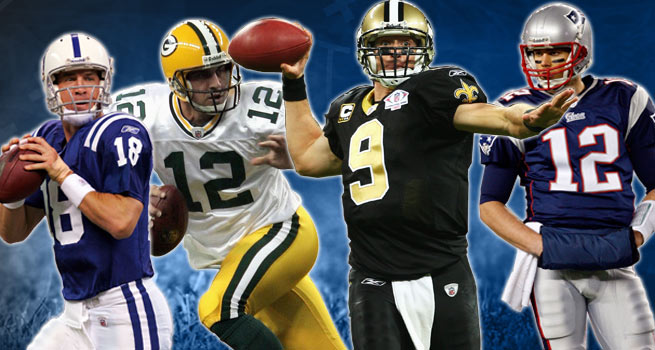
Top 20 Quarterbacks to Start a Team With

by Paul Knepper

Suspend reality with me for a moment and imagine that you are the owner of a new NFL franchise. You can pick any quarterback to head your team. Who would you choose?

Naturally, your first thought is Tom Brady or Peyton Manning, but this isn’t a one year deal. You’re building a team and must consider both the short and long term interests of your franchise. Age and durability are important factors. You may also want to consider off-the-field issues for the face of your franchise.

Here’s my list of the top 20 quarterbacks to start a team with.

20) Kevin Kolb

Kolb has finally landed a starting gig in his fifth year in the league. During limited playing time with the Eagles he showed signs of greatness and at other times appeared lost. The Cardinals obviously think he’s the answer to their quarterback problem, trading Dominique Rodgers-Cromarte and a second round pick for him, then signing him to a five-year $63 million contract.

19) Matt Schaub

Michael Vick’s one-time backup in Atlanta has found a home in Texas, where he’s led one of the most productive offenses in the league the past few years.  Of course, throwing to Andre Johnson always helps. Schaub’s not a franchise quarterback, but he’s probably in the top ten to fifteen QBs in the league and should remain so for the next five years.

18) Andrew Luck

The “suck for Luck” sweepstakes are in full swing and the Seahawks are the early favorite. He’s the consensus number one pick in the 2012 draft and the most highly touted pro quarterback prospect in years. His experience in a pro-style offense at Stanford should help him hit the ground running in the NFL.

17) Jay Cutler

For years we waited for this gunslinger to take his game to the next level. It’s not happening. At 28, in his sixth season in the league, the Bears know what they have in Jay Cutler, a good quarterback, with a great arm who still makes poor decisions and demonstrates questionable leadership ability. I’m not sure if I want to rest my Super Bowl hopes on that right arm.

16) Mark Sanchez

The verdict is still out on the Jets third-year signal caller. His completion percentage is cause for concern and he needs to continue to cut down on his mistakes over the middle. Still just 24, there’s room for improvement and it’s noteworthy that he’s played his best football in pressure-packed games, leading the Jets to the AFC Championship in consecutive seasons.

15) Tony Romo

Quarterback of “America’s team” is the most scrutinized position in sports and Romo’s schizophrenic play hasn’t helped matters. Take week one against the Jets for example. He was great for three quarters, then handed the Jets the game with two inexplicable turnovers. The most significant statistic attached to Romo is that the Cowboys have only won one playoff game during his tenure.

14) Eli Manning

Once you get past all the hype that comes with his last name, playing QB in the New York market and his recent statements, Eli is simply a good quarterback, nothing more. He’s in his prime right now and still led the league in interceptions last year. I can hear Giants fans screaming, “But he won a Super Bowl!” Yes, and so did Trent Dilfer and Brad Johnson; their busts aren’t lining the walls of Canton any time soon.

13) Joe Flacco

The Ravens signal caller continues to improve in this his fourth season and the team has rewarded him with greater responsibility and a more dynamic group of receivers. He hasn’t missed a game in his career and should continue to be a dependable, if not spectacular player for the next eight to ten years.

12) Cam Newton

It’s way to early to jump to any grand conclusions, but 854 yards passing in his first two games, one of which was against the defending champion Packers, is unbelievable. Last year’s Heisman winner is also capable of rushing for 100 yards on any given Sunday. I’ll take his upside over more established QBs like Eli Manning and Cutler.

11) Michael Vick

It took many seasons, a stint in the big house and some tutoring from Andy Reid and Marty Mornhenwig for Vick to become the quarterback the Falcons envisioned when they selected him with the first pick in the 2001 draft. The Eagles QB played MVP-caliber football during the first half of the season last year, though he’s had trouble staying healthy and his legs will be less of a weapon as he ages.

10) Peyton Manning

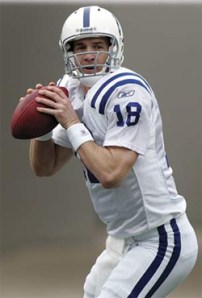
A mysterious neck injury may sideline the Colts franchise player for the entire season, meaning he may be 36-years-old the next time he lines up behind center. It’s fair to wonder if he’ll be able to compete at the same level and if so, for how long. Given his condition, I’d take 10-12 years of some of the young guns over two or three possibly diminished years from Peyton.

9) Matthew Stafford

Stafford can really sling it. The third-year quarterback tossed seven touchdowns in the Lions first two games this season. The only question about this former Georgia Bulldog is his durability. His first two seasons in the league were cut short by injuries, including one to his throwing shoulder last year.

8)  Josh Freeman

He doesn’t receive a great deal of press playing in Tampa, though to this point he’s been the most impressive quarterback from the 2009 draft, which included Matthew Stafford and Mark Sanchez.  Freeman took great strides last year, playing with the savvy of a seasoned veteran on a much-improved Bucs team.

7) Phillip Rivers

The Chargers brought back memories of the “Air Coryell” days last season, with Rivers throwing for a league-high 4,710 yards. And that was without the services of stud wide receiver Vincent Jackson for most of the season. Rivers and the Chargers lack of success in the playoffs prevent him from being ranked higher on this list.

6) Sam Bradford

This Heisman trophy winner and first pick in the 2010 draft has lived up to his billing so far, passing for over 3,ooo yards in his rookie season without the benefit of a number one receiver. He’s fully recovered from the shoulder injury that ended his junior year at Oklahoma and at the age of 23 has plenty of room for growth.

5) Matt Ryan

“Matty Ice” made Falcons fans forget about Michael Vick pretty quickly. The fourth year signal caller really came into his own last season, significantly improving his touchdown to interception ratio (28/9), while leading the Falcons to the number one seed in the NFC.

4) Drew Brees

The Siants QB had an off-year last season and still led the league in completion percentage. He has a Super Bowl MVP on his resume and is rightfully mentioned among the best quaretbacks in the game. At 32, he should have a few elite years left, but you may want to consider a younger option like one of the Matts (Ryan or Stafford).

3) Ben Roethlisberger

His off the field issues are well documented and there have been rumblings that he’snot the best teammate, but  Big Ben has led the Steelers to three Super Bowls, winning two of them. He doesn’t have the accuracy of Manning or Brady, but he has a knack for making plays when his team needs them most. At 29 years of age, he should have several more top notch seasons in him.

2) Tom Brady

Brady brings a championship pedigree and had perhaps his finest season last year, throwing 36 touchdowns, compared to just 4 interceptions. If you were choosing a QB for one season this former Michigan Wolverine would be your guy, but at age 34 he realistically only has two to three elite seasons left. Still, I like my chances of winning a Super Bowl in that short time period.

1) Aaron Rodgers

With his MVP performance in Super Bowl XLV Rodgers secured his place among the elite quarterbacks in the league and at just 27, he’s the youngest of the bunch. He’s the complete package on and off the field. If you were starting a franchise he’d be the number one pick.

Honorable mention:

Colt McCoy, Christian Ponder, Ryan Fitzpatrick, Blaine Gabbert, Jake Locker

Rafa’s Move

A year ago, Rafael Nadal was on top of the tennis world. He’d just polished off Novak Djokovic in the U.S. Open final, capping off a spectacular year in which he also won the French Open and Wimbledon and secured the number one ranking.

Fully recovered from the knee injuries which plagued him in 2009, he distanced himself from his arch nemesis, Roger Federer, who at age 29 was clearly on the downside of his career, and reasserted his dominance over Djokovic, the other threat to his throne. Still just 24, the Spaniard seemed poised to reign over men’s tennis for the next few years.

Djokovic always had as much talent as Nadal, but hadn’t been able to break through against two of the game’s all-time greats, Federer and Nadal. His arsenal included a powerful and accurate serve, an excellent return of serve and a dangerous forehand, but his backhand was inconsistent. In his matches against Federer and Nadal the deciding factors were often stamina and confidence. Federer and Nadal had them and Djokovic didn’t.

Tired of finishing second or third, Nole used last offseason to revamp his body and his game. He worked on his backhand and adpoted a gluten-free diet, which improved his stamina. His confidence seemed to follow. The new and improved Djokovic made his debut  at the 2011 Australian Open, where he desposed of Federer in straight sets in the semi-finals, then easily defeated number four seed Andy Murray for the championship.

His victory at the Aussie Open was just the beginning of what will go down as one of the greatest seasons in the open era. The Serbian came within a hiccup in the semi-finals of the French against Federer short of the Grand Slam. He’s lost just two of his 66 matches and in July took over the number one ranking.

The French was Djokivic’s only loss to Federer this year in five meetings between the two. Last week he came back from 2 sets down and fought off two match points to defeat the former world’s number one in the semi-finals at the U.S. Open. This time it was Federer who grew visibly fatigued as the match wore on.

Two days later Nole beat Nadal in the final for his first U.S. Open title. Prior to this year, Nadal had a 16-7 edge over Djokovic and was 5-0 against him in tournament finals and 5-0 in Grand Slams. This year the two have met six times, all in tournament finals and Djokovic has won them all, including the finals of Wimbledon and the U.S. Open. Two of the matches even took place on clay, Nadal’s best surface.

The Djoker didn’t just win those matches, he beat Nadal decisively. He took out the defending champ in four sets at Wimbledon and Nadal barely eked out a tiebreaker at the Open. Nobody has ever pushed Nadal around the court the way Nole did Monday night. Nadal admitted after Wimbledon that Djokovic is in his head and he appeared uncharacteristically unsettled on the court during their latest match.

The challenge for Djokovic now is to maintain his focus and desire. It’s easier to get to number one than to stay there. The potential distractions multiply, there’s to prove and he’s now being hunted by all the other top players on the tour. John McEnroe, the last male to produce a season comparable to Djokovic’s, when he went 82-3 in 1984, admitted that he became distracted by his celebrity status, and was never nearly the same player again.

History indicates that it will be nearly impossible for Nole to duplicate his sensational season, though assuming he remains healthy and focused, he may continue to rule men’s tennis for the foreseeable future. Federer is in his 30’s now and Murray lacks the firepower and fortitude to knock off the big boys. Nadal is the one man who can challenge him for that number one spot, at least until a new young champion bubbles up.

Nadal is just one year older than Djokovic. He’s a fierce competitor and has at least one weapon, his whip-like forehand, which can hurt the Serbian. But other aspects of his game were exposed in the U.S. Open final, most notably his first serve, which lacked the zip that was so effective during his 2010 U.S. Open run, leaving him vulnerable to Djokovic’s devastating returns. While his backhand is more than adequate against almost everybody else on the tour, he’s not able to match the hummers down-the-line that Djokovic unleashes on him.

Nadal has vastly improved his game before. The “King of Clay” learned to flatten out his strokes on faster surfaces, allowing him to finally beat Federer at Wimbledon, and an additional 10-15 MPH’s on his first serve got him over the hump at the U.S. Open last year. Now he needs to continue you work on his serve, add a little pop to his backhand and learn to take the ball on the rise against Djokovic in order to dictate the tempo of the points and keep his rival on the defensive.

Nadal and Djokovic are two superb champions with the potential to echo the great rivalries of Borg-McEnroe, Sampras-Agassi and Federer-Nadal. Players of their caliber usually bring out the best in each other. Rafa’s stellar 2010 campaign forced Nole to take his game to another level. Djokovic countered with the most dominant season in recent memory. It’s Rafa’s move.

Most Memorable Father-Son Moments in Sports

 by Paul Knepper

Whether it’s having a catch in the backyard or watching a football game together, fathers and sons have bonded over sports for generations. Many professional athletes still call their fathers after a big game and look to them for guidance and approval. Those athletes pass on the love of sports to their own sons. Occasionally, a ballplayer is fortunate enough to have his father or son present or even involved with the greatest moments of his career and those occasions often make for some of the most touching and memorable moments in sports.

These are the ten most memorable father-son moments in sports.

10) Robinson Cano’s father pitching to him at the Home Run Derby

The Yankees second baseman flew his father Jose in from the Dominican Republic to pitch to him in the Home Run Derby last month. Jose, who pitched six games for the Astros in 1989, clearly knew his son’s sweet spot. Robinson jacked 12 bombs in the final round, a derby record, to beat Red Sox first baseman Adrain Gonzalez and win the competition. The younger Cano was beaming as he and his father shared a victory embrace.

9) William Ligue Jr. and his son attacking Tom Gamboa

Not all memorable father-son moments are uplifting. In September 2002, William Ligue Jr. and his teenage son ran onto the field at Chicago’s Comiskey Park and attacked Kansas City Royals first base coach Tom Gamboa for no apparent reason. Fortunately, Gamboa didn’t receive any major injuries.

8)  Mark McGwire lifting his son after breaking the home run record

Ten-year old Mark McGwire was a part-time bat boy for the St. Louis Cardinals in the summer of 1998 when his father Mark was chasing Roger Maris’ home run record. When Big Mac hit number 62 off of Steve Traschel of the Cubs on September 8th at the old Busch Stadium, Matt was the first person to greet him at home plate. Mark hoisted his jubilant son over his head like a baby.

7) Dusty Baker watching his son almost get run over at home


Giants Manager Dusty Baker made his 3 1/2 year old son Darren a bat boy for the 2002 World Series. When Kenny Lofton tripled in the gap in the seventh inning of Game 5 with two men on, Darren went to retrieve the bat and almost got run over at the plate by J.T. Snow, who was scoring from second. Snow grabbed Darren by his jacket and carried him to safety as an embarrassed Dusty shook his lowered head in the dugout.

6) Pat Cash climbing into the stands after winning Wimbledon

In what has since become a tradition at the All England Club, Australian Pat Cash was so elated after knocking off Ivan Lendl in the 1987 Wimbledon final that he felt compelled to climb into the crowd to get to his family. By the time he reached his family’s box the entire crowd was caught up in his exuberance. Cash’s proud father was the first to greet him and gave his son a big hug.

5) The Griffeys hitting back-to-back home runs

When Ken Griffey Jr. broke into the big leagues with the Mariners in 1989, he and his father Ken Sr. became the first father-son combo to play in the Major Leagues at the same time. The two became teammates when the Mariners signed Senior in August 1990, and the highlight of the their tenure together came on September 14th when the duo became the first and only father-son combo to hit back-to-back home runs.

4) Drew Brees holding his son after winning the Super Bowl

Drew Brees capped off an M.V.P. season with a Super Bowl M.V.P. when his Saints beat the Colts in Super Bowl XLIV. During the post-game festivities Brees’ wife handed the QB his one year-old son Baylen, who looked adorable in his super-sized headphones. Cameras caught the wonderful scene of Brees holding his son as he soaked up the moment.

3) Favre’s fantastic performance the day after his father died


Brett Favre was heart broken when his father Irv died suddenly of a heart attack in December 2003, but #4 still suited up for the Packers Monday night matchup with the Raiders the following night. He said his father would have wanted him to play. Favre channeled his emotion into one of the most spectacular performances of his career throwing for 311 yards and four touchdowns in the first half in a Packers 41-7 romp.

2) Jim Craig looking for his father after winning gold

When the U.S. Olympic hockey team finished off their miraculous run at the 1980 games by defeating Finland for the Gold medal, the players jumped over the bench and embraced on the ice. Goalie Jim Craig stood alone looking off into the distance with an American flag draped around him. It’s become the enduring image from the most celebrated victory in American sports history. Nobody knew at the time that Craig was scanning the crowd for his father.

1) Derek Redmond finishing the race with his father’s help

When British sprinter Derek Redmond’s hamstring snapped with about 250 meters to go is 400 meter race at the 1992 Olympics in Bareclona, he refused to be carried off on a stretcher. Redmond continued the race, hopping on one leg, with a look of sheer agony on his face. His father Jim barged through security and ran onto the track to assist his son. Derek crossed the finish line with his arm around his father’s shoulders.

Honorable mention:

Manny Ramirez calling his dad with the Red Sox leading during Game 7 of the 2003 ALCS (which the Red Sox went on to lose) to talk about going to World Series.

Antonio Cromartie trying to name all of his kids on HBO’s Hard Knocks. 

Michael Jordan telling his children “I wouldn’t want to be you if I had to” during his Hall of Fame induction speech.

Jimbo’s Magical Run: 20 Years Later

by Paul Knepper

Tennis can be a lonely sport. You’re all alone on the court. There’s nobody there to share the joy of victory or burden of defeat. There’s no one to lean on when you’re tired or to commiserate with on the road. That was especially true for Jimmy Connors who made a point of distancing himself from the other members of the tour.

Such isolation lends itself to the possibility of an emotional connection between athletes and fans which doesn’t exist in team sports. Occasionally an individual athlete develops such synergy with the crowd that they feed off each other’s energy and elevate one another to greater heights. Muhammad Ali did it with the people of Zaire when he fought George Foreman in 1974 and Jimmy Connors achieved it with the New York crowd at the 1991 U.S. Open.

Connors was born and raised in East St. Louis, Illinois, but for all intents and purposes he became  a New Yorker. He played his best tennis at the U.S. Open in Flushing Meadows, Queens, where he won five of his eight grand slam titles, and was the only player to win the tournament on three different surfaces (The Open was played on grass until 1975, then switched to clay for three years, before changing to hard court in 1978.)

New Yorkers embraced him as one of their own. They saw a bit of themselves in the feisty left-hander with the indomitable will. Connors didn’t try and out finesse his opponents with tons of topspin or a delicate touch; he came right at them with his flat ground strokes and kept them on the defensive by taking the ball on the rise.

Fans appreciated that Jimbo wore his emotions on his sleeve and responded in kind, boisterously exhorting their hero on. Connors returned the favor with a smile and a wave or by cracking jokes for the cameras. He fed off the energy in the stands, which ramped the New York crowd up even more.

Jimmy had been ranked #1 in the world several times, once for 160 consecutive weeks, and won a record 109 tournaments, but after battling injuries in 1990 and 1991 he was ranked 174th and had to win a qualifying match just to gain entrance to the ’91 U.S. Open. The tournament began a week shy of his 39th birthday; in a sport in which 30 is ancient, nobody expected him to advance very far. But Jimbo never gave a damn what other people thought. He’d made a career out of defying the odds.

In the first round Connors faced Patrick McEnroe, younger brother of his longtime nemesis John. Patrick was no slouch himself, ranked 35th in the world and playing the best tennis of his career. Behind a strong serve and volley game, he captured the first two sets and took a 3-0 lead in the third.

The old man was short of breath and the crowd at Louis Armstrong Stadium had started shuffling out. John McEnroe admitted the next day that he changed the channel, believing the match was over. Up Love-40 in the fourth game, Patrick was about to put the nail in Jimmy’s coffin.

Suddenly, Connors discovered the fountain of youth. He zeroed in on Patrick’s serve, began stringing together points and came back to win the third set. Spurred on by the rapture of the fans that had remained, he finished McEnroe off 6-2, 6-4. The match lasted four hours and 18 minutes and ended at 1:35am.

Jimbo won his next two matches in straight sets, knocking off Michiel Schapers and the # 10 seed Karel Novacek. The energy of the crowd multiplied with each win and nobody on the tour knew how to create and harness that energy like Connors. It seemed to sustain him as he advanced through the tournament, compensating for the lack of juice in his legs.

As Jimbo took the court on his 39th birthday for his fourth-round contest against fellow American Aaron Krickstein, the fans at Louis Armstrong Stadium greeted him with a rendition of “Happy Birthday.” He needed them more than ever if he was going to beat the 24-year-old Krickstein.

Connors and Krickstein split the first two sets. Jimbo looked exhausted as he fell behind early in the third and made the risky decision to tank the set in order to preserve his energy for the fourth and fifth sets. The fourth went according to plan, but in the fifth set the younger Krickstein had Jimbo on the ropes at 5-2.

Once again, Connors came storming back. After big points he pumped his fist and the fans responded with a rousing ovation. At one point in the fifth set Jimmy looked into the camera and relayed the sentiment of the crowd, “This is what they paid for! This is what they want!” Krickstein was overwhelmed by the Connors mystique and the roars cascading down from the stands and Connors closed out the match in a fifth set tiebreaker.

After four hours and 42 minutes, the old warrior pointed to the crowd on all sides of the court to express his gratitude for their support. It was as if he was saying, “this is your victory too.” After the match, John McEnroe went to the locker room to congratulate his old rival. “I’ve got to go in there and touch him and see if he bleeds” Mac said.

Connors’ next opponent, in the quarterfinals, was Dutchman Paul Haarhuis, who had defeated #1 seed Boris Becker earlier in the tournament. Once again Jimmy fell behind, losing the first set, and trailed 5-4 in the second, with Haarhuis serving at 30-15, two points from winning the set.

It was unlikely that Connors’ could endure another five-set match so he had to make his move. He won the next two points, then delivered the most memorable sequence in U.S. Open history:

Haarhuis charged the net behind a strong backhand and all Connors could do was lob it back. Haarhuis slammed an overhead to Connors’ backhand side and Connors, back to the wall, lobbed it over again. Haarhuis smashed a second overhead and Connors was able to backhand it high into the air once more. This time, Haarhuis slammed the ball to Connors’ forehand side. Looking as spry as ever, the old man lunged to his left and lobbed it back.

By this point, Haarhuis was exhausted and his next overhead was his weakest. Connors pounced on the opportunity and drilled a crosscourt forehand. Haarhuis volleyed it back and Connors crushed a backhand down the line to win the point.

Connors unleashed a flurry of passionate fist pumps as the exalted crowd jumped to its feet and roared with appreciation. If the rally symbolized Jimbo’s indomitable will, then the ecstatic look on his face afterwards reflected his unparalleled love for the game.

The astonishing rally left Haarhuis emotionally drained. Connors won the third set in a tiebreaker and closed out the match 6-4, 6-2. Louis Armstrong Stadium erupted after the final point and once more Jimmy gave thanks to his fans.

The fountain of youth dried up in the semifinals, as Connors fell to Jim Courier in straight sets. Stefan Edberg won the tournament, but it was Connors who made it a U.S. Open to remember. For 11 days he enraptured every one who was there or tuned in to watch and those of us who did will never forget it.

Another Mountain to Summitt

by Paul Knepper

Summit   sum·mit / [suhm-it]

noun

1. the highest point or part, as of a hill, a line of travel, or any object; top; apex.                                                                                                                                                   2. the highest point of attainment or aspiration: the summit of one’s ambition.                                                                                                                                        3. the highest state or degree.

verb (used with object)

1. to reach the summit of.

Pat Summitt climbed to the pinnacle of her profession and secured a legacy as one of the greatest coaches ever, in any sport, at any level, male or female. In 37 seasons as the coach of the Tennessee Lady Vols she’s amassed a Division I record 1,071 wins and eight National Championships.

Her career so embodies the meaning of her last name that years from now it will be fair to wonder which came first, the person or the word.

Now at the age of 59, Summitt faces a mountain steeper than any she’s climbed before. The Lady Vols coach announced on Tuesday that she’s been diagnosed with early-onset dementia, Alzheimer’s type, a devastating illness which leads to a gradual decline in cognitive abilities such as memory, intellect, rationality, social skills and normal emotional reactions, and is eventually fatal.

Summitt said she didn’t feel like herself at times last season and experienced a lack of confidence on the sideline – a foreign feeling for the decisive coach with a take charge attitude – so she underwent a series of tests at the Mayo Clinic in Rochester, Minnesota in May. She received her diagnosis in June.

Summitt’s coaching style has always been one of a tough disciplinarian, an in-your-face, feisty motivator who demands the best from her players. Since she revealed her diagnosis, several of her former players have spoken about how their coach instilled in them a belief that they can handle any situation. She taught them to dig down deep and find their inner strength in difficult times to be greater than they thought they could be.

Now the coach has to heed her own lessons.

She has plenty of life to live and hearts to touch. This illness provides her with an opportunity to introduce the wisdom she has preached to her players for 37 years to a much broader audience. Many athletes and coaches have experienced their finest hours while battling illness.

Lou Gehrig, one of the greatest baseball players to ever live, is best remembered for the courage and dignity he displayed in the face of death before a packed house at Yankee Stadium.

Magic Johnson won five NBA Championships, though I’m fairly certain he would say his greatest achievement has been living a healthy and fulfilling life for 20 years with HIV. He’s brought awareness to the disease and served as a role model for countless others who are suffering.

Former N.C. State basketball coach Jim Valvano brought tears to our eyes with his heart-wrenching speech at the 1993 ESPY’s. His body riddled with cancer, he inspired millions with his message of hope, and he lives on in the foundation for cancer research which bears his name.

Valvano famously said of cancer, “It cannot touch my mind. It cannot touch my heart. And it cannot touch my soul.” The difference with Summitt is that her disease is one of the mind. That poses a different set of challenges, especially for a woman so accustomed to being in control, though many of the same principles apply. By facing her illness with dignity and grace Summitt can inspire so many.

She stated that she intends to continue coaching and will attempt to keep her mind sharp through daily mental exercises, though she conceded that she’ll need to rely on her assistant coaches more than ever. Tennessee’s interim athletic director Joan Cronan has supported her decision. The coach sounded like her old self on Tuesday when she told the Knoxville News Sentinel, “There’s not going to be any pity party and I’ll make sure of that.”

She called a team meeting that afternoon to inform her players of her condition. Junior guard Taber Spani said the meeting was business-like, with Summitt calmly telling the Lady Vols that nothing would get in the way of their quest for a ninth national title this season.

”More than anything she just emphasized that she’s our coach and that she wanted us to have complete confidence in her, and we do,” Spani told the Associated Press.

Summitt’s son Tyler, a walk-on member of the Tennessee men’s basketball team, said his mother initially had difficulty accepting the news. He said, “And there was anger. “Why me?” was a question she asked more than once. But then, once she came to terms with it, she treated it like every other challenge she ever had, and is going to do everything she possibly can to keep her mind right and stay the coach.”

John Wooden, the only college basketball coach to win more championships than Summitt ( with 10) said, “Sports do not build character, they reveal it.” The same can be said of illness.

Pat Summitt’s character has been on display for the past 37 years. She’s a fighter, a teacher, a leader and a winner. Somehow, the Lady Vols coach will find a way to summit this mountain as she has so many others in her life and blaze a trail for others along the way. That’s what she does.

Amar’e in the Land of Mao

In the latest edition of “What Are They Doing During the Lockout?” here’s a scenic shot of Knicks forward Amar’e Stoudemire scaling the Great Wall.

Top Ten Athlete Accessories

by Paul Knepper

At the Pro Football Hall of Fame induction ceremony on August 6th, inductee Deion Sanders concluded his speech by placing his signature bandana on his Hall of Fame bust. Throughout Prime Time’s career the all pro defensive back wore a bandana under his helmet during games and often kept it on for the post-game interviews.

Over the years, many other athletes have been known for their use of a specific accessory, something above and beyond the normal uniform, which they regularly wore either during competition or on the sidelines.

These are the top ten trademark accessories in sports.

10) Patrick Ewing’s wrist bands

Ewing took the phrase “breaking a sweat” to a whole new level. Minutes after tipoff, the Knicks center would be as drenched as Ted Striker trying to touch down on the runway in the movie Airplane! Some players use a headband to stem the flow of sweat, but Patrick opted for enormous wrist bands. One of the most enduring images of Ewing’s career is him standing on the foul line, dabbing his forehead with those gigantic bands, while the sweat continued to drip from his chin.

9) Pete Maravich’s socks


The Pistol was known for his flashy passing, infinite shooting range and dazzling ball-handling, though no description of the basketball prodigy would be complete without a reference to his floppy hair and scraggly socks. For a period during his time with the Utah Jazz  Maravich wore high socks with green, yellow and purple bands, though for most of his career he weaved his magic in raggedy loose socks that looked like they came off the feet of Woody Harrelson’s character Billy Hoyle in White Men Can’t Jump.

8)  Deion Sanders’ bandana

It wasn’t clear if Prime Time’s bandana served a purpose during the game, such as keeping the sweat out of his eyes, or was merely a fashion statement. Occasionally, Deion would change it up and arrive for an interview with a do-rag on or go Tupac style, with the backwards bandana, but he always returned to his signature look. The Hall of Fame should have left the bandana on Deion’s bust, which looks nothing like him and instead bears a strange resemblance to a mix between Vince Lombardi and Troy Aikman.

7) Jim McMahon’s shades

The colorful quarterback of the ’85 Bears developed an extreme sensitivity to light in his right eye after damaging his retina in a childhood accident. He became one of the first football players to wear a tinted visor on his face mask and often wore sunglasses on the sideline, which developed into a signature look for the rebellious signal caller. McMahon even sported his famous shades in the Bears epic Super Bowl Shuffle video (link below).

http://www.dailymotion.com/embed/video/x27ykw

6) Bjorn Borg’s headband

Borg is probably one of the five greatest tennis players of all-time, though his personality on the court was as bland as rice cakes, especially when compared to his rambunctious rivals John McEnroe and Jimmy Connors. What sports fans remember most about the talented Swede is the striped headband he wore just above his eyes to keep his long blond hair in place. The image has been imitated by everyone from Luke Wilson’s character in The Royal Tannenbaums to my lovely goddaughter Janie Paisner.

5) John Olerud’s helmet

Olerud suffered a brain hemorrhage and aneurism in 1989 while a student at Washington State University. Doctors advised the first baseman to wear a helmet in the field for protective purposes and he continued to do so for superstitious reasons long after he needed to. Over his 17 seasons in the Major Leagues, he was the only non-catcher to wear a helmet in the field.

That brings me to the funny story about Olerud and the notoriously absented-minded Rickey Henderson. Supposedly, when Henderson and Olerud were teammates with the Mariners, Rickey asked Olerud why he wore a helmet, then told him that he had a teammate the season before who also wore a helmet in the field. Olerud responded, “That was me.” Sadly, sources have confirmed that the exchange never happened, but it’s still a great story.

4) Richard “Rip” Hamilton’s mask

Hamilton broke his nose in 2002, then twice more during the 2003-2004 season, so a doctor recommended that he wear a customized plastic mask over his face to prevent it from happening again. The mask was certainly good luck, as Rip led the Pistons in scoring during the playoffs that season on their way to an NBA title. He’s worn it ever since. I always thought Jason’s mask from Friday the 13th would have been a lot more intimidating.

3) Andre Agassi’s hair piece

What makes this accessory so remarkable is that we had no idea it was an accessory at the time. Agassi’s long blond hair and his colorful clothes were the centerpieces of his rebel persona and “Image is everything” Cannon campaign. It wasn’t until the former tennis star’s autobiography Open was published in 2009 that we learned he was wearing a hair piece all along. We were duped!

2) Tommie Smith and John Carlos’ black gloves

Americans Tommie Smith and John Carlos won the gold and bronze medals respectively in the 200-meter dash at the 1968 Olympics in Mexico City, though it was their courageous black power salute on the medal stand which lives on in the American consciousness. The black glove on their hands remains one of the enduring symbols of the African-American civil rights movement and their defiant salute was recently immortalized in the form of a statue on San Jose State’s campus.

1) Kareem Abdul-Jabbar’s goggles

Plenty of basketball players have competed in sports goggles, though none embraced the look or became identified with them quite like Lakers great Kareem Abdul-Jabbar. He began wearing his specs while attending UCLA – when he was still known as Lew Alcindor – after scratching his cornea in a game against the University of Houston.

Abdul-Jabbar and his goggles reached a wider audience through his classic role as co-pilot Roger Murdock in Airplane! (Yes, that’s two Airplane! references in one article. I don’t care if I’m dating myself, it’s arguably the funniest movie ever made.)

Words of Wisdom from Carl Everett

At least once a baseball season I like to reflect on these words of wisdom from former center fielder Carl Everett:

“The Bible never says anything about dinosaurs.  You can’t say there were dinosaurs when you never saw them.  Somebody actually saw Adam and Eve.  No one ever saw a Tyrannosaurus Rex.”

Is Rodman Hall of Fame Worthy?

by Paul Knepper

I’m having a hard time wrapping my head around the fact that Dennis Rodman is being enshrined in the Naismith Memorial Basketball Hall of Fame tonight. I usually have an intuitive sense as to whether a player belongs in the hall of fame or not, but in Rodman’s case I can’t decide. I just find the whole thing odd.

That may be the perfect word to describe Rodman’s career: odd. I’m not talking about the cross dressing, colored hair, assorted tattoos, kicking a cameraman in the testicles or run-ins with the law. I’m referring simply to his play on the court. His game was odd.

In a sport and society which places such a premium on scoring, Rodman shunned convention as he did in so many other aspects of his life and focused on rebounding and defense instead.

Traditionally, players who don’t score are described as role players. I’ve never liked that term because I believe every member of the team plays a role. The great players play a lead role, but it’s still a role. It was Larry Bird’s role to knock down shots, Michael Jordan’s to score and defend and Magic Johnson’s to initiate the offense. You didn’t see Shaquille O’Neal bringing the ball up the floor or bombing threes because that wasn’t his role.

Yet, I recognize that there is a pecking order, especially among championship teams. There’s a lead role or roles for the stars, often a supporting role or two and the rest of the team makes up the supporting cast. Rodman’s lack of scoring and his role as a defensive and rebounding specialist has relegated him to the supporting cast in many people’s minds, though that perception may be inaccurate.

By mastering his role, he played a greater part in his teams’ success than most scorers do. He led the league in rebounding by a significant margin seven years in a row, averaging at least 14.9 per game in each of those seasons and as high as 18.7 in ’91-’92. The Worm was named to the NBA’s All-Defensive first team seven times and the league’s Defensive Player of the Year twice. He brought an infectious energy to the floor and perfected the art of getting under his opponent’s skin.

Yet, it’s difficult to escape the notion that scoring, at least a little bit, is a prerequisite for being a great player. After all, the object of the game is to put the ball in the basket.

There have been other great defenders and/or rebounders who have also scored; Wilt Chamberlain, Moses Malone, David Robinson, Tim Duncan, Elvin Hayes and Hakeem Olajuwan to name a few. Even Bill Russell, who wasn’t known as a scorer, averaged in double digits every season of his career, except his last, in which he scored 9.9 points per game. Similarly, four-time Defensive Player of the Year Dikembe Mutombo scored in double digits every year he was in the league until the age of 36.

Rodman averaged 7.3 per game for his career and just 5.5, 5.7 and 4.7 during his three seasons with the Bulls. The only player I can think of who’s comparable in terms of numbers and influence on the outcome of a game is a member of another Pistons championship team, Ben Wallace. But while Wallace may have matched Rodman’s defensive prowess, he didn’t dominate the boards like the Worm did.

That’s part of what makes it so difficult to determine how good Rodman was and why there’s been so much debate about whether he belongs in the hall of fame. We usually determine an athlete’s worth by comparing his statistics and impact on the game to that of similar players, but nobody else played the game the way Dennis did, so there’s no one to compare him to.

Even the significance of his five championships is difficult to decipher. Rings can be misleading. Steve Kerr has five and he barely got off the bench for two of them. Robert Horry won seven for three different teams and nobody would argue that he was a great player. Was Rodman more Kerr and Horry – supporting cast members – or a great player like Michael Jordan and Isiah Thomas?

Rodman won his first two rings with the Bad Boy Pistons in ’89 and ’90 and the last three with the Bulls in ’96, ’97 and ’98. In both instances he played with two other hall-of-famers and for a hall of fame coach.

He was the third best player in Chicago behind Jordan and Scottie Pippen and in Detroit was the third most valuable player at best. Isiah and Joe Dumars were the two stars and you can argue that Bill Laimbeer, Marc Aguirre and Vinnie Johnson all played a greater part in those Pistons championships. Admittedly, he hadn’t reached his prime yet during the Pistons run.

Still, being the third best player on a championship team is impressive and is certainly not prohibitive to induction into the hall of fame. Hall-of-famer Bill Bradley was the fourth or fifth best player on the Knicks championship teams of the early 70’s and Russell’s Celtics teams of the 60’s went five or six hall-of-famers deep.

Nobody questions James Worthy’s hall of fame credentials even though he was number three behind Magic and Kareem. Bird, Kevin McHale and possibly Dennis Johnson were better players than their teammate, hall-of-famer Robert Parrish.

In recent years, a three-star lineup has become the model framework for a championship team. Ray Allen was the third best player on the Celtics 2008 team behind Paul Pierce and Kevin Garnett and he’s headed to the hall. Miami’s third option Chris Bosh may follow him to Springfield one day as well.

The difference is that Parrish, Worthy, Bradley and Allen all scored and were viewed as co-stars or at least supporting actors. They were building blocks to those championship teams. You didn’t build a team around Rodman; he was a supporting cast member for the stars you already had in place. At least that’s the perception.

In reality, if you were starting a team and had to choose between Rodman or hall-of-famers Parrish, Bradley, Worthy and Dumars, it would be a tough call. And even if the perception that Rodman was a supporting cast member is correct, then he was the probably the greatest supporting cast member to ever play the game.

Ultimately, the hall of fame should be reserved for great players. Dennis Rodman was great at what he did, but did that make him a great player? It’s hard to say. There’s never been anybody like him.