June 4, 2026, marks the 50th anniversary of Game 5 of the 1976 NBA Finals between the Boston Celtics and Phoenix Suns, considered by many to be the greatest basketball game ever. It contained all the components of a classic battle: High stakes. Improbable comebacks. Controversial calls. Unlikely heroes. Miraculous shots. All played out on the hallowed parquet floor of Boston Garden. It was a game of multiple climaxes that refused to end, which is why it lives on in the annals of NBA history.
It also left behind one of the most unusual legacies in sports: a player immortalized not for winning, but for a single moment that didn’t decide the game. Gar Heard’s turnaround jumper, known as “the Shot Heard ’Round the World,” didn’t win the game. It merely extended the chaos.
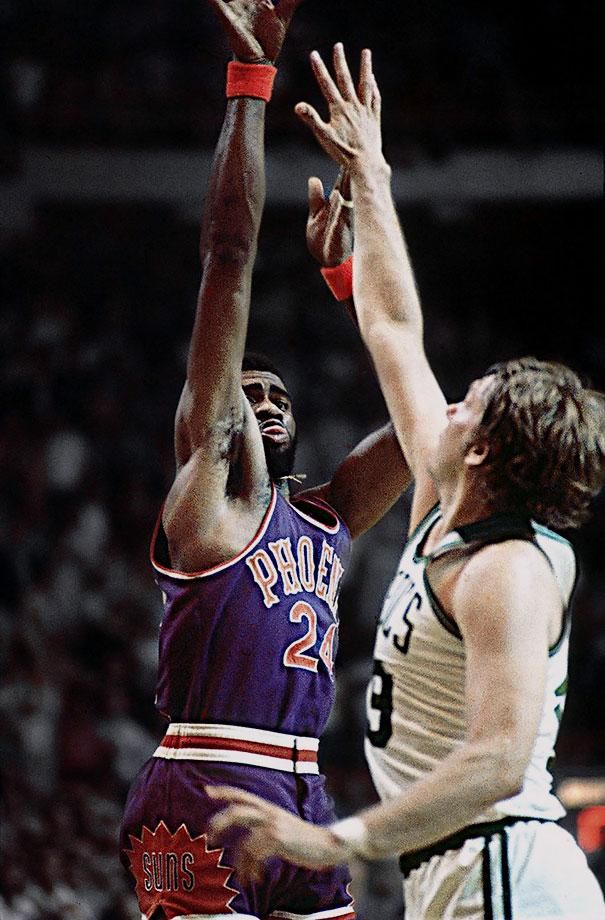
Heard received the inbounds pass at the top of the key, about 20 feet from the basket, with his team trailing 112-110 and one second on the clock in double overtime. He turned and fired a high-arching jump shot that seemed to climb all the way to the rafters before beginning its descent. Celtics forward Don Nelson contested the shot, though it didn’t matter. The ball sailed through the net. Tie game.
“I don’t believe it!” exclaimed Brent Musburger on the telecast. “I don’t believe what I just saw!” There would be triple overtime. The game appeared to be over moments earlier, but the Suns wouldn’t set.
Phoenix wasn’t supposed to be in a pivotal Game 5 against the Celtics. The Suns were 18-27 and in last place in late January. On February 1, they acquired Heard from the Buffalo Braves. Soon after, rookie Ricky Sobers replaced injured Dick Van Arsdale in the starting lineup. The team took off, winning 24 of its last 37 games to earn a playoff spot. Phoenix disposed of the Seattle SuperSonics in the first round.
Its opponent in the next round was the defending-champion Golden State Warriors. Led by Rick Barry, the Warriors won a league-high 59 games and were heavily favored. Phoenix upset the Warriors on their home court in Game 7, earning a trip to the NBA Finals. They were massive underdogs once again against a Celtics team led by future Hall of Famers John Havlicek, Dave Cowens, and Jo Jo White. The series began according to script with Boston taking the first two games at home. Phoenix responded, evening the series at home.
Boston’s vaunted fastbreak propelled it to a torrid start in Game 5. Cowens and Paul Silas controlled the glass, and Havlicek contributed 13 points in the first quarter. Boston led 13-3. Then 22-5. Then 28-10. The score was 36-18 at the end of the first quarter, and the Suns trailed by as many as 22 points early in the second. It appeared to be an insurmountable lead in the days before the three-point shot.
“There was no panic. There was no hanging your head. We stuck together,” says forward Curtis Perry. The Suns’ roster was composed of a mix of wily veterans and precocious rookies. Alvan Adams, their first-round pick in 1975, was quick for a center, had excellent touch from the outside and was an exceptional passer. The other rookie, Sobers, brought tenacity to the club. Paul Westphal, who was traded from the Celtics to the Suns before the season, was a brilliant shot-maker. Perry and Heard, two hard-nosed defensive forwards rounded out the starting five. Van Arsdale came off the bench, along with veterans Keith Erickson, Pat Riley, Nate Hawthorne, and Dennis Awtrey. John MacLeod was the coach with Al Bianchi as his assistant.
Adams remembers that squad as the closest team he played on over his 13-year career. Most of the guys were married and several of them were new to the team so the players and their wives often socialized together as couples. Throughout the season, the team stuck together through hard times. Game 5 was no different.
The score was 61-45 at halftime. Phoenix picked up its defensive pressure and opened the third quarter on a 23-7 run to tie the game at 68. The Celtics appeared to be in control again up 92-83 with 3:49 left in the game. Then Westphal erupted with nine of the next 11 points to tie it at 94 with 39 seconds remaining. Each team made a free throw to make it 95-95. Havlicek missed a shot with 8 seconds left. Phoenix grabbed the rebound and called timeout with three seconds remaining. Boston knocked away the inbounds pass and recovered the ball.
Silas signaled for a timeout in front of referee Richie Powers with one second on the clock, but Powers pretended not to see it. Boston didn’t have any timeouts remaining. If Powers had granted the timeout, it would have resulted in a technical foul, and most likely sealed the game for Phoenix. The referee later admitted that he didn’t want the game to end that way. Time expired. (Bianchi was furious that Powers didn’t make the call, which he believed cost the Suns a championship. He had a jeweler make him a 1976 Suns championship ring with the words “F- – – You, Richie Powers” inscribed in it.)
The game was tied at 101 after the first overtime. Jo Jo White converted a driving layup to give the Celtics a 109-106 lead with 19 seconds remaining in double overtime. Van Arsdale responded with a corner jumper with 16 seconds on the clock. Westphal knocked away the ensuing inbounds pass. Van Arsdale passed the ball to Perry, who missed a jumper. He grabbed his own rebound and fired again. That one connected to give the Suns a 110-109 lead with 5 seconds remaining. Boston called timeout. It inbounced the ball at halfcourt to Havlicek, who took three dribbles down the left sideline, then fired what Bob Ryan, who was covering the game for the Boston Globe, described as a “Nolan Ryan fastball” off the glass and in.
The clock ticked down to zero. Fans stormed the court. The game started at 9:00 and many of those in attendance were inebriated by the end of double overtime. Some fans turned over the scorer’s table. One attacked referee Powers. The Celtics returned to their locker room, believing they had won the game. Rick Barry accurately noted on the telecast that the game wasn’t over. There was time on the clock when Havlicek’s shot went in. The referees put one second on the clock. The Celtics returned to the court, and the game resumed.
The Suns were out of timeouts so they couldn’t advance the ball to halfcourt. They’d have to go 94 feet in one second. Then Westphal came up with a brilliant idea. He asked Powers what would happen if the Suns called timeout. Powers said they didn’t have any timeouts. Westphal asked what would happen if he called one anyway. Powers said the Celtics would shoot a technical foul shot, then the Suns would receive the ball at halfcourt. Westphal called timeout. White knocked down the foul shot to make it 112-110.
MacLeod drew up a play for Westphal, though the Suns believed Boston wasn’t going to allow him to catch the ball. Heard was the second option. He was ready for the moment. “Growing up you always take a shot that you think this is to win the game. This is that,” says Heard. Gar cut towards the top of the key and received the pass about 20 feet from the basket. He turned and fired over Nelson’s outstretched arm. “Gar’s aurora borealis shot,” Perry calls it.
Al McCoy was on the radio call: “Here’s Perry. To Gar Heard. Here’s the jump shot . . . GOOD! IT’S GOOD! IT COUNTS! GAR HEARD TIES IT! We’ll go to the third overtime!” Stunned silence in Boston Garden.
Adams, Awtrey, Cowens, and Charlie Scott had all fouled out. When Silas joined them with 3:23 remaining in triple overtime, Celtics coach Tom Heinsohn called on seldom-used reserve Glenn McDonald. McDonald had fresh legs, and Heinsohn told him to “run em.” McDonald scored six quick points. Jim Ard hit two free throws with 31 seconds left to put the Celtics up 128-122. One final frantic comeback attempt by the Suns fell short. Boston won 128-126.
Musburger signed off of the telecast: “From the Boston Garden. Where you have just witnessed the most incredible game in the history of the NBA.” Newspapers across the country proclaimed it “The Fabulous Fifth.”
The game ended after midnight and Game 6 tipped off less than 48 hours later, a Sunday afternoon in Phoenix. It was a dud. Both teams were exhausted. Scott, who had some juice in his legs after fouling out in regulation of Game 5, led the Celtics with 25 points. Boston won 87-80 and hoisted its 13th championship banner.
Heard’s shot emerged as the most memorable moment from Game 5. “I never felt like it would last that long,” says Heard of the attention. “I really didn’t. I thought that once we lost the game, that was it.” It’s unusual for a play from a losing team to become the defining moment of a game. When it does, it’s typically a mistake, such as Chris Webber’s timeout in the 1993 NCAA Championship Game. Gar’s shot is celebrated. It just wasn’t enough.
Heard is reminded of the shot “quite a bit,” particularly this time of year when it’s replayed on television and at Suns games. “I think most of the people remember me for that shot,” says Heard. “But I have disappointment in a way,” he says, noting that he played with many great players over an 11-year career. Heard was no one-shot wonder. The Georgia native averaged a double-double for several seasons and was an excellent shot-blocker. He’s quick to point out that his block on Jamaal Wilkes at the buzzer sealed Game 6 of the 1976 conference finals. He followed that up with 21 points, 12 rebounds, four blocks, and four steals in Game 7.
If you watch the game now it feels like a relic. Time and score aren’t displayed on the screen. The absence of a three-point line is glaring. Players are wearing short shorts. No tattoos. No choreographed celebrations. Coaches diagram plays on yellow league pads. In overtime, MacLeod ditches the pad and scribbles the play in chalk on the Garden floor. CBS’s camera zooms in, and Barry describes the plays as they’re being drawn up.
It’s a different sport, visually and structurally. Players congregate in the paint and the game is played from the inside-out. There’s more ball movement. Less designed plays or pick-and-rolls, and no three-point shots.
Games like this didn’t explode across the country via ESPN or social media. They filtered outward through newspaper columns and word of mouth. (The game aired on tape delay, after the local news.) Today, every angle would be clipped, posted, debated within seconds. In 1976, the legend had room to grow.
Fifty years later, people still talk about that magical night at Boston Garden. For good reason. The game holds up. It’s packed with suspenseful moments and phenomenal shots. Every time you think it’s over, a stunning turn of events prolongs it further. Bob Ryan was in attendance that night and has been following NBA basketball for over 60 years. When asked if it’s the greatest game he’s ever seen, he responds, “It’s the leader in the clubhouse.”
The Celtics look back on that game fondly, though it’s one of many dramatic victories for a franchise with 18 championships. It’s more meaningful for Phoenix. That game galvanized a Phoenix community that was relatively new to professional basketball and remains a defining moment for a franchise that has advanced to the Finals just twice since and has yet to win a championship.
There’s a richness in losing a game like that, which creates a unique bond between teammates. Heard, Perry, and Adams still live in Phoenix. They talk regularly and see each other at Suns games. Sobers is in touch with the guys as well. They reminisce about the ‘76 playoffs and that epic Game 5. “Every once in a while you catch lightning in a bottle like we did in 1976, where you have the camaraderie and chemistry and the talent,” says Perry.
Game 5 was the game that wouldn’t end. It still hasn’t.


Great article, Paul. The writing was great, but I learned a lot, too, as I was not familiar with this game.
I watched it with big Dave and Glen. We were