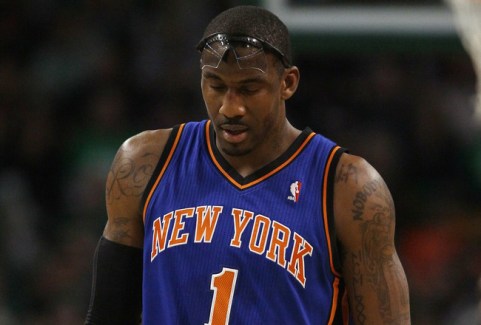
The Elephant in the Knicks Locker Room

It’s been a wild twelve months for the New York Knicks.

They acquired Carmelo Anthony, let General Manager Donnie Walsh go, endured an extended lockout, cut Chauncey Billups, signed Tyson Chandler, began the season with an 8-15 record and ended the first half on an improbable winning streak fueled by a Linsanity which captured the imagination of basketball and non-basketball fans from New York to Beijing.

Throw in the signing of former all-star Baron Davis, the recent addition of streak-shooter J.R. Smith, speculation about Mike D’Antoni’s job security and questions about whether Amar’e Stoudemire and Carmelo can co-exist and somehow the most crucial story of the Knicks season has been almost completely overlooked by the media and fans.

Amar’e Stoudemire has lost his explosiveness.

The dynamic scorer the Knicks signed to a five year $100 million contract in the summer of 2010 can no longer jump.

Pick and rolls which once culminated in him throwing it down with authority now result in mini-hooks or push shots which over the past few weeks have been swatted back in his face with staggering regularity. He hasn’t had his legs underneath him when releasing the jump-shot from the elbow which had become such a potent weapon for him in recent years. STAT’s scoring and rebounding numbers, 17.5 and 8 per game are the lowest since his rookie season and his 44% field goal percentage is by far the lowest of his career.

It’s not just Stoudemire’s scoring prowess which has fallen off. His lateral quickness is significantly diminished as well. Never a great defender, he now hobbles after his man on pick and rolls like a washed up Penny Hardaway, unable to push off on his knees.

STAT’s apologists are quick to argue that his struggles are the result of a long layoff last summer due to a back injury and the extended lockout, as well as the emotional strain from the recent tragic death of his brother, but the signs are much more ominous.

Amar’e may have been behind schedule due to his back injury, but he was doing full workouts by the fall and has had two months since the start of the season to get his legs back. Dirk Nowitzki admittedly came into the season so out of shape that the Mavericks held him out of games for a week so he could work on his conditioning and he’s since reestablished his old form. The tragic death of Stoudemire’s brother occurred just a few weeks ago and doesn’t explain his lackluster performances before that.

Even more concerning is that Amar’e’s decline appears to be a trend which can be traced back to last season. The 6’10 forward’s stellar play during the first half-season of his Knicks career had him in the Most Valuable Player discussion. He was averaging 26.1 points and 8.6 rebounds per game at the all-star break and had the Knicks poised to make their first playoff appearance in seven years.

In the second half, his scoring and rebounding numbers dipped to 23.5 and 7.3 per game. Some writers attributed the decline to a reduction in opportunities due to the acquisition of Carmelo, but anybody who watched the Knicks regularly could see that he didn’t have the same spring in his step. Some nights it looked like there wasn’t any juice in his legs at all. In and of itself, the drop-off last season could be attributed to the abundance of minutes he played early in the season, but the trend has continued this year.

Stoudemire is only 29-years-old, typically still the prime of an NBA player’s career, though he joined the league straight out of high school and has already endured ten grueling NBA seasons during which he’s suffered major injuries. The microfracture surgery he underwent on his left knee in 2005 was so serious that the Knicks were unable to insure his $100 million contract. Many general managers around the league thought they were crazy for committing that much guaranteed money to a player with that kind of history.

The Knicks forward also suffered a detached retina during his tenure with the Phoenix Suns, which nearly ended his career and a back injury in the playoffs last year that was more serious than first believed. Knicks fans know from watching Larry Johnson how a back injury can rob a player of his explosiveness.

Amar’e can still be a solid contributor without the burst that once made him an all-star – 17.5 points and 8 rebounds isn’t too shabby – but if he is indeed on the downside of his career it would be a devastating blow to the Knicks. With so much of their cap space dedicated to Amar’e, Melo and Chandler over the next three seasons, they need all three of their maximum-salary players to perform at an all-star level if they’re going to compete for a championship.

Amar’e is still guaranteed $60 million after this season. That salary, combined with the lack of insurance on his contract render him virtually untradeable, even if he were to regain his old form.

The new Collective Bargaining Agreement threw the Knicks a lifeline in the form of the Amnesty Clause, which they could have used as insurance for Amar’e’s deal. While they wouldn’t have been able to recover the remaining money on his contract in the event that he were injured or his quality of play severely declined, they would have been able to clear his salary from the cap by releasing him. Instead, they went all in on Amar’e once again, using the clause on Billups (whose option they had picked up just six months earlier) in order to free up cap space to sign Chandler.

So why has Amar’e’s downturn received minimal coverage by the local and national media? In part, it’s been overshadowed by Carmelo’s struggles, the Chandler acquisition and of course, Linsanity. For national journalists and sportscasters who don’t watch the Knicks on a regular basis, it’s easy to attribute Amar’e’s struggles to an inability to co-exist with Carmelo or to what has been a strange, compressed, lockout-shortened season.

Another reason Amar’e’s slide has been overlooked in New York specifically is that the media and fans simply don’t want to believe that STAT’s skills may be declining. Amar’e came to the Knicks when no other superstar would and embraced the challenges of playing in the Garden, breathing life into a dormant franchise and re-invigorating a fan base that was starving for quality basketball. New Yorkers also recognize that if he hadn’t come to NYC, Melo and Chandler never would have either. They desperately want him to succeed.

Ultimately, there’s only one person who knows what’s wrong with Amar’e and that’s Amar’e himself. Last week, he told Alan Hahn of MSG Network, one of the few reporters who have discussed the issue of Amar’e’s explosiveness both publicly and with the Knicks forward, that he’s still getting his legs back and is almost there.

The Knicks and their fans better hope he’s right. If Amar’e can’t soar above the rim, the Knicks championship aspirations will be grounded with him.

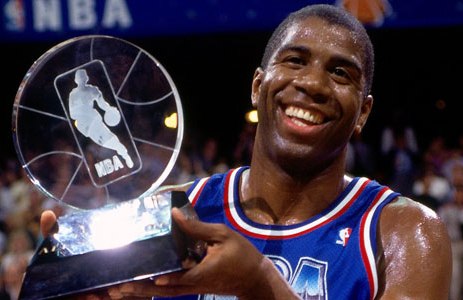
Magic’s All-Star Sendoff

It’s NBA All-Star weekend and this year’s festivities in Orlando mark the 20th anniversary of the most inspirational All-Star performance in the league’s history. Just months after being informed that he’d tested HIV positive, Earvin “Magic” Johnson received a rightful sendoff from the league he helped build.

On November 7, 1991, Earvin “Magic” Johnson shocked the world when he announced that he’d contracted the HIV virus and would be retiring from the game of basketball immediately. That press conference is crystallized in the memories of all basketball fans who were old enough to remember. Nothing revealed the severity of the situation more than the stoic expression on Magic’s face, devoid of the trademark smile we’d all grown so accustomed to.

It’s easy to forget that little was known about HIV/AIDS twenty years ago other than that it was believed to lead to quick and certain death. The indomitable Magic had finally met his match in the game of life; or so it had appeared.

As the 1991-92 season progressed without him, fans showed their support for the beloved architect of the Lakers “Showtime” offense Magic by casting more All-Star votes for him than any other player in the Western Conference even though he hadn’t played one game that season. However, it wasn’t clear if he’d honor the fans’ wishes and play in the game.

In 1992, the American public wasn’t well educated about HIV/AIDS. Nobody was sure exactly how the disease was spread. Some players, including fellow all-stars Karl Malone and Mark Price, expressed concern about acquiring the virus through Magic’s sweat or blood and make it clear that they didn’t want to play with him.

Players, fans and analysts questioned how effective Magic would be even if he did play. He hadn’t competed competitively in months and the public wondered whether the HIV virus or possible side effects from the many medications he was taking would effect his performance. Furthermore, there was concern that it could be detrimental for his health to play.

Ultimately, with the blessing of his doctors and the rest of the game’s participants, Magic decided to take the court at Orlando Arena in Orlando Florida. As he’d done so many times throughout his career, he quickly silenced his doubters.

The Western Conference all-stars played a fast-paced style, reminiscent of the Lakers “Showtime” offense, and Magic had no trouble keeping up. He knifed through the defense and dazzled the crowd with vintage no-look passes, flashing his patented smile after every big play. He was back in his element, playing the game he loved, as if he’d never left.

The Western Conference all-stars ran away with the game, defeating the East 153-113. Magic finished with 25 points on 9-of-12 shooting and added nine assists and five rebounds in just 29 minutes of play and was named the game’s Most Valuable Player.

With a few minutes remaining and the outcome no longer in question the game turned into a personal farewell for one of basketball’s all-time most beloved players. With a minute left, the rest of the players cleared out and let Magic guard his close friend Isiah Thomas one-on-one. Zeke ran down the shot clock dribbling behind his back, then as he looked to get off a jump shot Magic’s long reach forced him into heaving an airball. The next East possession was Michael Jordan’s turn and he wasn’t going to take it easy on his old rival. Undaunted, Magic got a hand in his face, causing MJ to miss off the front of the rim.

Then it was Magic’s turn. His teammate Clyde Drexler got him the ball at the top of the key with 20 seconds remaining on the clock and Isiah guarding him closely. Magic backed him down with a couple dribbles, then stepped back and released an awkward looking, rainbow, three-point shot. Swish! He nailed it!

Nobody could believe that knuckleball found its way into the basket. It was his third three-pointer in the last three minutes. Magic pumped his fist, as a huge smile crept across his face, and the crowd exploded in jubilation. The East didn’t even bother inbounding the ball. The clock ran out as players from both teams hugged Magic. For one last last time, it was his night.

There have been more competitive NBA All-Star Games than the one in 1992, but none more memorable. Like his game-winning hook shot over the oustretched arm of Kevin McHale in Game 4 of the ’87 Finals or when he jumped center in place of Kareem and led the Lakers to the championship in his rookie season, Earvin Johnson reminded us once again that he’s simply Magic.

Clyde Invigorated by Linsanity

The excitement and energy surrounding new Knicks point guard Jeremy Lin has reinvigorated Knicks Hall of Famer and broadcaster Walt “Clyde” Frazier. Clyde has taken his rhymes to twitter and is making appearances on national sports programs to discuss the new phenom, who Frazier’s former teammate and captain Willis Reed said this week reminds him of a young Clyde.

Most notably, Frazier dug deep into his legendary wardrobe this to find the perfect outfits to match the pageantry known as Linsanity. He wasn’t kidding when he tweeted before the Knicks/Lakers showdown at the Garden last Friday night…

“The Knicks and Lakers are in town …my brown and white cow will astound!”

Wednesday night Clyde followed it up with a “more conservative” brown leather jacket for the Knicks matchup with the Sacramento Kings.

It’s Melo’s Time

When Donnie Walsh was named President of the Knicks in April 2008 he had a plan. The former Pacers GM intended to rid the franchise of  the bloated contracts left over from the disastrous Isiah Thomas era in order to create cap space to sign one or two superstars during the free agent bonanza of 2010, the kind of superstars that would return the once proud franchise to championship contention.

Almost four years later, Walsh’s plan has come to fruition, albeit with different all-stars than he had anticipated. After striking out on LeBron James and Chris Bosh in the summer of ’10, Walsh signed former Phoenix Sun Amar’e Stoudemire to a five-year $100 million contract.

Unlike many of his peers Amar’e embraced the challenge of returning the Knicks to glory. He made it cool to play in New York again, so cool that his buddy Carmelo Anthony forced the Nuggets to trade him to the Knicks several months later. Two weeks ago, the two superstars (along with $58 million) enticed Tyson Chandler, of the 2011 champion Dallas Mavericks, to sign with the team as well.

In Stoudemire, Anthony and Chandler the Knicks have the most formidable front line in the NBA and the makings of a good team. If Amar’e and Melo learn to play together they can be very good.

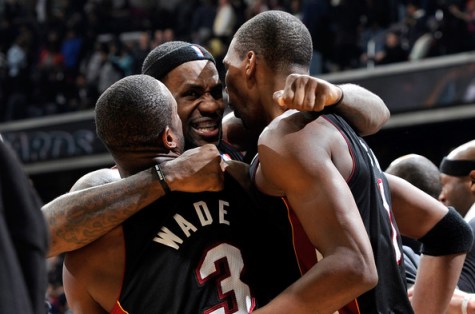
But in order for them to win a championship in the next few years Carmelo Anthony needs to be great. Great like Dwyane Wade when he refused to let the Heat lose in the 2006 NBA Finals or Dirk Nowitzki knocking down off-balance shots from every angle on the court in the closing minutes against the Heat last season. Every championship team (with the exception of the 2004 Pistons) has had a dominant player who took over games in crunch time. Carmelo has to be that guy.

Come playoff time, when New York faces Derrick Rose and the Bulls, Wade and Lebron’s Heat and possibly Kevin Durant and the Thunder in the Finals, Melo needs to be the best player on the floor. Not necessarily at all times, but for significant stretches, particularly in the fourth quarter. Carmelo can be that guy.

Amar’e’s importance to the Knicks shouldn’t be glossed over. His winning attitude changed the culture of a moribund franchise and without his decision to come to New York, Melo and Chandler wouldn’t have followed. He’s earned the right to be captain and the last Knick introduced during player introductions. Though he lacks the explosiveness of his younger days, he’s still an imposing offensive force and the team will rely on his scoring. But he’s not Melo.

There are less than ten players in the world who possess the skills necessary to lead a team to a championship and Carmelo Anthony is one of them. He’s the best pure scorer in the league. The 6’8 forward can blow by his man with a devastatingly quick first step, which he allows him to get to rim with ease or set up a jab-step to create space for his picture perfect jumper. He can light it up from behind the arc or take his man in the post.

Teams are forced to double team him and when they do he makes them pay. Though he may seem like a one-dimensional player at times, Melo is an excellent passer, so much so that Knicks Coach Mike D’Antoni plans on running the offense through him this season, and is capable of grabbing double digit rebounds every game.

Perhaps most importantly, Melo possesses what ESPN’s Skip Bayless refers to as “the clutch gene.” He wants the ball in the closing minutes of tight games and he’s consistently among the league leaders in shooting percentage for game-tying or game-winning shots.

Still, despite an NCAA championship, Olympic gold medal and four all-star appearances, Melo hasn’t reached his full potential as a player. There are some glaring holes in his game, particularly his reluctance to play defense, a tendency to bog down the offense with his isolation plays and an unwillingness to take conditioning as seriously as many of his peers. In fact, some of his teammates on the 2008 Summer Olympics team teased him about his belly.

Now in the prime of his career, at the age of 27, the Brooklyn native has a chance to make a fresh start with a Knicks team that has the nucleus in place to form a championship team, something he never had in Denver. The Knicks aren’t a finished product, as General Manager Glen Grunwald continues to work to solidify the point guard position (He’s hoping newly signed Baron Davis will fill that role once he returns from a back injury) and add some front court depth.

It’s also typically a slow climb to a championship, beginning with tough playoff losses, as a team grows into a cohesive unit and learns how to finish games in the playoffs. The Knicks probably won’t peak for another year or two, but the run starts now and it begins with Melo.

His seven-year stint with the Nuggets was a prelude to the main event. Madison Square Garden is where Carmelo Anthony will define his basketball legacy. Deliver a championship to New York and he’ll go down as a legend.

Which L.A. Team is More Likley to Win It All?

For decades the Los Angeles Clippers have been the laughing stock of the NBA, the red-headed step-brother to a Lakers franchise which has dominated the league with a flare that captures the glitz and glamor of Tinseltown.

The Clippers have made the playoffs just twice since moving to L.A. in 1984. Their notoriously stingy owner Donald Sterling routinely allowed his best players to walk, bungled draft picks and failed to attract any star power to the media capital of the world. Meanwhile, the Lakers won eight NBA championships during that period on the backs of superstars so big they only need one name, Kareem, Magic, Shaq and Kobe.

So when the NBA lockout finally concluded last week and two of the league’s top players, Chris Paul and Dwight Howard, were on the trading block and both reportedly interested in playing in L.A., basketball fans and insiders assumed that the Lakers would land one, if not both of them. Given the Clippers reputation as a moribund franchise, nobody believed they were seriously in the running, even though they had several attractive young assets.

Initially, it looked as though the scenario would play out as expected, with the Lakers reaching an apparent agreement on a three-team deal involving the Rockets and Hornets in which they would obtain Paul in exchange for Pau Gasol and Lamar Odom. Then at the last minute, the league – which currently owns the Hornets – set off a firestorm by nixing the trade for “basketball reasons.”

Still, history dictated that the Lakers would find a way to restructure the deal and get their guy. But that’s not what happened. Instead, a devastated Odom reportedly asked to be traded. Instead of giving their versatile big man time to cool off, in Clipper-esque fashion, the Lakers shipped one of their biggest trade chips to the Mavericks for virtually nothing (the Mavs 2012 first round draft pick.)

The Clippers swooped in amid the chaos and began serious negotiations with the Hornets for Paul, which culminated in a deal Wednesday night in which they sent Eric Gordon, Minnesota’s unprotected 2012 first-round pick, Chris Kaman and Al-Farouq Aminu to New Orleans for the four-time all-star point guard.

The trade gives the Clippers the best guard-big man tandem in the league with Paul and last season’s Rookie of the Year Blake Griffin, a combination reminiscent of Steve Nash and Amar’e Stoudemire during their glory days in Phoenix.

Paul wasn’t the only move the Clippers made this past week. Donald Sterling’s club won the bidding for veteran point guard Chauncy Billups, who can also play some two guard next to Paul, after he was waived by the Knicks under the amnesty provision. The club also signed gritty small forward Caron Butler and matched the four-year $43 million offer Golden State made to their up-and-coming restricted free agent center DeAndre Jordan.

With a formidable starting five and the best one-two punch in the league other than LeBron and D-Wade, for the first time ever, the Clippers have the makings of a legitimate rivalry with the Lakers. In fact, one could argue that they have a better chance than their Staples Center cohabitants to win the championship this season.

The Lakers were swept by Dallas in the playoffs last season, Phil Jackson retired and they completely mishandled the Odom situation, turning their biggest strength, their deep front line, into a weakness. They have numerous question marks heading into the season, including an aging backcourt, the relationship between Bryant and new head coach Mike Brown and as always, whether Bynum can stay healthy.

Yet, the Lakers still have the potential to be an elite team. Don’t forget, they’re just two years removed from back-to-back championships and last I checked, they still have one of the top five players in the world in Kobe Bryant. Pau Gasol and Andrew Bynum form a devastating power forward/center tandem and both are solid bargaining chips for a potential trade with Orlando for Howard.

The Clippers have weaknesses as well, particularly inexperience and a lack of depth down low, which will be crucial in this compressed season. With several new parts and very little time to gel, the Clippers probably aren’t ready to compete for a championship this season, though they’re legitimate contenders and they’ve certainly closed the gap between themselves and the Lakers.

As Blake Griffin said when asked about the acquisition of CP3, “When you hear the Clippers, it’s not going to be a joke anymore. I can guarantee you that.”

We’re So Sorry, Uncle Albert

Free Agent Albert Pujols is Ready to Field Offers

Albert Pujols has been the best player in baseball for the better part of the past decade and appeared to be hitting the free agent market at the perfect time this fall. The all-star first baseman just led the Cardinals to their second World Series championship during his tenure in St. Louis, becoming just the third player to blast three home runs in a World Series game in the process in Game 3 against the Rangers.

So, why do there appear to be so few teams vying for his services?

The truth is, in many ways, the timing of Pujols’ free agency couldn’t have been worse. There are usually at most 10 to 12 teams that have the resources to match or exceed the nine year, $200 million offer the Dominican slugger turned down from the Cardinals during last spring training. However, due to lack of need or finances, many of those teams simply aren’t interested.

The first rule of baseball free agency is to try and involve the Yankees in the negotiations. The Steinbrenner clan is often willing to pay way over market rate to get their man (See Alex Rodriguez and C.C. Sabathia). Typically, even if a player has no interest in donning the Pinstripes, he can count on the Yankees upping the ante for other teams interested in his services.

The problem is the Yankees have one of the best all around first basemen in baseball, Mark Teixeira, locked up to a long term deal. Teix is too good in the field to move to DH in order to make room for Pujols and even if Pujols were willing to DH for the Yankees, which is unlikely, the Yanks want to keep the DH spot available for the aging left side of their infield, Derek Jeter and Alex Rodriguez. The team’s primary concern is beefing up a shallow starting rotation, not adding a big bat.

The team usually vying with the Yankees for elite talent on the market, their arch rival, the Boston Red Sox, are set at first base as well, having locked up Adrian Gonzalez through 2018. They too are focused on adding a couple of arms to a patchwork rotation which fell apart this past September.

Two big market teams that are usually willing to throw around big dollars have fallen on hard times financially. New York Mets owner Fred Wilpon is embroiled in a lawsuit stemming from the Bernie Madoff scandal and is reluctant to spend an exorbitant amount of money before that matter is resolved. He just let the team’s best player Jose Reyes sign with the division rival Miami Marlins. Even if Wilpon were willing to dish out the cash, the Mets are several players away from being serious contenders and appear to be in rebuilding mode, a situation which doesn’t appeal to Pujols.

The Dodgers, another historically high spending team are in complete turmoil. Contentious divorce proceedings caused owner Frank McCourt to file for bankruptcy and led Major League Baseball to compel him to sell the team. Despite the uncertainty of the situation, the team recently re-signed five-tool centerfielder Matt Kemp to an eight year $160 deal, but don’t expect them to extend another contract offer of that magnitude before a new owner is on board and by that time Pujols will have signed elsewhere.

Other big market teams, such as the Phillies and White Sox are set at first base, with Ryan Howard and Paul Konerko. The Angels’ Mark Trumbo led rookies in home runs and RBIs this past season and the team anticipates the return of Kendry Morales from knee surgery. They have more pressing needs to address than first base, specifically, the left side of their infield.

All of these circumstances have left the game’s best player flirting with the Miami Marlins and visiting with the Toronto Blue Jays, in an attempt to gain leverage in negotiations with the Cardinals. The Chicago Cubs have long been considered a potential suitor for the three-time MVP winner, though their interest has only been lukewarm to this point.

It’s questionable whether Pujols would even be willing to play for a rebuilding team like the Cubs and Chicago’s new General Manager Theo Epstein will certainly take into consideration another factor which is working against Pujols, his age. Prince Albert turns 32 in January, which may have meant nothing during the steroid era, but with more stringent drug testing in place,  even the best conditioned players are slowing down in their mid to late 30s.

Prospective suitors need look no further than Alex Rodriguez. In 2007, at the age of 31, the Yankees third baseman hit 54 home runs and drove in 156 runs on the way to his third MVP award. After that season the Yankees signed him to an outrageous $270 million, 10 year deal.

Since then he hasn’t played more than 137 games or hit over 30 home runs in any of the past three seasons. The Yankees are stuck paying him $27 million a year (possibly more if he breaks the home run record) through the age of 42. Teams are understandably wary of making the same mistake with Pujols.

The few teams that have an opening and the means to sign a first baseman of or near Pujols stature also have the luxury of a younger and cheaper alternative in Prince Fielder. Cecil’s son is only 27 years-old and his numbers were very similar to Pujols last season. He’d make a nice consolation prize for the Cubs or Cardinals, which places less pressure on them to increase their offers for Pujols. The Orioles, Mariners and his former team, the Brewers, have expressed interest in Fielder.

Baseball’s winter meetings began yesterday in Dallas and as the hot stove heats up, it wouldn’t be surprising to see a couple of other teams like the Rangers or Nationals throw their hat in the ring with a serious offer to Pujols. However, as of now, the greatest player in the game is garnering minimal interest on the free agent market. He may have to settle for the nine year, $200 million deal the Cardinals offered him last spring.

How Will NBA Teams Use the Amnesty Clause?

The final details of the collective bargaining agreement between NBA owners and players are still being ironed out, though one thing we know for certain is that the agreement will include an “amnesty clause.” The clause will allow teams to waive one player and though the team will still be required to pay the player, his salary will not count against the salary cap or for purposes of the luxury tax. The clause can be used at any time, but only on players who were under contract when the new CBA was signed.

Players who are waived under the amnesty clause will then be available on waivers, but initially only teams that are under the salary cap can bid on them. If none of those teams claim an amnestied player then cap-strapped contenders like the Lakers, Heat and Mavericks will be able to stock up on other teams castaways.

Unlike the so-called Allan Houston amnesty clause in the 2005 CBA, the new amnesty clause will not require teams to use it immediately.  They may hold onto the clause until next summer when there’s a stronger free agency class not to use the clause at all as the Knicks inexplicably chose not to use the Allan Houston clause on Allan Houston in ’05.

This is a breakdown of which players each time will likely use the clause on.

Atlanta Hawks

Joe Johnson isn’t a franchise player, though at $107 million over the next five years he’s being paid like one. That being said, the Hawks aren’t going to release their best player. The wiser move is to get out from under the $24.9 million in cap space devoted to Marvin Williams over the next three years and rid themselves of the constant reminder that they selected him over Deron Williams and Chris Paul in the 2005 draft.

Boston Celtics

The only potential candidate for amnesty in Boston is Jermaine O’Neal and the $6.2 million he’s due this season. O’Neal was rarely healthy enough to play last season and had little impact when he did, but with a lack of big men on the market, the Celtics may roll the dice on O’Neal’s gimping knees making it through the season.

Charlotte Bobcats

Michael Jordan would love to shed the $18 million owed to Boris Diaw over the next two seasons, but the overweight Frenchman is a greater contributor than backup center DeSagana Diop, who’s set to make more than $13 million over the next two years, with a player option that could put his three year total over $20 million.

Chicago Bulls

One year into his six year, $90 million deal, Carlos Boozer is looking like a bad investment. The Bulls played equally well when he was hurt last season and his backup Taj Gibson was more effective at times during the playoffs. If they can add a scoring power forward or top notch two guard to share the backcourt with Rose they should let Boozer go. If not, the $15 million owed to Kyle Korver and $13.8 million to Ronnie Brewer over the next three years are other options.

Cleveland Cavaliers

Quite a coup by the Cavaliers! They received a first round pick, which turned into Kyrie Irving, in exchange for taking Baron Davis albatross of a contract off the Clippers hands and now they get to cut Davis and remove the remaining $28.7 million of his contract from the cap. The Clippers must be kicking themselves. Again.

Dallas Mavericks

The Mavs decision regarding the amnesty clause will depend on whether they can re-sign Tyson Chandler. If so, there’s no reason to pay Brendan Haywood $35 over the next four years to be a backup center after Ian Mahinmi gave them quality minutes in the NBA Finals. If Chandler gets away then Haywood is their best option at center and the Mavs will stand pat.

Denver Nuggets

It didn’t take long for the Nuggets to regret signing Al Harrington to a deal worth $27 million over the next four years. That being said, with Wilson Chandler and J.R. Smith signing with Chinese teams, they may want to hold on to Harrington’s scoring off the bench, at least for the time being.

Detroit Pistons

The Pistons have three prime candidates for amnesty, two of which stem from General Manager Joe Dumars disastrous free agent summer of 2009, Charlie Villanueva and Ben Gordon, who are due $24.2 and $37.2 million respectively over the next three seasons. However, the Pistons will likely use this opportunity to finally part ways with the disgruntled Richard Hamilton, who has $25 million remaining on his deal.

Golden State Warriors

David Lee is an excellent rebounder, but the third best player on a below .500 team isn’t worth $14 million a year for the next five years. Still, at least Lee is a solid contributor, which is more than can be said for Andris Biedrins, who’s due to make $27 million over the next four seasons. If one of these big men is waived it will likely be Biedrins.

Houston Rockets

Hasheem Thabeet hasn’t been able to get off the bench since the Rockets selected him with the number two pick in the 2009 draft. It’s time for them to sever ties with the former UConn center and the remaining $5.2 million guaranteed to him.

Indiana Pacers

This is an easy one for the Pacers. There’s only one excessive contract on their roster and it’s the $7.5 million owed to James Posey for this season.

Los Angeles Clippers

Center Chris Kaman has been hobbled by injuries the past couple of years. The smart move is re-sign restricted free agent DeAndre Jordan and attempt to trade Kaman to a team starving for a big man. If they sign Jordan and can’t move Kaman then they want to consider eliminating the $12.7 million owed to him from their 2011-12 cap.

Los Angeles Lakers

Will the Lakers cut the cord with Metta World Peace? His game is slipping and they’re indebted to him for $21.8 over the next three seasons. GM Mitch Kupchak is looking to make the roster younger and more athletic, but there aren’t any small forward free agents who fit that bill. Barring a trade for an athletic perimeter player, the Lakers will probably use the provision on little used forward Luke Walton instead. Bill’s son has two years and $11.5 million remaining on his contract.

Memphis Grizzlies

The Grizz signed swingman Rudy Gay to a five year, $82 million contract last summer and then came within a game of the conference finals without him. They need to clear cap space in order to re-sign Marc Gasol and cutting Gay would be the most logical way to do that, but the Grizzlies aren’t plush with cash like the Lakers or Knicks and management isn’t willing to pay a player of that caliber not to play for them. They could try and trade Gay for cheaper parts and probably won’t use the amnesty clause at all.

Miami Heat

Mike Miller never got into the flow of the Heat’s offense last year and failed to make opponents pay for double teaming one of the “big three.” He’s the only amnesty possibility on a team without many guaranteed contracts. Miller is owed $6 million per year for the next two years with a player option for $6.6 million for a third season, which isn’t excessive for a sharp shooter, but Miami may need to waive him in order to free money to sign a defensive minded big man.

Milwaukee Bucks

The Bucks are is in no-man’s land; they don’t have the building blocks for a contender, but aren’t bad enough to look rely on ping pong balls for a franchise player. If they decide to shed some salary, the $27 owed to Drew Gooden over the next four years would be a good start, but I’m guessing the Bucks will pass on the amnesty option.

Minnesota Timberwolves

David Kahn, the much maligned GM of the T-Wolves, shocked NBA insiders when he signed Darko Milicic to a four-year $20 million deal in the summer of 2010. The question is whether Kahn is willing to admit that he made a mistake after just one season and sever ties with the Serbian big man. The Wolves could also use the clause on reserve forward Martell Webster who’s scheduled to make $10 million over the next two years.

New Jersey Nets

Travis Outlaw‘s outrageous contract exemplifies why NBA owners felt they needed to protect themselves from overspending on mediocre players. Outlaw, who signed a five year, $35 million contract with the Nets in the summer of 2010 averaged just nine points per game last season. Don’t expect him to be joining the Nets when they make their move to Brooklyn.

New Orleans Hornets

The owner-less Hornets don’t have an obvious selection for amnesty relief, but in a last ditch effort t0 convince Chris Paul to stay in New Orleans, they could free themselves of the $21.8 million owed to Trevor Ariza over the next three seasons and replace him with two moderately priced contributors.

New York Knicks

Where was the amnesty clause when the Knicks desperately needed it four years ago? With Eddie Curry finally off the books and Jerome James, AKA, “Big Snacks” a distant memory, the Knicks don’t have any atrocious contracts on the books. The only real candidate for amnesty is Renaldo Balkman who’s set to make just $3.3 million over the next two years, but when the Knicks try to land a third superstar next summer, every little bit helps.

Oklahoma City Thunder

Nobody should be more infuriated about the amnesty clause than Sam Presti. The OKC GM masterfully constructed a contending team in a small market, while his contemporaries foolishly overpaid for vastly overrated stiffs. His reward is that he has to sit back and watch as they’re granted a do-over. Presti doesn’t have one excessive contract on his roster.

Orlando Magic

Orlando GM Otis Smith had to be praying for a double amnesty clause because he’s desperate to get rid of Gilbert Arenas and the $62.4 million he’s due over the next three seasons, as well as the $34.5 remaining on Hedo Turkoglu‘s contract. Ultimately, Smith will opt for Arenas, who’s owed more money and is the less productive of the two. Then he’ll try and get a team to take Turkoglu off his hands as part of a deal for Dwight Howard.

Philadelphia 76ers

A year ago, the Sixers would have cut ties with Elton Brand, who still has $35 million remaining on his contract over the next two years, but Brand had a bit of a comeback season and is the only low post threat on this up-and-coming team. The more likely scenario is that’s they’ll create $6.7 million more in cap space by using the clause on Andres Nocioni. The Argentinian forward played just twelve minutes a game last season.

Phoenix Suns

Josh Childress has four years and $27 million remaining on his deal with the Suns, which is way too much for a player who was stuck on the bench behind Grant Hill, Jared Dudley, Channing Frye and Hakim Warrick last season. The former Atlanta Hawk will likely be searching for a new home soon.

Portland Trailblazers

Just two years ago, Brandon Roy was arguably among the top ten players in the league and the Trailblazers rewarded their franchise player with a maximum salary contract. Then his knees gave out, causing him to miss most of the past two seasons and undergo numerous procedures. At just 27, Roy’s days as a franchise player are over and though he may still be able to help a team off the bench, he’s not worth any where near the $68.7 million remaining on his deal. Portland fans won’t like it, but the Blazers need to let their captain go.

Sacramento Kings

The Kings won’t feel compelled to use the amnesty clause on any of their current players, though if they’re looking to free up some cap space in order to be a player in free agency Francisco Garcia is the most likely candidate. Garcia is an athletic swingman, but his limited skill set makes his replaceable and waiving him would free up over $6 million per year for the next three seasons.

San Antonio Spurs

Richard Jefferson is the obvious choice here. The former Nets forward is on the downside of his career and never found his niche in the Spurs offense. Couple that with the the $30 million he’s owed over the next three years and the Spurs dealing George Hill for rookie forward Kawhi Leonard and the writing is on the wall for Jefferson.

Toronto Raptors

Jose Calderon is a mediocre point guard at best, but is being paid like an all-star at the rate of $10 million per year over the next two seasons. The problem is that the only other point guard on the roster, Jerryd Bayless, is incapable of running an offense. The more likely victim of the amnesty clause is Linas Kleiza and the $14 million he’s due over the next four years.

Utah Jazz

Mehmet Okur missed much of last season with a torn Achilles tendon and in the last year of his contract, the Jazz are attempting to move in a younger direction. With a number of talented big men, including the third pick in the 2011 draft, Enes Kanter, the Jazz will shed the $10.9 million owed to Okur this season from their cap.

Washington Wizards

Rashard Lewis has become the poster boy for the owners’ push for an overhaul of the system. The Wizards forward is set to make a staggering $43.8 million over the next two seasons. This for a player who averaged 11.7 points and 5.1 rebounds per game last season on a terrible team.

Melo and Amar’e Take Their Talents to Sesame Street

In the latest edition of “What are They Doing During the Lockout,” Knicks stars Carmelo Anthony and Amar’e Stoudemire recently made their second appearance on Sesame Street. Here they are hanging out with their homeboy Grover.

The Basketball Junkie’s Lockout Survival Guide

If you love the NBA as I do, then the past month has been absolute torture for you. A little piece of you dies every time the NBA cancels a new block of games.

It doesn’t help that the media routinely builds up hope with reports that “progress was made” or “there’s reason for optimism that a deal will get done soon,” only to inform you the following day that talks have broken off and the two sides are as far apart as ever. As depressing as it is, it’s impossible to turn away because you desperately want to see some basketball.

As the lockout continues to drag on and the threat of more games and potentially even the season being canceled, NBA fans need to find alternative sources of entertainment. So I came up with a lockout survival guide consisting of ten ways NBA junkies can get their fix until the two sides reach an agreement.

10) NBA Gossip

How bad are you jonesing for some NBA action? Athletes and their families have infiltrated the world of reality television and gossip publications. You need look no further than the Kardashian sisters, Khloe and Kim, who  married NBA players Lamar Odom and Kris Humphries. Carmelo Anthony’s wife Lala Vazquez has her own show on VH1 called Lala’s Full Court Press and Basketball Wives is back for a third season. You can also see what many of your favorites ballplayers are up to by following them on twitter.

9) High School Hoops

This may seem like a desperation move, but it could end up being quite rewarding. If you really love the game, you’ll enjoy checking out some of the top teams and potential future stars in your city or simply watching local players or teams progress over the course of the season.  

8)  Basketball Books

You can stay close to the game by brushing up on your basketball history. There are countless great books about the history of the game, players, teams and leagues, as well as informative manuals on Xs and Os. Jerry West’s new book Jerry West: The Life and Legend of a Basketball Icon has received rave reviews and you can find other ideas from a previous post counting down the ten best basketball books I’ve read.

7) Join a League

Who needs to watch b-ball on TV when you can play yourself? Rent out a local high school gym once a week with a bunch of your buddies or join a team in a competitive league. There are leagues for all different ability and age levels. Alternatively, you may consider coaching a youth intramural team in your spare time.

6) Street Ball

Let’s hope it doesn’t come to this because if the next street ball season arrives before the NBA returns it will mean that the entire 2011-12 season was canceled (unless you live in a warm climate where the playgrounds are packed year round). Street ball at its best is basketball in its most artistic and improvisational form. Every major city has a park where the best street ballers show off their games, the Mecca being Rucker Park in Harlem, New York City.

5) Occupy the NBA

One of the most frustrating aspects of the lockout is that we the fans feel completely helpless. The players argue that their unique talent drives the league and they should be compensated accordingly. News flash! There would be no NBA without the fans. That $4 billion the players and owners are arguing over comes from our pockets, yet we have no say in these negotiations.

Take the power back! In the spirit of the times, express your displeasure with the current lockout by occupying the NBA. David Zirin discussed this issue at length a few weeks ago in his column Edge of Sports.

4) Hockey

Remember this game? It’s played on ice, six guys on a side, with sticks, a puck and the occasional brawl. Many basketball fans grew up on hockey as well, but lost interest in the game as the NHL’s popularity has declined in the U.S. over the past twenty years. If you prefer professional sports, it may be a good time to give hockey another chance.

3) Old School Hoops

If it’s NBA or bust for you and no other level of basketball will do, there are plenty of great old NBA games available for your viewing pleasure. NBATV is currently airing games from the memorable 1993 playoffs, highlighted by two great conference championship series between the Bulls and Knicks and Rockets and Suns. ESPN Classic is another source for legendary NBA games and your local sports channel may turn to NBA classics as well, with plenty of air time to fill during the lockout.

2) European Leagues

With the NBA on hiatus, the highest quality of basketball is being played in Europe. Many NBA players have signed with European teams either for the entire season or until the lockout ends, including all-stars Deron Williams and Tony Parker. The Euroleague, a tournament consisting of 24 of the best teams in Europe is underway and can be seen live on Euroleague.net and ESPN 3. There are many high quality leagues throughout Europe. Two of the best are Liga ACB in Spain and the Italian league Lega Basket Serie A. Eurobasket.com is a great source for information about the various leagues and news on NBA players playing in Europe.

1) College Basketball

For fans who love the NBA, this is your most accessible and exciting alternative until the lockout ends. Oddly, the NBA labor strife should result in greater competition in the college game this season. Some of the best players in the country, including North Carolina forward Harrison Barnes and Ohio State big man Jared Sullinger, remained in college in order to avoid the possibility of being locked out.

A Champagne Super-Nova?

by Paul Knepper

The Yankees have become as synonymous with October as the leaves changing color and candy corn, but they were no sure bet to make the post-season this year. Coming out of spring training they had major question marks in the rotation. Ace CC Sabathia, unpredictable A.J. Burnett and Phil Hughes, an 18-game-winner last season, were penciled into the first three spots in the rotation. It was the fourth and fifth starters that were a concern.

The Bombers suffered two major blows to their hopes for a rotation during the off-season when GM Brain Cashman lost his number one priority, prized free agent Cliff Lee, to Philadelphia and Yankee great Andy Pettitte decided to hang up his pinstripes for good. Those losses were compounded by the rival Red Sox apparent plethora of quality starters.

Cashman attempted to plug up the holes in the rotation by signing over-the-hill veterans Freddy Garcia and Bartolo Colon to minor league contracts. Colon turned 38 in May, hadn’t pitched 100 innings in a season since he won the Cy Young award with the Angels in 2005 and sat out the entire 2010 season while undergoing controversial stem cell procedure on his shoulder. Garcia was another reclamation project who has lost a great deal of velocity after undergoing shoulder surgery in 2007. Nine years removed from his last all-star game, his E.R.A. hadn’t been below 4.00 since 2005 and he won a total of five games from 2007-2009.

Colon and Garcia’s main competition for the last two rotation sports came from unheralded rookie Ivan Nova. The Yankees signed the Dominican right-hander as an undrafted free agent in 2004, then lost him in the 2008 Rule 5 draft before re-signing him as a free agent a year later. The 24-year-old wasn’t considered one of the team’s top prospects and failed to generate the kind of hype surrounding Hughes and Joba Chamberlain a few years ago. He pitched decently over 42 innings during a cup of coffee with the big club in 2010, but didn’t appear ready to start for a playoff caliber ballclub.

Needless to say, the Yankees didn’t know what they were going to get from Nova, Colon and Garcia and were rested their pre-season hopes on Sabathia, Burnett and Hughes. So if somebody told Cashman in spring training that Burnett and Hughes would both have an E.R.A. over five and win 16 games between them, but the Yankees would easily win the A.L. East, he would have thought they were crazy. That’s exactly what happened.

Hughes’ velocity was down at the start of the season. He got shelled in the month of April and ultimately landed on the DL with inflammation in his shoulder. Burnett has a disaster, failing to bounce back from a putrid 2010 campaign and criticizing manager Joe Girardi in the process. The season could have been lost, but Colon, Garcia and Nova surprisingly picked up the slack.

Colon’s fastball began reaching the mid 90’s for the first time in years. He’s given the Yankees 150 quality innings and his E.R.A. just recently rose to 4.00 as he began to tire. Garcia’s been even more impressive. Relying on guile and changes of speed the one-time 18-game winner has kept hitters off balance all season long. He won 12 games, sporting a 3.62 E.R.A. and will likely be the team’s third starter in the playoffs.

But it’s Nova who’s been the most pleasant surprise among the Yankee starters. The right-hander throws five pitches well, though his two-seam fastball is his out pitch. Reaching the low 90’s on the radar gun, the two-seamer ties up hitters with  its late sinking action. Nova has shown unusual poise on and off the mound, especially following an undeserved mid-season demotion when Hughes returned form the DL.

Nova’s become manager Girardi’s second most dependable starter after Sabathia and a leading candidate for A.L. Rookie of the Year. He’s won 16 games in just 27 starts, including his last twelve decisions, the longest such streak by a rookie starter since Larry Jansen of the Giants did the same in 1947.

Nova seems poised to be a mainstay in the Yankee rotation for years to come, though as with any other Yankee, the true test is how he performs in the post-season. And with Garcia and Colon finallly showing signs of fatigue over the past few weeks, Girardi will be depending on his young right-hander even more so in October.

Nova will be slotted in the number two spot in the rotation, behind Sabathia, where he has big shoes to fill.  Over the past fifteen years, Pettitte set a pretty high standard for the number two starter, winning more post-season games (19) than anyone in Major League history, after often changing the momentum series with his Game 2 starts.

As the old adage goes, pitching wins championships, and history has demonstrated that a team needs at least two hot starters to survive and advance in the playoffs. Sabathia is a pretty safe bet to pitch well in the big games ahead. If the Yankees are going to pop champagne after a 28th World Series championship Nova needs to pitch like a star.