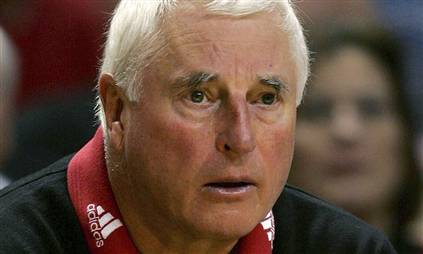
I’ve found this year’s NBA playoffs to be riveting, though I’m sure Bobby Knight would not agree. The General made his opinion of NBA basketball clear several years ago when he uttered these famous words:
“If the NBA were on channel 5 and a bunch of frogs making love were on channel 4, I’d watch the frogs, even if they were coming in fuzzy.”
Here’s a bonus clip of Knight’s top ten sounds bites.
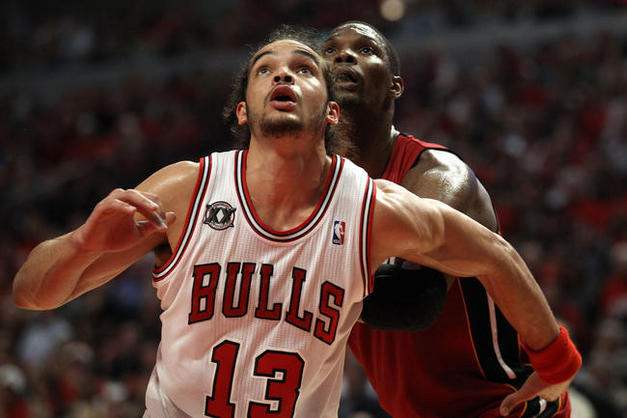
One of the key matchups in the Eastern Conference Finals between the Heat and Bulls has been Chris Bosh against Joakim Noah. On paper Bosh is the better player. The six-time All-Star has averaged 20 points and 9.2 rebounds for his career, though his numbers took a hit this season as he deferred to LeBron James and Dwayne Wade.
Noah, on the other hand, has yet to make an All-Star team and posts just 8.5 points and 8.4 rebounds for his career. This was his best statistical season, in which he averaged 11.7 points, 10.4 rebounds and 1.5 blocks per game. The Bulls center is a superior defender and excellent passer. His greatest value lies in the intangibles he brings to the court, specifically his infectious energy.
The two big men have guarded each other at times during the current series. Bosh has been the better offensive player, scoring at a rate of 24 points per game and carried the Heat offensively during stretches of Game 3 when Noah was in foul trouble. Yet, Noah has exceeded Bosh in just about every other statistical category, including; rebounds, blocks, steals and assists. His passing out of the high post and help defense has been particularly impressive.
Bosh and Noah are both in their prime, ages 27 and 26 respectively. Bosh has the name and the numbers, but Noah’s value to the Bulls is immeasurable. Which one would you rather have on your team?
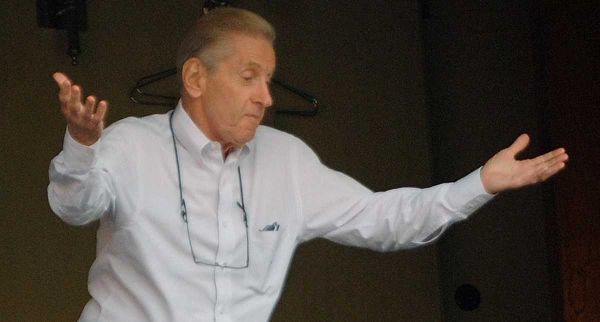
The New York Mets have hit rock bottom. Team owner Fred Wilpon is being sued for more than $1 billion by the trustee who’s recovering money obtained fraudulently through Bernie Madoff’s Ponzi Scheme. Desperate for an infusion of cash, Wilpon’s been seeking an investor to purchase a minority share of the team for a reported $200,000.
Meanwhile, the Mets are languishing in fourth place, appear to have no direction as a franchise and attendance is down at Citi Field. Just when it seemed the situation couldn’t get much worse for the Mets and their owner, Wilpon bashed his best players and devalued the very franchise he’s trying to sell, in an interview with Jeffrey Toobin for an article to be published in the The New Yorker.
Wilpon took shots at three of the Mets biggest assets, right fielder Carlos Beltran, shortstop Jose Reyes and third baseman David Wright. He said of Reyes, who’s in the final year of his contract: “He thinks he’s going to get Carl Crawford money,” referring to the seven-year, $142 million contract Crawford signed with the Red Sox this past winter. “He’s had everything wrong with him. He won’t get it.”
Wilpon referred to himself as a “schmuck” for signing Beltran to his current seven-year, $119 million contract following a great post-season with the Astros in 2004. He added that Beltran, who is coming off knee surgery, is “65 to 70 percent of what he was” and also reportedly mocked Beltran by pantomiming the outfielder’s check swing in the ninth inning against Adam Wainwright in Game 7 of the 2006 NLCS, which ended the series.
Of David Wright, the face of the franchise, Wilpon said: “Really good kid. A very good player. Not a superstar.” The owner did speak positively about first baseman Ike Davis, though he slammed the team in the process: “Good hitter – shitty team – good hitter.”
Mets fans have been speculating for months that the team would move Beltran and possibly Reyes before the trade deadline. Beltran isn’t the player he once was, but is still a solid switch hitter who could contribute to a contending team and Reyes is likely going to demand a lot of money for a injury-prone player. So what Wilpon said came as no surprise, but why say it? There’s a reason why it’s common practice for baseball team’s to discuss player evaluations and personnel decisions internally. By implying that Reyes and Beltran will not be back in Queens next season, he severely diminished GM Sandy Alderson’s leverage in trade talks.
Wilpon may be correct about Wright as well. Over the past few seasons the third baseman hasn’t performed like the superstar the Mets expected him to be. He has however, been a very good player, an exemplary representative for the franchise and a gamer who just played for a month with an undiagnosed broken back. Not only does he deserve better, but why would Wilpon antagonize one of only two marquee players on the team – Johan Santana being the other – likely to be wearing a Mets uniform next season. Wright, characteristically, responded with class: “Fred is a good man and is obviously going through some difficult times. There is nothing more productive I can say at this time.”
Wilpon’s comments are particularly perplexing because he’s not a novice, unaccustomed to dealing with the media. He and Nelson Doubleday Jr. became co-owners of the team in 1986 and Wilpon bought Doubleday out to be become the sole owner in 2002. He also doesn’t have a history of making controversial statements or criticizing his players publicly, like a recently deceased owner across town. The most likely explanation is that the stress he’s under from the Madoff fallout has affected his judgment and possibly his mental well-being.
Toobin’s piece in The New Yorker was supposed to help restore Wilpon’s image and even includes quotes from Madoff himself, exonerating his old friend of any responsibility for the Ponzi Scheme. It reportedly portrays Wilpon as a bright businessman, though the owner’s own words point to the contrary. Wilpon supposedly referred to his franchise as “snakebitten,” but it’s the people who lost their life savings to his benefit that were “snakebitten.” The Mets are just run by a fool.
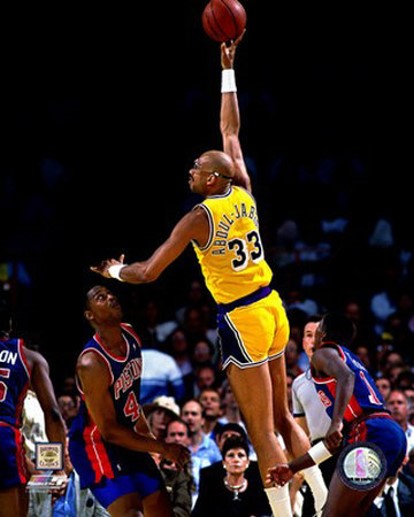
In case you haven’t heard, former Laker great Kareem Abdul-Jabbar is irked that the Lakers haven’t built a statue of him in front of the Staples Center. “I don’t understand (it),” the leading scorer in NBA history told the Sporting News this week. “It’s either an oversight or they’re taking me for granted. I’m not going to try to read people’s minds, but it doesn’t make me happy. It’s definitely a slight. I feel slighted.”
I know, it sounds ridiculous. But there are very few people in the world who can complain that there hasn’t been a statue built of them and actually be taken seriously. Abdul-Jabbar is one of them. I don’t intend to enter into a discussion as to what makes one statue worthy, though since the Lakers have built them for former players, it’s puzzling that Kareem hasn’t been included. Not only is he deserving, but there may not be a more statuesque image in sports than #33 releasing his patented hook shot.
There are currently five statues in front of the Staples Center: Earvin “Magic” Johnson, Jerry West, longtime Laker announcer Chick Hearn, Wayne Gretzky and Oscar De La Hoya. Gretzky and De La Hoya played other sports and Hearn was an announcer. Abdul-Jabbar made it clear that he believes West and Magic deserve their statues. He believes he deserves one as well. Magic agrees with him. Kareem’s former teammate tweeted yesterday that he “deserves and has earned a statue, even before me.”
Abdul-Jabbar’s credentials are impeccable. He was the greatest college basketball player ever, leading UCLA to three national titles (at a time when freshmen weren’t eligible to play). He went on to win six NBA championships (five with the Lakers) and was named league MVP a record six times, as many as Magic and Larry Bird combined. The big man was selected to a remarkable 19 All-Star games and remains the all-time leading scorer in NBA history.
Abdul-Jabbar admitted that President of the Staples Center, Tim Leiweke, told him he would be next to receive a statue, though he’s not very optimistic. He tweeted on Wednesday, “Rumor has it that I will be getting a statue. A caveat for all my fans – don’t hold your breath. Lakers don’t care about me.”
Obviously, as the former Laker captain tweeted yesterday,”This is not just about a statue, its about being appreciated by the people that I worked so hard for. The statue was just the last straw.” Yesterday morning he elaborated on several incidents with the Lakers during a revealing interview on ESPN’s “Mike & Mike In the Morning.”
Kareem expressed bitterness that the team didn’t help him land a job when he first disclosed an interest in coaching in 1994. They eventually hired him as an assistant coach in 2005, though he was never one of Phil Jackson’s top guys and didn’t even sit in the front row of the bench with the other coaches and players. He’s angry that the team asked him to take a reduction in salary last year and was insulted when told to sit in a small cramped seat towards the back of the plane during the Lakers series against the Magic in the 2009 NBA Finals, though there were more spacious seats available up front.
In general, he feels like the franchise hasn’t compensated him the way they have other former stars. He stated on “Mike & Mike,” “When you look at what he [Lakers owner Dr. Jerry Buss] did for Earvin and what he’s done for me. Big disparity.” Magic was given part ownership of the team, an upper office position and was head coach for a short time, while it took Kareem years to get hired as a second tier assistant.
It’s difficult to argue with Kareem’s assessment that he’s underappreciated by the Lakers. In fact, he may be the most underappreciated athlete in American sports. He’s the NBA’s all-time leading scorer and his sky hook was the most indefensible shot the league has ever seen. Yet, he’s an afterthought in most discussions about the greatest basketball player of all-tome. No team’s willing to even consider him as a head coach and he’s not the subject of countless books and documentaries like his contemporaries Magic and Bird.
Unfortunately, Kareem brought this lack of respect and near banishment upon himself. He was distant and condescending toward teammates and coaches and his disdain for the media, the individuals who shaped his public persona, was legendary. Jordan understood the power of media. Magic’s statue is as much a testament to his smile as his game. Kareem, on the other hand, was known to read the paper while conducting post-game interviews.
Is it any wonder that team executives don’t view him as coaching material or that the media doesn’t reminisce about him the way they do with Magic and Jordan? Is it really surprising that Laker executives aren’t falling over themselves to build a statue of the likeness for a player who was almost universally disliked?
Kareem is very intelligent and introspective, so it was fascinating to hear him reflect on the perception people have of him during “Mike & Mike.” He’s self aware enough to recognize that “people think that I don’t like people.” He said he’s always been shy and reclusive, and in retrospect can see how that gave people the wrong impression. He also noted that his coach at UCLA, the legendary John Wooden, discouraged players from speaking to the press which led him to distrust the media and give them the cold shoulder. He admitted that if he could do his career over again he would handle things differently and now encourages his protege, Lakers center Andrew Bynum, to deal with the media in a more positive manner.
His demeanor during the interview with “Mike & Mike” reaffirmed Kareem’s description of himself. It was obvious from his body language and the way he fidgeted with his hands that he’s still painfully shy and uncomfortable doing interviews. I don’t think he smiled once during the nearly hour long interview, much of which revolved around a movie he produced called On the Shoulders of Giants, which he’s clearly passionate about.
Kareem may be justified in his belief that he’s underappreciated by the Lakers; the problem is how he chose to deal with it. He should have addressed his various grievances with the organization as they arose, instead of letting them build up until he exploded with anger over twitter. Calling out management publicly made him appear pompous, petty and somewhat cowardly. He also did himself a disservice by igniting this firestorm right before embarking on a media tour to promote his movie. He’s still a poor communicator and continues to rub people the wrong way.
Just about every basketball fan and member of the basketball media agrees that Kareem deserves a statue alongside Jerry West and Magic Johnson, and the Lakers will likely comply in the next few years. But what the big man still doesn’t understand, in spite of his self-reflection, is that the Lakers haven’t built a statue of him precisely because he’s the kind of man who would complain publicly that a statue hasn’t been built for him.
Tonight the NBA will hold its annual draft lottery to determine which team will have the first selection in the 2011 Draft, scheduled to take place on June 23rd at the Prudential Center in Newark. Every team that didn’t make the playoffs has a chance to win the No. 1 pick. The worse a team’s record, the greater their odds of getting lucky.
The NBA lottery system began in 1985, with the Knicks winning the first pick and the right to draft the highly touted center from Georgetown, Patrick Ewing. No. 1 picks have had varying degrees of success in the NBA. Some have fulfilled expectations and gone on to legendary careers and some have been simply solid contributors, while others have been complete busts.
This is a ranking of the careers of the 26 first overall picks in the NBA Draft since the lottery system was implemented. It’s based on what they’ve accomplished thus far, not career projections.
26. Greg Oden, Portland Trailblazers (2007) – There are 82 games in a season. That’s how many games Oden has played with the Trailblazers – over four seasons. It’s deja vu all over again for a franchise that drafted injury-riddled centers Bill Walton and Sam Bowie with the first pick. GM Kevin Pritchard lost his job for taking Oden instead of Kevin Durant.
25. Michael Olowokandi, Los Angeles Clippers (1998) – The “Kandi Man” never developed a low-post game and often looked lost on the court. Over nine seasons, he averaged a measly 8.3 points per game and is looked upon as one of the biggest busts in league history.
24. Kwame Brown, Washington Wizards (2001) – Michael Jordan’s folly has shown minimal improvement in his game over ten seasons in the league. He’s been booed out of a few cities due to lack of commitment and a combative attitude, though he was a solid contributor off the bench for the Bobcats this season, delivering 7.9 points and 6.8 rebounds per game.
23. Pervis Ellison, Sacramento Kings (1989) – “Never Nervous Pervis” had a couple of very good seasons early in his career with Washington, but bad knees rendered him ineffective for the majority of his 12-year career. Averaging just 9.5 points and 6.7 rebounds in a career is not what one would expect from a No. 1 selection.
22. John Wall, Washington Wizards (2010) – Wall had an impressive rookie season for the lowly Wizards, averaging, 16.4 points and 8.3 assists. The kid is just 20-years-old and his ceiling is unlimited. How high he climbs will depend on his work ethic, attitude and his jump shot.
21. Joe Smith, Golden State Warriors (1995) – Smith is a high energy guy with a reliable mid-range jumpshot and has been a solid role player throughout his career. But Golden State was expecting more than 10.9 points and 6.4 rebounds per game from this average Joe.
20. Andrea Bargnani, Toronto Raptors (2006) – Toronto was hoping to land the next Dirk Nowitzki when they selected this seven-foot Italian with a feathery touch. He’s no Dirk, but he did flourish as the team’s number one option this season to the tune of 21.4 points per game.
19. Kenyon Martin, New Jersey Nets (2000) – Early in his career, Martin was a key component of a Nets team that made back-to-back trips to the NBA Finals, but he never became the force that many people projected. After a series of knee injuries, little remains of the jumping ability that once made him an outstanding defender.
18. Andrew Bogut, Milwaukee Bucks (2005) – Bogut’s a fundamentally sound big-man who’s improved each year in the league. He’ll never be a superstar, though he contributes 15 points and 10 rebounds a game. Unfortunately, it’ll likely continue to come in the relative obscurity of Wisconsin.
17. Blake Griffin, Los Angeles Clippers (2009) – Griffin put to rest any concerns about his health following a severe knee injury in 2009. The most explosive big man to enter the league in many years is on his way to a Hall of Fame career, barring injuries. But he has to do it for more than one season to move his way up this list.
16. Derrick Coleman, New Jersey Nets (1990) – DC was a tremendous talent, but laziness and an uncontrollable ego derailed his career. He averaged over 20 points and 10 boards per game for three consecutive seasons, with minimal effort. He ultimately ate himself out of the league after just five games with the Pistons in 2004.
15. Glenn Robinson, Milwaukee Bucks (1994) – The “Big Dog” was an elite during his 10 years in the league. However, the former Purdue star never developed the other aspects of his game and earned a reputation as a selfish player.
14. Larry Johnson, Charlotte Hornets (1991) – “Grandmama” was a ferocious interior presence during his first few seasons before a back injury curtailed his explosiveness. The 1992 NBA Rookie of the Year was a two-time All-Star with the Hornets and utilized an array of post moves to help the Knicks advance to the NBA Finals in 1999.
13. Danny Manning, Los Angeles Clippers (1988) – Manning was a great athlete with long arms who could beat you in many ways. The MVP of the 1988 Final Four for Kansas made the All-Star team twice, but was hampered by bad knees throughout his career and was forced to retire after scoring just 34 points in the 2004 season.
12. Elton Brand, Chicago Bulls (1999) – For several seasons you could mark him down for 20 points and 10 rebounds a night. However, the two-time All-Star hit a wall when he signed with the 76ers in the summer of 2008 and he hasn’t been the same player since.
11. Yao Ming, Houston Rockets (2002) – Fans have already forgotten how good Yao was before injuries ruined his career. He averaged 25 points per game during the 2006-2007 season and could be depended on for 10 rebounds and a couple blocks per game.
10. Brad Daugherty, Cleveland Cavaliers (1986) – Daugherty was a consistent 20-10 performer for a very good Cavs team in the early 1990s. He was selected to five All-Star teams before recurring back problems forced him to retire at the age of 28.
9. Derrick Rose, Chicago Bulls (2008) – At 22 he was the youngest MVP in league history and you can make an argument that he’s already the best player in the game. If he can lead the Bulls to a championship this season he’ll climb a few spots higher.
8. Chris Webber, Orlando Magic (1993) (Traded to Golden State Warriors on Draft Day) – C-Webb never won that elusive ring, but he was the centerpiece of some great Sacramento teams in his prime. He’s one of only six players in NBA history to average 20 points, nine rebounds and four assists a game for his career.
7. Dwight Howard, Orlando Magic (2004) – He’s the most intimidating force in basketball and won Defensive Player of the Year for the third consecutive time this season. And to think the Magic were considering drafting Omeka Okafor instead. Ultimately, his legacy will hinge on whether he wins a championship.
6. Allen Iverson, Philadelphia 76ers (1996) – Only five players in NBA history averaged more points per game for their career than A.I.’s 26.7. “The Answer” led the league in scoring four times and carried the 76ers to the NBA Finals in 2001.
5. Patrick Ewing, New York Knicks (1985) – Ewing was the best shooting center the league’s ever seen and in 1996 was named one of the 50 greatest NBA players of all-time. Though he never won a championship, he led the Knicks to 13 consecutive playoff appearances and made 11 All-Star teams.
4. David Robinson, San Antonio Spurs (1987) – The Admiral teamed up with Tim Duncan to win two championships near the end of his career. A force on both ends of the floor, Robinson was named Defensive Player of the Year in 1992 and won the league MVP in 1995. All this after being forced to sit out his first two seasons in order to honor his commitment to the U.S. Navy.
3. LeBron James, Cleveland Cavaliers (2003) – LeBron is the prototype for a basketball player. His combination of size, strength, quickness, athleticism and intelligence is unparalleled. The only thing missing from his resume is a ring and he could take care of that in the next few weeks.
2. Shaquille O’Neal, Orlando Magic (1992) – Shaq has lived up to the hype that surrounded him when he left LSU. With the exception of Chamberlain, the Diesel is the most dominant big man to ever step on a basketball court. He was an unstoppable force for a decade and a half, winning four championships along the way.
1. Tim Duncan, San Antonio Spurs (1997) – This unheralded superstar may be the best player of the post-Jordan era. The Big Fundamental has won four rings and two MVP awards and is considered by many basketball insiders to be the greatest power forward in the history of the game.
Basketball is a young man’s game. That’s never more evident than during the playoffs after a grueling 82 game season. A basketball player’s prime is typically between the ages of 25-27 and 30-33, so when superstars on the top teams hit their early to mid thirties their teams drop from the ranks of the championship contenders and young stars rise to take their place. The transition of power is usually gradual, but this NBA post-season has seen the most abrupt changing of the guard in a long time.
Since the 1990’s the Lakers and Spurs have been the dominant franchises in the NBA, with the Celtics joining them over the past four seasons. Led by Shaquille O’Neal and later Kobe Bryant, the Lakers won 5 championships between 2000 and 2010, including back-to-back titles as recently as 2009 and 2010. Tim Duncan’s Spurs won four titles over that span and the Celtics big three of Kevin Garnett, Ray Allen and Paul Pierce carried the Celtics to two NBA Finals, winning the championship in 2008.
The Celtics knew they had a small window when they acquired Allen and Garnett in the summer of 2007. Garnett was 31, Allen 32 and Pierce about to turn 30. The “Big Three” won a championship in their first season together, then Garnett injured his knee the following year and they were bounced in the second round by the Magic. Garnett recovered and Boston pushed the Lakers to Game 7 in the NBA Finals last season.
The Big Three and coach Doc Rivers returned for one final run, but a younger, more athletic Heat team ran them off the court in the second round this year. The Celtics may have extended the series beyond five games if Rajon Rondo had been healthy, but it was obvious Boston’s time had passed. Garnett especially looked old and tired throughout the series, with the exception of Game 3. Allen’s decline has been minimal and Pierce’s game was never built on speed to begin with, but Garnett was the linchpin of their trademark defense. He turns 35 this week, Allen 36 this summer and Pierce 34 in October. GM Danny Ainge will try and add a more athletic supporting cast next season, but realistically, the Celtics championship window has closed.
San Antonio won their last ring in 2007, when they swept LeBron’s Cavaliers, though they’ve remained one of the elite teams in the league since. Just when most people wrote them off as a serious title contender, coach Gregg Popovich installed a new offense, which propelled the Spurs to the number one seed in the Western Conference this season. However, come playoff time, all of Manu Ginobili’s crafty moves and Tony Parker’s quickness couldn’t hide the fact that the anchor of the interior defense that led them to four championships, Tim Duncan, looked like a dinosaur. He may be the greatest power forward of all-time, but the 35-year-old was embarrassed in the first round by the Grizzlies big men Marc Gasol and Zach Randolph.
Perhaps the most surprising turn of events in the playoffs has been the two-time defending champion Lakers being swept in the second round by the Mavericks. With Phil Jackson on the bench, Kobe Byrant and three talented big men in Andrew Bynum, Pau Gasol and Lamar Odom, the Lakers seemed a near lock to return to the NBA Finals. Sure, they looked sluggish at times during the regular season, but they’ve turned it on in the post-season before.
Kobe had a typical Kobe season, averaging 25 points per game, but he appeared to age before our eyes in the Mavs series. The greatest player of the past decade turns 33 this summer and he has a lot of mileage on those legs. Don’t forget, he entered the NBA straight out of high school at the age of 18 and with the Lakers advancing to the finals seven times over his 15-year career, he’s played 208 playoff games.
It was evident during the Mavs series that he didn’t have the same lift on his jump shot and wasn’t able to get to the rim. He’s still one of the best players in the league, but he’s no longer the best and his days of being the primary threat on a championship team are likely over. You can be sure that was a factor in Phil’s decision to call it quits.
Among the three teams, the Lakers have the best chance to regroup, shake up the roster and make another run at a ring. The Spurs and Celtics have their money locked up in aging stars and lack the pieces to acquire an additional great player. The Lakers on the other hand have a few things going for them. One, their early exit appeared to be due as much to chemistry issues as fatigue and that can be fixed. Two, because they have three talented big men who are either in or entering their prime, they will be in the running to acquire one of three potential stud free agents next summer, Chris Paul, Deron Williams and Dwight Howard. Three athletes like to live and play in L.A. There’s already speculation that Howard wants to be a Laker as well as Thunder point guard Russell Westbrook.
With the Lakers, Spurs and Celtics out of the way, the Dallas Mavericks, Oklahoma City Thunder, Chicago Bulls and Miami Heat advanced to the conference finals. The Mavs are a part of the old guard. Led by 10-time All-Star Dirk Nowitzki, they’ve won 50 games in each of the past 11 seasons and made it to the 2006 NBA Finals. They’re not a great team, but there’s no great team in the league this year. They may be good enough to steal championship in this transitional season if the new guard isn’t quite ready to grab the torch. However, Dirk will be the 33 this summer and the majority of their nucleus is in their early and in Jason Kidd’s case, late 30’s. If they do win a championship this year, don’t expect them to repeat.
The Thunder, Bulls and Heat are the new elite, the Lakers, Spurs and Celtics of the next five to seven years. The Heat are the most celebrated of the new superpowers, with the two best players in the world in James and Dwyane Wade. The two stars dominated the perimeter against Boston like nobody since Jordan and Pippen. At 29, Wade is in his prime and the 26-year-old James has several stupendous seasons ahead of him. Let’s not forget their other perennial All-Star, Chris Bosh. Even if they don’t break through this season it’s a safe bet that they’ll win multiple rings over the next five years.
The Bulls took the league by storm this season under new coach Tom Thibodeau’s defensive instruction, winning a league high 62 games. MVP Derrick Rose may be the greatest athlete to ever play the point guard position and at 22-years-old has plenty of room to improve on the accuracy and range of his jump shot, as well as his defensive. He and double-double machine Joakim Noah set the tone with their scrappy play and will be the cornerstones of the franchise for the next decade.
Small forward Luol Deng is extremely versatile and is still just 26-years-old. Last summer’s free agent acquisition Carlos Boozer has been a bit of a disappointment, though he’s struggled with a toe injury in the playoffs. The Bulls have other solid young role players in Taj Gibson and Omer “Asik and destroy.” They may be a shooter away from a championship, though they’ll be a beast in the East for many years to come.
The last of the new super powers is Oklahoma City, with their two-headed monster of Kevin Durant and Russell Westbrook. Durant led the league in scoring for the second consecutive season and it’s easy to forget that he’s only 22-years-old. Westbrook benefited tremendously from his time with the U.S. National Team last summer and much like Rose, brings astonishing athleticism to the point. The Thunder locked up Durant with a long term contract last summer and if they can do the same with Westbrook the dynamic duo will take carry the Thunder to great heights.
The Thunder aren’t just a two man show either. General Manager Sam Presti has done an excellent job of adding complimentary parts around his two stars. Power forward Serge Ibaka is a superb athlete and has developed into one of the best shot blockers in the league. At 21, he’ll to continue to improve. James Harden can fill it up off the bench and the mid-season acquisition of Kendrick Perkins brought the Thunder much needed toughness and a veteran presence with championship experience in the locker room.
The Lakers, Spurs and Celtics will continue to put up a fight in the early rounds of the playoffs. They’re too proud not to. But their championship window has closed. Kobe, Garnett and Duncan are growing old. The transition to the new masters of the NBA universe is under way. Dwight Howard, Chris Paul, Deron Williams, Blake Griffin, a young Grizzlies team and the revamped Knicks are among those who will look to put their stamp on the league. However, barring drastic player movement or injuries, it’s Rose, Durant and James’ league now. These conference finals are a preview of years to come.
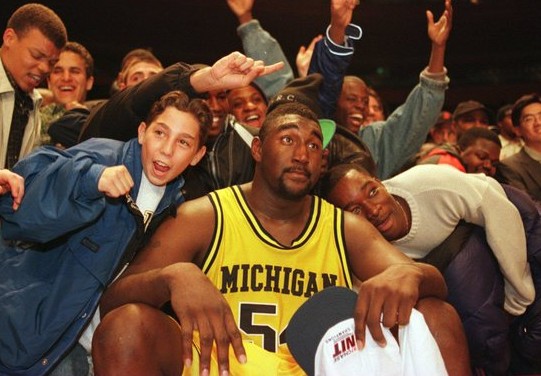
Robert “Tractor” Traylor was a freshman at the University of Michigan the same year I was. The six-foot-eight, 300 pound center was literally and figuratively the big man on campus. His career was marked by disappointment and scandal, but the Michigan faithful loved him any way. He died Wednesday of a heart attack at the age of 34.
Traylor was a McDonald’s All-American during his senior season at Murray-Wright High School in Detroit. He stepped on campus in the fall of 1995 as the coach Steve Fisher’s prized member of a stellar recruiting class. The year before, Fisher landed five freshmen, including Jerod Ward, Maceo Baston and Maurice Taylor, who were touted as the next Fab Five. Michigan fans thought another trip to the Final Four was imminent.
On a team replete with pro prospects Traylor stood out from the pack. My eyes were always drawn to him when he was on the court. He had tools that can’t be taught and make scouts drool; quick feet, soft hands and tremendous agility for his size. It was awe-inspiring to watch this mammoth of a man pick a guy’s pocket, scurry after the loose ball, then dribble down the court and finish with a thunderous dunk. His combination of size and athleticism reminded me of a young Charles Barkley.
Traylor dunked so hard that you half expected the backboard to come down. One night it did. During Michigan’s 1996 season opener against Ball State he shattered the backboard at Crisler Arena on a breakaway dunk. The big man didn’t run for cover. He stood in the paint admiring his work as the glass rained down on him.
Traylor’s size, talent and marketable nickname quickly made him the face of the Wolverines. His love for basketball and infectious exuberance endeared him to his teammates and fans. Number 54 smiled often during games and I recall on more than one occasion him literally skipping down the court to embrace his teammates after a big play.
Midway through his freshman year, Traylor was behind the wheel when a few Michigan players and high school senior Mateen Cleaves got into a car accident during Cleaves’ recruiting visit. Traylor broke his wrist in the accident, though the damage had only just begun. Reporters began asking questions about how a poor kid from Detroit could afford a pimped out Ford Explorer. A six-year investigation revealed that Traylor and other Michigan players accepted in excess of $600,000 from a booster named Ed Martin. The school received two years probation and was stripped of NIT and Big Ten titles won during Traylor’s time there.
Traylor and his teammates were also disappointing on the court. Their greatest accomplishment was winning the NIT tournament in 1997 – Traylor was named tournament MVP – hardly a crowning achievement for a school with Michigan’s expectations. The Wolverines did win the inaugural Big Ten Tournament in 1998, but failed to advance past the second round of the NCAA Tournament.
On a personal level, Traylor had a very impressive junior season and declared for the 1998 NBA draft. The big man averaged 16.2 points and 10 rebounds per game while shooting 58% from the field. He would have scored more had there not been several other scorers on the team. During his three years in Ann Arbor he learned to use his size more effectively and developed some semblance of a post game.
NBA scouts took notice. Most believed that based on his rare combination of size and athleticism he had plenty of room to continue to improve. The Dallas Mavericks selected Traylor with the sixth pick in the draft and immediately traded him to Milwaukee for Pat Garrity and the ninth pick, some German named Dirk Nowitzki.
Traylor was a bust in the NBA. He averaged a measly 4.8 points and 3.7 rebounds per game over seven seasons with Milwaukee, Cleveland and the Hornets. He lacked the work ethic to go along with his talent and never took conditionally seriously. Tractor Traylor would have always been a big man, but he could have slimmed down significantly, like Celtics forward Glen “Big Baby” Davis. He also never developed the post-game or jump shot to necessary to become an offensive threat. His NBA career is best remembered as the answer to the trivia question: Who did the Mavs trade for Nowitzki?
After the NBA Traylor played pro ball in Europe for a few years. Over the past couple of seasons he took his game to Puerto Rico, which is where he died. He left behind a wife, two children and a complicated legacy. Tractor Traylor ignited a scandal which my alma mater still hasn’t fully recovered from and his career was a tremendous disappointment, but I’ll always remember him as a uniquely gifted athlete who enjoyed playing basketball as much as I enjoyed watching him.
In today’s digital age every significant sports moment is tweeted, posted on Facebook and Youtube and replayed on highlight shows for days on end. Yet, there’s something sublime about capturing the essence of a moment in a photograph, especially in the pastoral game of baseball, whose golden years predated television and the digital camera. Classic baseball images immediately evoke specific memories or emotions in fans.
It’s not necessarily the greatest moments which produce the most iconic pictures and not every landmark achievement has a definitive photo associated with it. For example, while there are many great shots of Cal Ripken breaking Lou Gehrig’s streak, no quintessential photograph has emerged, though one may in time. Certain memorable play-by-play calls lack an instantly recognizable accompanying image, such as Bobby Thompson’s “shot heard round the world.” Sometimes a classic photo emerges from a fairly routine play.
This is my list of the 15 most iconic baseball photographs.
15) A Record Tarnished
On August 7, 2007 at 8:51 pm PDT, Barry Bonds hit career home run 756 off of Mike Bacsik of the Washington Nationals. No photo is more representative of the steroid era and the confusion and anger it created among fans.
14) The Greatest of All-Time
On May 1, 1991, Rickey Henderson stole his 939 base to pass Lou Brock as the stolen base king and as he so eloquently put it become “the greatest of all-time.” He finished his career with a remarkable 1,406 stolen bases.
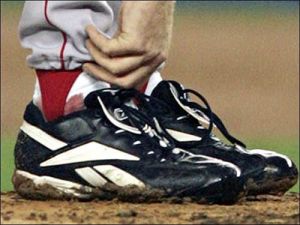
13) The Bloody Sock
Curt Schilling beat the Yankees in Game 6 of the ALCS despite a torn tendon in his ankle sending the series to seventh game in what was an historic comeback by the Red Sox. Even though it occurred in the ALCS, Schilling’s bloody sock is the quintessential image of the Sox winning the World Series and ending their 86 year drought.
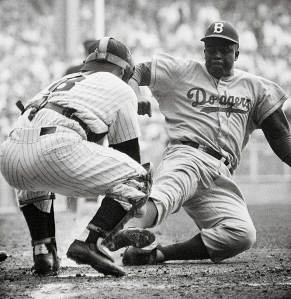
12) Jackie Stealing Home
In the most discussed and debated play of Jackie Robinson’s illustrious career, the Dodgers second baseman stole home off of Whitey Ford in the 8th inning of Game 1 of the 1955 World Series. The Yankees held on to win the game 6-5, but the Dodgers came back to beat their crosstown rivals in the series for the first time. Fifty-six years later catcher Yogi Berra still swears that Robinson was out.
11) “I don’t believe what I just saw!”
Kirik Gibson’s stunning pinch-hit blast off Dennis Eckersley in Game 1 of the 1988 World Series is best known for Jack Buck’s legendary call, though every baseball fan knows the image of a gimpy Gibson pumping his fist as he rounds first base.
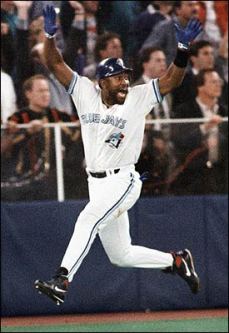
10) “Touch em all Joe, you’ll never hit a bigger home run in your life!”
The Blue Jays were trailing the Phillies 6-5 in the bottom of the ninth inning with one out in Game 6 of the 1993 World Series, when Joe Carter hit a walk-off three-run home run off Mitch Williams to win the series. Carter joined Bill Mazeroski as the only players to end a world series with a home run.
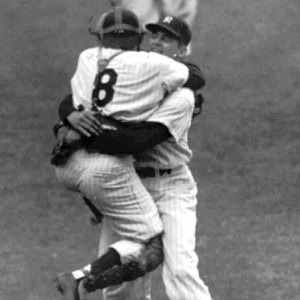
9) Don Larsen’s Perfect Game
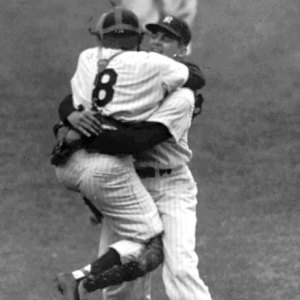
Yankee hurler Don Larsen tossed a perfect game in Game 5 of the 1956 World Series against the Brooklyn Dodgers. No other pitcher has even thrown a no-hitter in the World Series. This classic photo shows Larsen’s catcher Yogi Berra jumping into his arms after the last out.
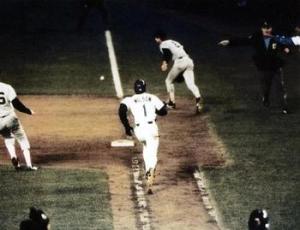
8) The Ball goes through Buckner’s legs
People forget that the Mets had already come back from two runs down with two outs and nobody on in the bottom of the tenth inning in Game 6 of the 1986 World Series before the ball went through Buckner’s legs. Still, Buckner’s error on Mookie Wilson’s grounder was devastating more than any other player came to symbolize the Red Sox 86 years of futility.
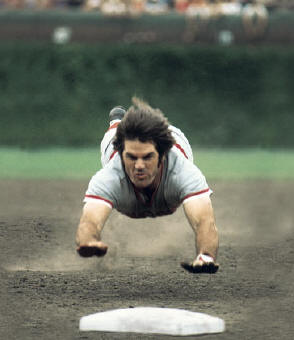
7) Charlie Hustle
Pete Rose had plenty of noteworthy moments in his career, from base hit 4,192 to bowling over Ray Fosse in the 1970 All-Star Game. Though no photograph is more representative of the career of the man known as Charlie Hustle than the above picture.
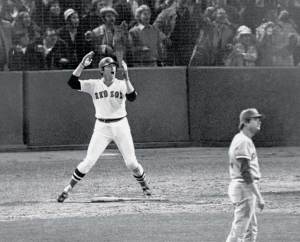
6) Fisk Waves it Fair
Perhaps no image better captures the passion and suspense that is post-season baseball than Carlton Fisk waving the ball fair in the bottom of the 12th inning in Game 6 of the 1975 series. The ball tucked in just to the right of the foul pole, over the Green Monster, sending the series to Game 7, where the Sox eventually lost to the Big Red Machine.
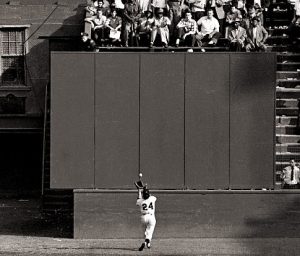
5) The Catch
Considered by many to be the greatest play they’ve ever seen, Willie Mays’ catch at the Polo Grounds off the bat of Vic Wertz in Game 1 of the 1954 series between the Giants and Indians has become the enduring symbol of his greatness. The throw after the catch to keep the runner scoring was even more impressive.
4) Joltin Joe’s Streak
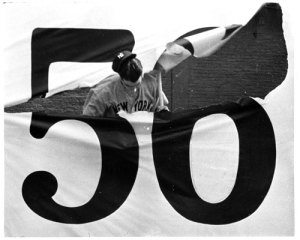
There’s no greater testament to Joe DiMaggio’s record 56 game hitting streak than the fact that it still stands 70 years later. In fact, nobody has even come close to matching it. This shot of the Yankee Clipper breaking through the 56 banner has become the enduring image of his achievement.
3) The All-Time Home Run King
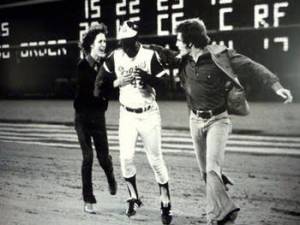
These fools are two of the most famous fans in sports and nobody even knows their names. Seriously, any shot of Hank Aaron circling the bases after breaking the most revered record in sports seems incomplete without them. Hammerin Hank’s historic 715th home run came off of Dodgers pitcher Al Downing on April 8, 1974.
2) The Babe Says Goodbye
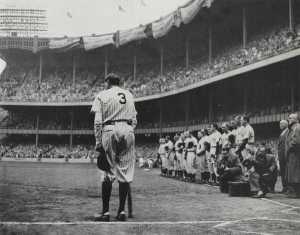
April 27, 1947, was Babe Ruth day at Yankee Stadium and throughout the country. His body ravaged by throat cancer, Ruth said goodbye to the house that he built. He died just over a year later. Ironically, this shot from behind of a weakened, hunched over Babe remains the lasting image of such an effervescent and powerful man.
1) The Luckiest Man on the Face of the Earth
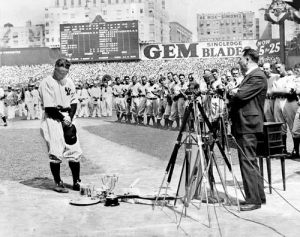
The Iron Horse built a career on courage and grace, though it wasn’t until he was forced to walk away from the game that he showed us the true depth of his spirit. Gehrig stood before Yankee fans and the world knowing that at the age of 36 he faced certain death and declared “Today I consider myself the luckiest man on the face of the earth.”
Ever see footage or hear a sports fan waxing poetic about a classic sporting event and find yourself wishing you could have been there in person, taking in the sights and sounds, riding the emotions of the crowd? Suspend belief with me for a moment and assume you could travel space and time to sit in the stands for any legendary contest or remarkable individual achievement. Which event would you choose? Here’s my list of the top 20 sporting events I wish I had attended.
20) The Ball Goes Through Buckner’s Legs
It wasn’t just the Buckner play that made the game so fantastic. People forget that the Mets rallied from two runs down, with two outs and nobody on base in the bottom of the tenth inning, an elimination game for them, before Mookie Wilson’s grounder rolled through Bill Buckner’s legs. Shea Stadium was rocking.
19) Game 6 of the 1980 NBA Finals
League MVP Kareem Abdul-Jabbar went down with an ankle injury in Game 5 and though the Lakers went on to win the game and take a 3-2 lead over the 76ers, the situation looked bleak without their captain. Magic Johnson was just a 20-year-old rookie, but he was fearless. The point guard started at center for the Lakers in Game 6 and erupted for 42 points, 15 rebounds and 7 assists.
18) Don Larsen’s Perfect Game
You know the quiet tension in a stadium when a pitcher is working on a no-hitter late in a game? Imagine the final innings of a perfect game in Game 5 of the World Series between crosstown rivals the Yankees and Brooklyn Dodgers. The man affectionately known as Gooney Bird remains the only pitcher to throw a no-hitter in the World Series, never mind a perfect game.
17) Brazil Wins Its Third Consecutive World Cup
Brazil’s defeat of Italy in the 1970 World Cup Final in Mexico may have been the pinnacle of the greatest soccer team ever assembled. Pele, Clodoaldo, Rivelino and Tostao played with a fluidity and improvisation that was beautiful to watch. The highlight of the game was Carlos Alberto’s “wonder goal,” considered by some historians to be the greatest goal ever.
16) Connors Outlasts Krickstein
The way that Jimmy Connors and the crowd fed off of each others energy during his remarkable run to the 1991 U.S. Open Semi-finals was simply magical. I could have picked the 39-year-old Connors first round comeback against Patrick McEnroe or his epic battle against Paul Haarhuis, but his marathon victory over Aaron Krickstein in a fifth-set tie-breaker was the most unlikely and impressive of the bunch.
15) Louis Knocks Out Schmeling
Joe Louis lost his first bout with Germany’s Max Schmeling in 1936, but two years later he avenged the loss with a first round knockout in Yankee Stadium. The fight lasted just two minutes and four seconds, but the Brown Bomber’s knockout was a blow to the theory of Aryan superiority and invoked a sense of pride in Americans of all colors.
14) Wilt Scores 100
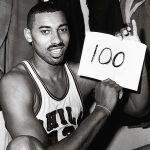
The date was March 2, 1962. The incomparable Wilt Chamberlain of the Philadelphia Warriors scored an even 100 points against the New York Knicks. That’s without the benefit of a three point line. It’s considered among the most dominant performances in any sport.
13) Jackie Robinson Breaks the Color Barrier
I would love to have been in attendance when Jackie took the field for the first time as a Brooklyn Dodger, preferably sitting among the 14,ooo black fans who attended the game at Ebbets Field. The game itself was unremarkable, but the demise of the color barrier was an historic moment for baseball and our nation.
12) The Rumble in the Jungle
George Foreman had won the Heavyweight belt by pummeling Joe Frazier and was a heavy favorite when he stepped into the ring against Muhammad Ali in Kinshasa, Zaire on October 30, 1974. Foreman went on the attack and appeared to be winning the fight, but Ali tired him out using the now famous rope-a-dope and chopped the champion down in the eight round, to the delight of the African crowd.
11) The Shot Heard Round the World
“The Giants win the pennant! The Giants win the pennant! The Giants win the pennant!” There’s nothing like the animosity that comes with an intra-city rivalry, especially when the teams are in the same division. The National League pennant came down to the final day of the season between the Brooklyn Dodgers and the New York Giants and Bobby Thompson’s home run off Ralph Branca capped off one of the greatest baseball games ever played.
10) Secretariat Moving Like a Tremendous Machine
I’m not a horse racing fan, but when I hear sports fans talk about Secretariat with such awe and reverence it makes me wish I was there to see the Thoroughbred cap off the Triple Crown in dazzling fashion at the 1973 Belmont Stakes.
9) Hank Aaron Becomes the All-Time Home Run King
The record has since been sullied by Barry Bonds, but at one time, Babe Ruth’s 714 home runs was the most esteemed record in sports. Aaron endured unspeakable racism with remarkable grace in pursuit of the milestone and on April 8, 1974 his resilience paid off when he smacked number 715 off of Dodgers pitcher Al Downing.
8) Namath Backs Up His Guarantee
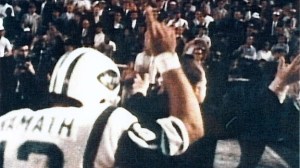
A few years after the NFL-AFL merger most Americans didn’t take the AFL seriously. The Jets were 18-point underdogs to the Baltimore Colts heading into Super Bowl III. Three days before the big game, Broadway Joe Namath proclaimed, “We’re gonna win the game. I guarantee it.” Then he backed it up winning the MVP Award for the Jets 16-7 victory.
7) The Willis Reed Game
I must disclose that I’m a die hard Knicks fan and there’s nothing I would rather see than the Knicks win a championship. Add in the hysteria that overtook Madison Square Garden when an injured Willis Reed walked out of that tunnel in Game 7 of the 1970 NBA Finals and I would have been in a state of bliss. Reed provided the inspiration, but Walt Frazier paced the Knicks past the Lakers with 36 points, 19 assists, seven rebounds and five steals.
6) Nadal and Federer’s Epic Battle at Wimbledon
The 2009 Wimbledon Final was an epic battle between two of the All-Time champions at the height of their powers on the grandest stage in the sport. Federer was playing for a record sixth straight Wimbledon title and fought desperately to keep his crown, but ultimately Nadal broke through at the All England Club in a five-set thriller considered by many to be the greatest tennis ever played.
5) Jesse Owens Outruns Fascism
The 1936 Olympics in Berlin was supposed to be Hitler’s platform to showcase the superiority of the Aryan race. I wish I could have been sitting in old Adolph’s box and seen look on his face as African-American Jesse Owens ran circles around the Germans on his way to four gold medals in track and field.
4) The Thrilla in Manilla
The third installment of the celebrated trilogy between Ali and Frazier may have been the most devastating. In the later rounds Frazier’s eyes had swollen shut and he could no longer see Ali’s punches coming. His trainer Eddie Futch stopped the fight after the 14th round against his fighter’s wishes. Unknown to Frazier’s corner, Ali had walked backed to his own corner after the 14th and instructed Dundee to cut his gloves off. Ali later said it was the closest he had ever come to death.
3) The Miracle on Ice
America was reeling in the winter of 1980. The specter of Watergate still hung of the country, the Iran hostage crisis was fresh in peoples minds, Cold War rhetoric was escalating and the economy was in the toilet. That backdrop led to an outpouring of patriotism when the U.S. hockey team miraculously defeated Cold War foe, the Soviet Union in the semifinals of the 1980 Winter Games. That it occurred on American soil in Lake Placid, New York was the icing on the cake.
2) Game 6 of the 1996 World Series
Nobody will argue that it was the greatest game ever played, but as a 19-year-old Yankee fan I had never seen my Yankees win the World Series. To this day watching Charlie Hayes secure that final out remains one of the happiest moments of my life. I would have given anything to have been in Yankee Stadium that night trotting around the outfield on a horse alongside Wade Boggs.
1) The Fight of the Century
It was the most anticipated sporting event of the 20th century and did not disappoint. Ali’s title was vacated four years earlier when he refused induction into the U.S. Army and Frazier was the current champ. Both were undefeated. The contest was framed as a battle of ideologies because of Ali’s stance on the Vietnam War and he upped the ante with his relentless trash talking. Frazier broke Ali’s jaw and knocked him down in the 15th round on his way to victory by decision. After the fight Frazier was reportedly close to death and spent several days in the hospital. And he was the winner.
Honorable mention:
1982 NCAA Tournament Final between Georgetown and UNC
Gibson Wins Game 1 of the 1988 World Series
Flutie’s Hail Mary against Miami
The “Hand of God” game in the 1986 World Cup
Borg vs. McEnroe in the 1980 Wimbledon Final
Reggie Jackson hitting home runs on three consecutive pitches in Game 6 of the 1977 series.
The Immaculate Reception
Hagler vs. Hearns
Christian Laettner’s game winner against Kentucky
Cal-Stanford football game – “The Band is on the Field”
Jordan drops 55 on the Knicks after coming out of retirement
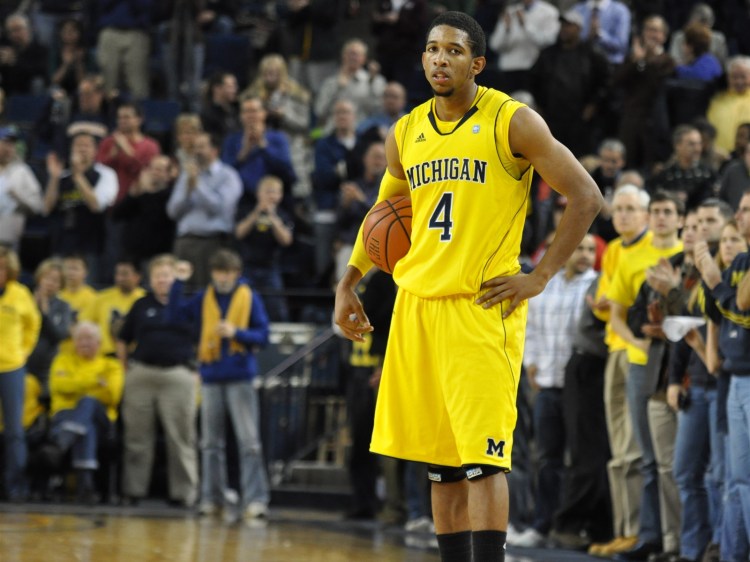
University of Michigan point guard Darius Morris confirmed yesterday that he will remain in the NBA draft. The sophomore point guard was Michigan’s best player last season and nearly led the Wolverines to a second round upset over Duke in the NCAA tournament. He has an NBA body, great talent and has grown by leaps and bounds over his two seasons in Ann Arbor, but he’s not ready for the NBA.
The vast majority of kids entering the NBA draft aren’t prepared to play in the league. Most haven’t mastered the basic skills necessary to excel at their position and many aren’t emotionally mature enough to handle the rigorous day-to-day life of a professional athlete. More than ever, the draft has become a talent grab, with emphasis placed on natural physical ability. Who has the quickest first step? What’s his wingspan? How’s his vertical leap?
The first 14 selections, known as Lottery picks are typically used on superb athletes with at least a decent skill level. In the mid to late first round teams snatch up unpolished or unathletic big men and highly skilled perimeter players who lack the explosiveness of lottery picks. Morris doesn’t fit into any of those categories.
There’s a lot to like about Michigan’s former point guard. At 6’4 he’s tall for his position and quick and long enough to defend point guards and shooting guards at the next level. He’s quick off the dribble, a crafty finisher in the paint and has learned to create shots for himself and his teammates.
Michigan Coach John Beilein has been outspoken about Morris’ work ethic. The sophomore may have been the most improved player in the country this season, raising his scoring and assists per game from 4.4 and 2.6 to 15.0 and 6.7. His shot selection and accuracy also vastly improved.
Morris became a leader on and off the court. When Michigan was struggling midway through the Big Ten season and appeared to be on its way to another NIT bid, he spoke up at a team meeting and took responsibility for his poor play. From that point on he elevated his game and led the Wolverines to the NCAA tournament, where he played his finest basketball, knocking down a slew of clutch shots.
Yet, anybody who watched Morris on a regular basis knows that he still has major flaws in his game. His outside shot is inconsistent at best and lacks range. He connected on just 25% of his three-point attempts this past season. Teams can just sit back and let him shoot. Think Rajon Rondo, but unlike Rondo he’s not quick enough to make up for it. His decision making has improved, but he still forces too many shots and commits costly turnovers. He’s years away from being able to run an offense in the NBA.
Morris initially declared for the draft in April, but didn’t hire an agent, allowing him to maintain his amateur eligibility and return to school. He met with the NBA advisory committee, which provides underclassmen who are considering entering the draft with feedback from general managers in the league as to where they may be drafted. Morris was reportedly told that he’d likely be selected in the second round.
Unlike first round picks, second round picks aren’t guaranteed money and often don’t even make the team. Morris may believe that he’ll impress the scouts enough between now and the draft to work his way into the first round, but the flip side is that he may not get drafted. He only needs to look at his former Michigan teammate Manny Harris. Harris went undrafted last year after leaving school following his junior season. He was fortunate enough to sign on with the Cavaliers, but few undrafted players make a roster.
Harris is one of countless players who left school early only to be passed over on draft day. The local cautionary tale is Omar Cook, a highly touted point guard from Brooklyn who declared for the 2001 draft after a stellar freshman year at St. John’s. The shifty point guard was originally projected to be a lottery pick, but slipped to the second round because like Morris he couldn’t shoot. He was drafted by the Magic, who immediately shipped him to Denver, where he failed to make the team and was never heard from again.
If Morris stayed another year his stock was almost certain to continue climbing. Given his work ethic and the arc of his progression as a player he would have been in the running for Big Ten Player of the Year next season. If he continued to improve his jump shot and assist to turnover ratio he almost certainly would have been a first round pick next near, maybe even crept up towards the lottery. That would mean a lot more money than he’ll make as a second round pick and most importantly, it would have been guaranteed. The prospect of a lockout looming over the NBA would seem to be further incentive for him to return to Ann Arbor next year.
It’s never clear to outsiders who a kid listens to or what he bases his decision on when pondering whether to enter the draft. Morris said he discussed it with Coach Beilein and his family. Beilein knows better than anybody how much room Morris has to grow. He hasn’t said whether he agrees with Morris’ decision as coaches sometimes do. You wonder who else was in his ear, friends, agents, maybe a girlfriend. Perhaps his ego led him to believe that he’ll be drafted in the first round, yet even if he is, he won’t go nearly as high as he would have next year.
Morris appears to be a good kid who’s worked hard for the opportunity to play in the NBA. I hope he makes it. After announcing his decision to remain in the draft, he said, “Playing professional basketball has always been a dream for me.” Omar Cook had the same dream.