The Greatest Show in Sports

by Paul Knepper

Roger Federer vs. Rafael Nadal doesn’t have the pageantry of the Super Bowl, the tradition of Michigan vs. Ohio State or the rancor of Red Sox – Yankees; what makes their matches so spectacular is the quality of play. Theirs is a rivalry built on brilliance and artistry, desire and power, spins and angles. It’s two legendary warriors battling for every point, until one champion is left standing.

Together Federer and Nadal have dominated men’s tennis for the past eight years. From the the 2003 Wimbledon through the 2010 U.S. Open they won 25 of 30 majors and one of the two has been seeded number one at the last 30 Grand Slam tournaments.

Federer is considered by many to be the greatest tennis player of all-time. From his feathery touch on half-volleys to his lethal forehand, never has an athlete made the sublime look so ordinary. He has no holes in his game and has prevailed on every surface. The Switzerland native  holds the men’s record for most Grand Slam titles, with 16, and his 23 consecutive semi-finals appearances in Grand Slams may be the most remarkable feat in all of sports.

Whereas Federer is the epitome of grace, Nadal is like a bull, who flattens opponents as much with his sheer will as his crushing ground strokes. Born and raised on the Spanish Island of Majorca, Nadal developed a fierce whipping motion on his forehand which creates a heavy topspin ideal for clay surfaces. The southpaw has won six of the seven French Opens he’s entered and at the age of 25 is already considered the greatest clay court player ever. Over the past few years, increased velocity on his serve and an improved net game have enabled him to translate his success to other surfaces.

Federer and Nadal have clashed 25 times since 2004, with Nadal winning 17 of them, though the majority of their matches have been played on clay. Nineteen of those took place in the finals of a tournament, including 8 Grand Slam finals. In the early years, the edge belonged to Federer, then in his prime and nearly unstoppable on grass and hard court.

The 2008 Wimbledon was the turning point in the ongoing feud. Nadal was 22-years-old and his game was beginning to click on all cylinders. He had pushed Federer to five sets in the Wimbledon final the year before, and though the five-time defending champion showed no signs of slowing down, there was a sense that it might be the young Spaniard’s time.

The drama of the finals matchups between Federer and Nadal is inherent in the nature of the tournament. For two weeks, the excitement rises and pressure mounts as fans witness stellar shot making and five set contests in anticipation of the two champions on different sides of the bracket facing off at the end.

It’s a crescendo similar to the Final Four in the NCAA Tournament, except these  men stand alone. They don’t have any teammates to share the spotlight or the blame, to confer with about strategy or lean on during difficult stretches. They live inside their own heads, relying on the discipline, intelligence, focus, determination, resilience, confidence and courage that got them there.

Federer and Nadal cruised to the 2008 Wimbledon finals. What ensued was a match no tennis fan will ever forget; the two champions at the height of their powers slugged it out for a thrilling five sets. Nadal was nearly flawless as he grabbed the first two sets, but the five-time defending champion would not go quietly. He clawed his way into the match and though unable to convert on several break points, won the third and fourth sets in tie-breakers.

The fifth set was awe-inspiring, with seemingly every point ending on a stunning winner.  With darkness threatening, Nadal finally captured the fifth set 9-7, and promptly collapsed on his back in utter joy. The match was the longest Wimbledon final ever at 4 hours and 48 minutes. Three-time Wimbledon champion and commentator John McEnroe, himself a one time participant in a five set finals thriller against Bjorn Borg on that same court, was one of many people to declare it the greatest match they’d ever seen.

The rivalry has taken on another dimension over the past few years, as both men have made themselves more vulnerable and revealed a fondness for one another. Devastated that his best effort was no longer enough to beat Nadal, Federer broke down in tears after losing to his rival in the finals of the 2009 Australian Open. Nadal responded by putting his arm around his opponent and went out of his way to praise Federer, stating that he would certainly break Pete Sampras’s record of 14 Grand Slam titles. Federer, for his part, calls Nadal by his nickname Rafa.

Nadal still routinely refers to Federer as the greatest player of all-time and it’s difficult to argue with him. What’s become equally apparent is that Nadal is one of the five greatest players ever himself. When else have two of the top five players in the history of an individual sport faced off against each other? Perhaps Muhammad Ali and Joe Frazier. That may be the best analogy for the Federer-Nadal rivalry, the 2008 Wimbledon final was their Thrilla in Manilla.

In August of 2008, Nadal secured the world number one ranking and never looked back. Federer, who turned 27 that summer, began to slip just a bit, though he was far from done. In fact, he rallied to win the French Open and Wimbledon the following year. Nadal had gained the upper hand in the rivalry, though the clashes remained as intense as ever.

The two champions most recently squared off at the Finals of the French Open earlier this month. Novak Djokovic had been the big story heading into the tournament due to his undefeated record this calendar year. The Serbian was seeded number two behind Nadal and if he had beaten Federer in the semi-finals would have been the number one player in the world. Perhaps inspired by the doubters, Federer turned in his best performance in years and knocked off Djokovic in four sets.

His finals matchup with Nadal was riveting once again. Federer was surgical early in the first set, moving the Spaniard around by mixing up speeds, spins and location. He had Nadal on the ropes, up 5-2, but lost the next five games and the set. It looked like Nadal might roll over him at that point, but a proud Federer continued to fight. He surprised Nadal with well disguised drop shots and swung away for the corners, ripping several backhands down the line for winners.

Equally impressive was Nadal’s ability to run down and return many of those shots. Federer lost a heartbreaking second set tiebreaker, but rallied to take the third 7-5. Then Nadal took control of the tempo with his powerful ground strokes and pounded Federer into submission, 6-1 in the fifth, for his sixth French crown.

Wimbledon begins on Monday, with Federer and Nadal both chasing history. Federer is pursuing his seventh Wimbledon crown, which would tie him with Sampras for the most ever, and Rafa is chasing Federer. With ten Grand Slams of his own, Roger’s 16 is in his sites. Nadal is the number one seed and Federer number three, so if they meet once again it will be in the finals. Let’s hope they do. They’re the greatest show in sports.
The Unremarkable Odyssey of Joba (Steve) Chamberlain

by Paul Knepper

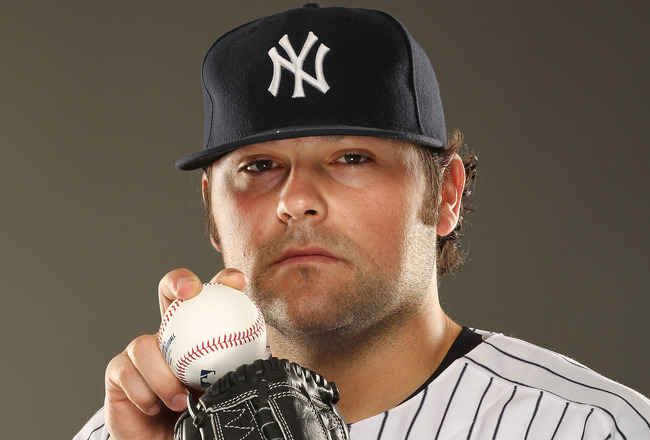
On August 7, 2007, the Yankees called up 21-year-old flamethrower Joba Chamberlain to fill their desperate need for a set-up man for Mariano Rivera. All the kid did was strike out 34 batters, while allowing just one earned run in 24 innings and help the Yankees recover from a dreadful start of the season to earn the Wild Card. Like that, Joba Chamberlain was the most popular athlete in New York.

Born Justin Chamberlain, his baby cousin called him Joba because he couldn’t pronounce Justin. Chamberlain once said that he thought the name sounded “dynamic,” so he adopted.

Dynamic, was how Yankee fans saw the 21-year-old with the rising fastball that reached triple digits at times on the radar gun. He complemented the heater with a filthy slider in the low 90’s. In addition to his nasty stuff, the rookie had swagger. He gyrated and pumped his fists on the mound after big strikeouts and though many opposing players thought he was showing them up, his emotion invigorated a veteran Yankee team that had been plodding through the season.

The man with the dynamic name was also a public relations man’s dream. Newspaper and television headlines ran with the obvious Jabba the Hut Star Wars references and the Yankees jumped on the phenomenon by selling “Joba Rules” t-shirts, a play on the innings and appearance limitations imposed on the youngster by the organization. Fans and writers began comparing him to another husky right-hander, Roger Clemens, and some proclaimed him the eventual replacement for the great Mariano Rivera.

Soon we learned that Joba was raised by a single dad, Harlan Chamberlain, who’s confined to a motorized scooter due to a childhood bout with polio. Harlan is also a Native American and has several relatives who still live on the Winnebago Indian Reservation where he was born. The TV cameras caught the elder Chamberlain, whom Joba described as his best friend, shedding tears of pride as Yankee fans serenaded his son the first time he witnessed Joba pitch in the big leagues in person.

As Joba-mania reached a level of hype not seen in New York since Doc Gooden, I grew skeptical. Sometime during his splendid run in the summer of ’07, I began calling him Steve. It was my way of staying grounded as a Yankee fan. I knew that more than likely, Joba would have fairly ordinary career; It was his name and story that were somewhat unique, and that’s what fans hung on to. I was convinced that if he were a white man with an ordinary name like Steve, instead of a Native American named Joba, there would have been much less hype.

I recognized that Chamberlain’s stuff was electric and there’s no denying the quality and impact of his performance upon being called up to the big club, but I didn’t believe his talents were as rare as many Yankee fans did. Every season several teams around the league call up a pitching prospect or two who throw in the mid to upper 90’s. The majority of them don’t develop into top line starters or closers, even among those who experience immediate success as Joba did.

Most pitchers who thrive immediately are unable maintain their production, either due to the psychological rigors of being a major league pitcher or because the hitters in the league make adjusts and catch up to them. The other major obstacle to long term success for a young flamethrower is arm trouble. For every great strike out pitcher who had an illustrious career, you can point to two who burned out early. The statistics were simply not in Chamberlain’s favor.

Another red flag was the small sample size of Joba’s success. He hadn’t been a huge prospect like fellow ’07 call-up Phil Hughes and since he’d pitched just a season and a half of minor league ball the Yankees had a limited body of work from which to evaluate him. He hadn’t pitched nearly enough innings to demonstrate that he could be an effective starter at the major league level, as the Yankees projected.

Like everything else pertaining to the Yankees, their prospects and young stars receive greater hype than those in other organizations. I’d seen way to many uber prospects and fast starters pass through the Yankee organization, only to disappear into oblivion. Over the previous two decades there was Hensley “Bam Bam” Meulens, Kevin Maas, Ruben Rivera, Brien Taylor, Drew Henson, Sam Militello and Russ Davis, to name a few.

I’d also seen what the media could do with an intriguing story line. Orlando “El Duque” Hernandez had an impressive career with the Yankees, especially in the playoffs, however, it was his story that made him a compelling figure. He arrived in New York through a remarkable, if not entirely true, tale of fleeing Cuba on a raft in shark infested waters. Combine that with a classic nickname, a distinctive leg kick and an air of mystery that arose from his refusal to conduct interviews, based on his supposed inability to speak English, and you have a media sensation.

Yankee fans, starving for a young pitching prospect, were particularly susceptible to the Hollywood storyline. The last Yankee farmhands to develop into consistent contributors on the rubber were Andy Pettitte and Mariano Rivera, both of whom made their Pinstripe debuts in 1995. New Yorkers were also wary of losing the arms race with the rival Red Sox, who had traded for Josh Beckett during the winter of ’06, signed Japanese star Daisuke Matsuzaka prior to the ’97 season and had two promising young starters of their own in Jon Lester and Clay Buchholz.

The Yankee organization also contributed to the expectations for Joba by the way they handled him. General Manager Brain Cashman made it clear that he intended to build the team around Chamberlain, Hughes and fellow hurler Ian Kennedy. Chamberlain was branded untouchable during Cashman’s trade negotiations with the Minnesota Twins for their star pitcher Johan Santana.

Cashman was afraid to blow out his prize possession’s arm, so he had manager Joe Girardi handle his young stud with kid gloves. The team announced during spring training of 2008 that Joba would begin the season in the bullpen, in order to limit his innings. In mid May, Girardi announced that Joba would join the rotation and after being stretched out in the minors he made his Major League debut against Roy Halladay and the Blue Jays on June 3rd.

Chamberlain had mixed success in the rotation before being placed on the disabled list in August with rotator cuff tendinitis. He was 3-1 as a starter with eight no decisions and finished the season with a 2.60 E.R.A. and 118 strikeouts in just 100 innings.

Following the 2008 campaign, the Yankees indicated that Chamberlain would be in the rotation in 2009, in what many in the organization expected to be a breakout year for the fireballer. But, Chamberlain’s fastball, which cracked triple digits in ’07 was topping out at 92-93 M.P.H. and decreased in velocity as his pitch count climbed. He lost control of the strike zone and his confidence spiraled downward.

To make matters worse, the Yankees instituted a low ceiling on his pitch counts late in the season in order to preserve his arm. Then Girardi moved him back to the bullpen for the playoffs in 2009, where he served as Rivera’s set-up man during the team’s championship run. Once again, Chamberlain didn’t know what his role was with the team.

Heading into the 2010 season, Girardi declared an open competition for the fifth spot in the Yankees rotation between Chamberlain, Hughes, Alfredo Aceves and Sergio Mitre. Hughes won the job and Chamberlain was banished to the bullpen once again, where his velocity was still down and control continued to suffer. His E.R.A topped out over five at the All-Star break, though he finished the season strong.

The Yankees didn’t exactly give Joba a vote of confidence by signing former Tampa Bay Rays closer Rafael Soriano in the winter of 2011, to a staggering 3 year $35 million contract to be the set-up man and eventual successor to Rivera, the role Joba was once supposed to fill. Chamberlain still hadn’t fully regained the pop on his fastball, though he pitched well early in the season, posting a 2.83 E.R.A in 27 appearances.

Then his career took another turn for the worse when he tore a ligament in the elbow of his throwing arm last week. Joba required the dreaded Tommy John surgery, which will keep him off the field for 10 to 14 months. The procedure has become commonplace in baseball and many players have returned to form a year or two later. Some have even throw harder after the surgery than they did before the injury. However, for many players the procedure essentially marks the end of their career, as they never regain their pre-injury form.

Joba burst onto the scene like a rock star and emerged as the crown jewel of the Yankee farm system, projected to be either a future number one starter or Rivera’s successor. Four disappointing years later, he blew out his arm like so many hot shot hurlers before him, and at the age of 25, his career is in jeopardy. Even if he fully recovers he’s likely destined for a career in middle relief. If his name was Steve nobody would even remember him in 20 years.

Ten Greatest NBA Duos

by Paul Knepper

Basketball is a team game, though often performed at the highest level when two players work in concert. The pick-and-roll remains the most productive offensive set and no play is more enthralling than an alley-oop. Rarely has a lone superstar carried a team on his back to an NBA championship. Shaq needed Kobe, Jordan needed Pippen and Isiah needed Dumars.

During past this season LeBron James and Dwyane Wade distinguished themselves as the most dynamic duo in the league, even though they fell just short of a championship. Before they can be considered among the elite duos to ever player the game they have to do it for more than one season.

These are the ten greatest NBA duos ever.

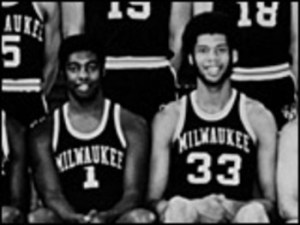
10) Kareem Abdul-Jabbar and Oscar Robertson (Milwaukee Bucks)

“The Big O” and Lew Alcindor teamed up for the 70-71 season and led the Bucks to a league best 66 wins. They rolled to the NBA Finals, where they defeated a Baltimore Bullets team led by Earl Monroe and Wes Unseld 4-0. The next day Alcindor announced that he’d changed his name to Kareem Abdul-Jabbar. The two hall of famers played just three more seasons together and never returned to the finals, as Robertson’s skills declined in his mid-30’s.

9) Isiah Thomas and Joe Dumars (Detroit Pistons)

Isiah and Dumars teamed up four nine seasons as the starting bakcourt for the Detroit Pistons. Isiah handled the ball and Dumars knocked down jumpers, while locking down the best shooting guards in the league. The “Bad Boys” won back-to-back championships together in 1989 and 1990. Dumars won the 1989 Finals MVP and Isiah took the award in 1990.

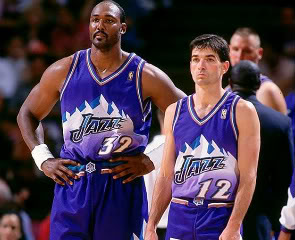
8)  John Stockton and Karl Malone (Utah Jazz)

Stockton and Malone mastered the pick-and-roll over their 18 seasons together and went to the playoffs in every one of them. The NBA’s all-time assist leader and second all-time leading scorer led the Jazz to the Western Conference Finals five times in seven years, including back-to-back trips to the NBA Finals in 1997 and 1998, but weren’t able to get past Jordan and the Bulls.

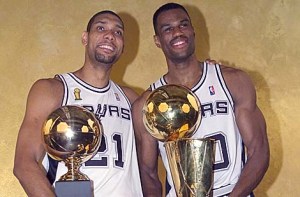
7) Tim Duncan and David Robinson (San Antonio Spurs)

Robinson’s injury during the ’96-’97 season was a blessing in disguise for the Spurs. With the first pick in the ’97 draft they landed Tim Duncan, creating the twin towers that would lead the Spurs to the promised land. San Antonio defeated the Knicks in five games in the ’99 Finals and after a three-peat by the Lakers, Duncan and company delivered Robinson a second ring as a retirement gift in 2003. Duncan was named the MVP of both finals.

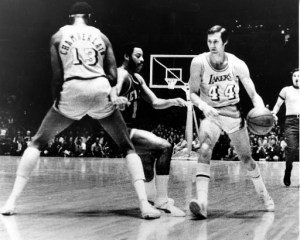
6) Wilt Chamberlain & Jerry West (Los Angeles Lakers)

West and the Wilt played together in L.A. for just five seasons, though they advanced to the NBA Finals in four of them and defeated the Knicks to get “the logo” his first ring in 1972. That season West and “The Big Dipper” led the Lakers to 69 wins, including 33 consecutive wins, a record which still stands today.

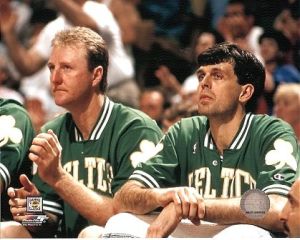
5) Larry Bird & Kevin McHale (Boston Celtics)

Bird and McHale made five trips to the NBA Finals during their 12 seasons together in Boston, winning championships in ’81, ’84 and ’86. Larry Legend ripped teams hearts out with his long range shooting, while McHale dominated inside with a vast array of post moves. Were their careers not derailed by injuries (McHale never fully recovered from playing on a broken foot in the ’87 playoffs and Bird’s back gave out on him), they may have won more rings.

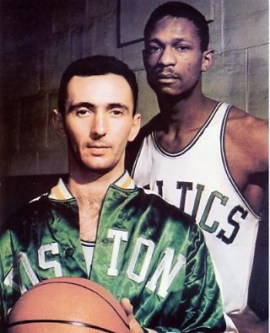
4) Bill Russell and Bob Cousy (Boston Celtics)

Russell and Cousy were the first dominant duo in the league, both innovators who changed the way their positions were played. They won 6 championships in the late ’50’s and early 6o’s before Cousy retired in 1963. They don’t rank higher on this list because they had so much talent around them, especially Russell. In fact, you can argue that Cousy wasn’t even Russell’s greatest wing man. Slick-shooting Sam Jones was by Russell’s side for 10 of his 11 rings and Havlicek joined him for the later years of his career.

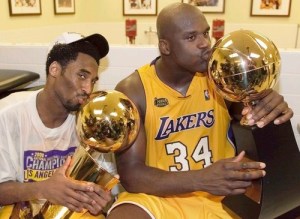
3) Kobe Bryant and Shaquille O’Neal (Los Angeles Lakers)


Shaq and a young Kobe joined forces to form an indefensible inside-outside punch which carried the Lakers to three consecutive championships from 2000-2002. Shaq won the Finals MVP each time. Ultimately, the only thing that stood in between this dynamic duo and several more rings was their own egos.

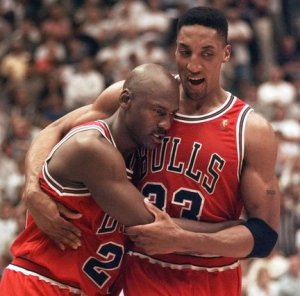
2) Michael Jordan and Scottie Pippen (Chicago Bulls)

No two players have ever controlled the perimeter on both sides of the court like MJ and Pippen. Together, they led the Bulls to 6 championships, by way of two different three-peats, ’91-’93 and ’96-’98. Had Michael not walked away from the game for nearly two seasons they likely would have won eight in a row.

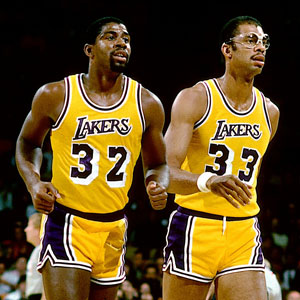
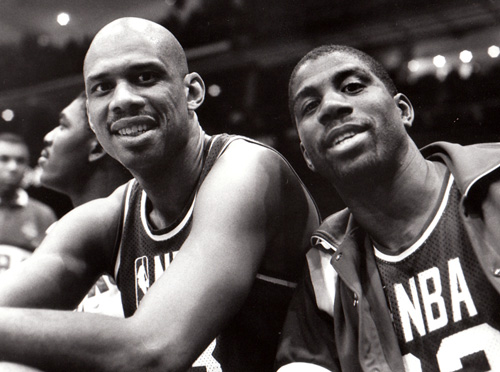
1) Magic Johnson and Kareem Abdul-Jabbar (Los Angeles Lakers)

They’re two of the top five players to ever to play the game, the flashy point guard, with the no-look passes and the dominant big man with the unstoppable hook-shot. Magic and Kareem won five championships together and appeared in 8 NBA Finals over their ten seasons as teammates. Kareem led the way in the early years, then Magic carried the load as Kareem grew older.

Honorable Mention:

Jerry West and Elgin Baylor (Los Angeles Lakers)

Moses Malone and Julius Erving (Philadelphia 76ers)

Willis Reed and Walt Frazier (New York Knicks)

Cuban Allows Players to do the Talking

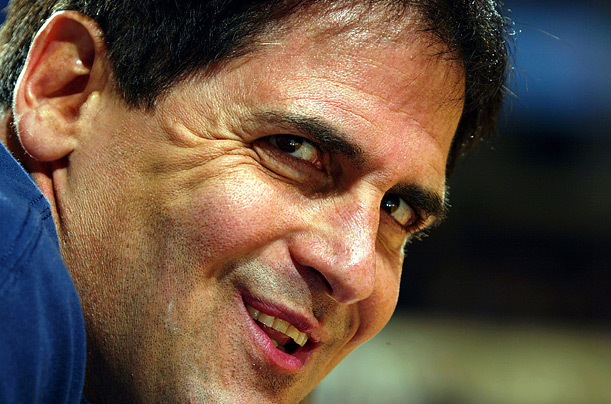
Since he purchased the team in 2000 Mark Cuban has been the face and voice of the Dallas Mavericks, even more so than his star forward Dirk Nowitzki. The young dot-com entrepreneur has been brash, outspoken, often controversial and a relentless self-promoter. Now, with the Mavs at the precipice of their first championship, their owner has gone silent.

Cuban represents a new breed of team owners; he’s the embodiment of every sports fan’s dream, the super-fan who became an owner. He ditched the owner’s box for a courtside seat and instead of wearing a suit he sports a skin-tight Mavs t-shirt. He used to join the team huddle at times and always celebrates on the court along with the players after a big win. When he purchased the Mavs Cuban instantly upgraded the facilities in Dallas, including adding a new state of the art locker room which was the envy of every players on every other team, and he solicits suggestions from fans about their viewing experience and the team.

The Pittsburgh native relishes the attention he’s received and was one of the first sports figures to utilize various mediums such as Twitter to promote his team, other business ventures, and of course, himself. He’s always available for interviews – often conducted while on his treadmill – and has grabbed headlines for his forays into other sports, including; attempts to buy a major league baseball team, participation in a WWE wrestling match, funding a study on the feasibility of a playoff system in college football, and working with Vince McMahon to form an MMA organization to compete with UFC. Let’s not forget his short-live stint on ABC’s “Dancing With the Stars.”

The Mavs owner is also notorious for criticizing the officiating, drawing the ire of NBA Commissioner David Stern and receiving fines totaling close to $1.8 million. The last time the Mavs were in the finals, in 2006, against these same Miami Heat, Cuban was fined $250,000 for various comments he made about the officiating after the Mavs Game 5 loss. Earlier in that playoff run, he had to cough up $200,000 for running on the court and confronting an official during a game between the Spurs and Mavs.

So it was confounding when suddenly, without warning or explanation, the Mavs owner went silent after his team’s first round playoff series against the Portland Trailblazers in early May. He still tweets “Lets go Mavs” on game days and can be seen cheering on his team from behind the Mavs bench, but he doesn’t comment on the games or the officiating and has refused to grant any interviews over the past month and a half.

I thought surely, the impassioned owner would have something to say to his old nemesis Phil Jackson after the Mavs swept the two-time defending champions Lakers in the second round. But not a peep. I assumed he wouldn’t be able to hold back from verbally sparring with Dwyane Wade, as he had in the past, or pile on to the barrage of criticism being leveled at LeBron James. But still, not a word.

Members of the media have offered several theories to explain Cuban’s silence. Some say he concluded that the games are about the players and it’s best for his team if he remains silent. His outbursts win his players any favors; if anything, when he pisses off the officials the Mavs are less likely to get a call. Maybe he understands he understands that his outbursts aren’t necessary as a motivation tool for this veteran team and only serve as a distraction.

Another theory is that Cuban simply decided to respect his players’ wishes. Over the years, several Mavericks, including his good friend Nowitzki, have asked Cuban to control his behavior. Some writers have noted that Cuban has mellowed over the years, especially since his kids were born, though that wouldn’t explain the sudden change in behavior.

Another proposed explanation is that the Mavs owner is acting on superstition. The Mavs lost in the 2006 Finals to the Heat and have underachieved in the playoffs since. Perhaps if Cuban altered his behavior it would lead to different results. He also may have stopped speaking to the media for any number of reasons, then didn’t want to rock the boat when the Mavs kept winning.

Regardless of the reason, members of the media and bloggers like myself found Cuban’s silence perplexing and disappointing. The Mavs and Heat have plenty of star power, with at least four future Hall of Famers, and plenty of drama stemming from “The Decision” and LeBron’s recent struggles, but it lacks an engaging personality. James, Wade and Dirk don’t have the charisma of Jordan or effervescence of Magic. There’s not a quotable character like Rodman or Artest and neither coach has aired any grievances publicly.

There’s a vacuum for Cuban and his ego to fill, but he chose not to. The series has been better for it. The players have spoken with their play on the court, in what has been one of the most competitive NBA Finals in recent memory. Every game has been riveting, coming down to the final minute of play. There have been dramatic comebacks, players competing through illness and injury and last second shots by the game’s elite.

Sure, an inordinate amount of attention has been focused on LeBron’s struggles, but it’s grounded in his performance on the court. Any tantrums or snide remarks by Cuban would have detracted from the games and players themselves. Through his silence, Nowitzki finally received long overdo recognition as one of the greatest shooters in the history of the league. Role players like J.J. Barea and Udonis Haslem have been the topic of discussion for their contributions.

Some of the Mavs players have filled the vacuum with trash-talk. Jason Terry called out LeBron James after Game 3, stating that he didn’t think the Heat forward could shut him down for seven games. DeShawn Stevenson said what many of us were thinking after Miami’s Game 4 loss, that LeBron “checked out” in the fourth quarter. During Game 5 the cameras caught Shawn Marion barking in LeBron’s ear as LeBron posted him up.

The Mavs have found their swagger. They’re poised and confident, heading into Game 6 of a what has been an enthralling series. Nowitzki said in an interview on May 11th, “It should be about the players, never about the owner.” Cuban picked a great time to finally listen.

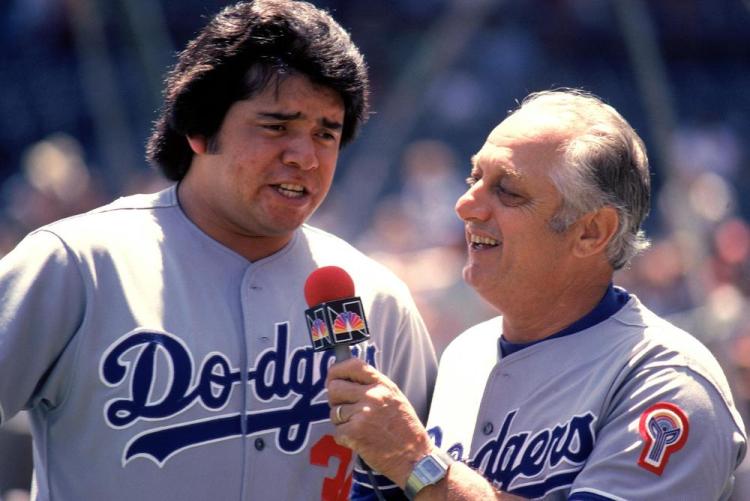
Tommy’s Take on Fernando-mania

Legendary Dodger manager Tommy Lasorda was always quick with a joke. During the summer of 1981, the skipper was asked what terms his Mexican-born pitching sensation Fernando Valenzuela might settle for in his upcoming contract negotiations.

Lasorda’s responded: “He wants Texas back.”

Dirk and the Mavs Stun the Heat

by Paul Knepper

Five years ago, the Dallas Mavericks and Miami Heat met in the NBA Finals. The Mavs won the first two games at home and were poised to put a strangle hold on the Heat in game 3, leading by 13 points with just six minutes remaining in the fourth quarter. Then the bottom fell out for Dallas.

Dwyane Wade led a furious comeback, scoring 12 points in the final six minutes and the Heat won 98-96. Dirk Nowitzki had an opportunity to tie the game at the free throw line with 3.4 seconds left and the Mavs down two, but he missed one of his shots.

Miami’s comeback completely changed the momentum of the series. The Mavs were a young team and crumbled after blowing the game. The Heat won the next three games and the championship. Wade was propelled to super stardom, while Nowiztki was labeled soft and mentally weak.

The agony of that collapse seemed to linger with the Mavs as they were knocked out of the playoffs in the first round in three of the next four seasons, despite tremendous success in the regular season, including a league best 67 wins in 2006-2007.

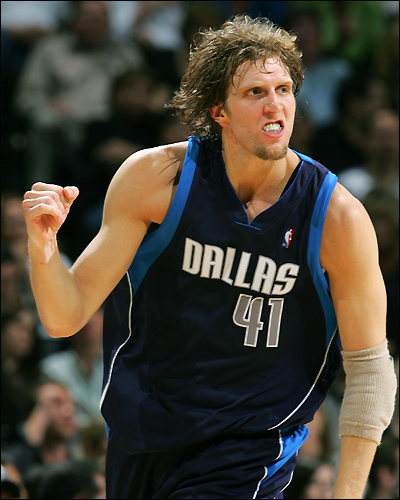
Dirk hungered for another shot at a title. He worked tirelessly to perfect his jump shot, shooting from different angles, different spots on the floor, on the move and even off-balance. More importantly, he turned his weaknesses into strengths. The German shed the soft label by taking his game to the high post and aggressively driving the ball strong to the basket, instead of settling behind the three-point line. Through sheer determination and the wisdom that comes with experience, he learned how to close out tight games.

Meanwhile, Dallas management assembled a veteran cast around him, players with extensive playoff experience who knew how to finish games. Point guard Jason Kidd is a future hall-of-famer who played in two NBA Finals with the Nets; Shawn Marion went deep into the playoffs on several occasions with the Suns and Tyson Chandler made a playoff run a few years ago with the New Orleans Hornets. All three brought necessary grit to a team lacking toughness.

Across the country, in Miami, Pat Riley pulled off a free agency coup in the summer of 2010 by signing LeBron James and Chris Bosh to join Wade in South Beach. The three stars developed chemistry as the season progressed and were in sync come playoff time. They didn’t lose a game on their home court as they plowed through the Pacers, Celtics and Bulls on their way to the NBA Finals.

The Mavs handled the Trailblazers in round one, then swept the two-time defending champion Lakers and finished off the Thunder to set up a rematch with the Heat.

The two teams are very different than they were five years ago. In fact, each team has just two players remaining from that series, Nowitzki and Jason Terry for the Mavs and Wade and Udonis Haslem for the Heat. There’s no rivalry between the teams, though for Dirk it must feel like destiny that his long-awaited opportunity for redemption comes against the very team that revealed his flaws and stained his reputation as a ballplayer.

Miami suffocated the Mavs in Game 1 with their relentless defense, holding the Western Conference champions to 37% from the field in a 92-84 victory. Dallas was outrebounded, couldn’t match the Heat’s athleticism on the perimeter and three of their most dependable players throughout the playoffs, J.J. Barea, Chandler and Terry, were non-factors. Worse yet, the Heat didn’t even play particularly well; they shot just 39% from the field and neither Wade nor James went off.

Fans and the media overreacted after one game, as they tend to do, and many predicted it would be a short series, that the Heat’s “big three” would steamroll the Mavs. So Game 2 had the feel of a must win for Dallas. Since the league went to the 2-3-2 format in 1985 only one team has come back to win the series after losing the first two games in the NBA Finals, the 2006 Heat. The Mavs also needed to deliver a blow in Miami, where the Heat hadn’t lost a game all post-season and quell concerns about a torn tendon on the middle finger of Nowitzki’s non-shooting hand.

The game tight was tight throughout the first half and was tied at 51 at halftime. Early in the fourth quarter, the Heat pulled away. They converted Mavs turnovers into highlight reel fast breaks, in what became a dunk contest between Wade and James. Wade, who was feeling it all night, capped  a 13-0 run with a three ball from the corner to give the Heat a 15 point lead with 7:33 left. He lingered for a moment in front of the Mavs bench after dropping what appeared to be the final dagger of the game and possibly the Mavs season.

But these aren’t the 2006 Mavs. They’ve been here before. Dallas trailed Oklahoma City by 15 in the fourth quarter of Game 4 of the Western Conference Finals and came storming back to win in overtime on the wings of a Bird-esque shooting performance by Nowitzki.

Despite being down by 15 last night, the Mavs continued to fight. They dug in defensively and Miami did them a favor  by reverting to the stagnant one-on-one play they struggled with early in the season. Dallas coach Rick Carlisle went with a small lineup for a couple of minutes, which seemed to jump-start the offense. Terry scored 8 points in the fourth quarter, including a sweet pull-up jumper from the wing. Marion hit a runner from the right side and Kidd knocked down an open three on a kickout from Dirk, though in the end it was Dirk who brought the game home.

Carlisle called for staggered screens on the left side of the floor to free up Dirk at the top of the key, where he could catch and shoot or drive to the hole, while being able to see where the double team was coming from. The German scored the Mavs last nine points. He tied the game with under a minute remaining, then nailed a three-pointer to put the Mavs up three with 27 seconds remaining.

Following a timeout, Mario Chalmers tied the game with a three of his own on a blown defensive assignment by the Mavs. On the ensuing possession, Dirk received the ball at the top of the key with Chris Bosh guarding him. He faked right, spun back left, hesitated, then took two long strides and laid it in with his injured left hand with 3.5 seconds left. Wade’s last second heave fell short and the Mavs won 95-93.

Dallas finished the game on a 22-5 run. It was one of the greatest comebacks in NBA Finals history and eerily reminiscent of Wade and the Heat’s spectacular triumph in Game 3 of the 2006 series. Only this time Dirk was the hero. The Heat revival was the turning point of the ’06 series. It crushed the Mavs. Last night, a tougher, more experienced Dirk returned the favor. How will Miami respond?

A Tale of Two Buckeyes

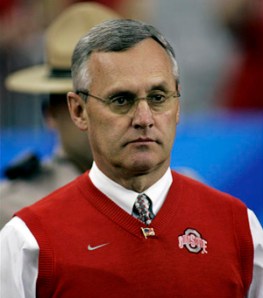
Ohio State University head football coach Jim Tressel resigned yesterday amid mounting accusations of violations within the Ohio State program and his role in covering them up. During his ten seasons in Columbus, the man known for his trademark red and gray sweater-vests won a remarkable seven Big Ten titles, the 2002 National Championship and went 9-1 against the Buckeyes’ archrival Michigan. He was a religious man, a father figure to his players and adored by the Buckeye faithful.

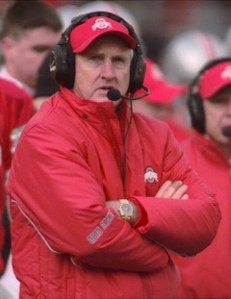
Tressel’s predecessor at OSU John Cooper, who was fired after the 2000 season, was despised by OSU alumni for his 2-10-1 record against the Wolverines. Tressel and Cooper’s old nemesis, former Michigan football coach Lloyd Carr recently shed light on the difference between the two men. On May 17th, following an announcement by the National Football Foundation indicating that Carr had been elected to the College Football Hall of Fame, he told Dan Wolken of TheDaily.com, “John Cooper always told me, ‘You know, they may fire me, but they’ll never fire me for cheating.'” Apparently, the mighty sweater-vest didn’t share his convictions.

Below is an audio link to Carr’s comments about Cooper. He also talks about the integrity of his mentor Bo Schembechler and his views on the enforcement of NCAA rules.

http://www.dailymotion.com/embed/video/xiriq0

I Was Wrong About LeBron

by Paul Knepper

My voice could be heard among the chorus of boos across this country when LeBron announced that he was “taking his talents to South Beach” last summer. Like many basketball fans, I felt he violated the code of the playground – that the best players split up and try to beat each other – and thought he did a disservice to the fans of Cleveland and the Cavalier organization by leaving with all the pomp and circumstance of “The Decision.”

There was one more reason I was disappointed in LeBron’s choice; the basketball junkie in me wanted to see this uniquely gifted athlete become the most spectacular player he could be. I believed that wouldn’t happen in Miami where he’d have to defer at times to Chris Bosh and Dwyane Wade. I thought never again would we see the LeBron who carried the Cavs on his back night after night and scored their last 25 points in a legendary performance against a great Pistons defense in Game 5 of the 2007 Eastern Conference Finals. In a sense, I was correct, LeBron isn’t that player anymore. He’s better.

From the moment he entered the league LBJ drew comparisons to Michael Jordan. It’s a burden that every supremely talented perimeter player must endure in the wake of his “Airness,” from Harold Miner to Kobe Bryant. Jordan was the greatest player of all-time, so fans, scouts and executives are always looking for the next him. Bryant’s success only reinforced the Jordan prototype. His game is similar to MJ’s; they played in the same system for the same coach.

LeBron’s decision to wear his idol’s #23 only hastened the comparisons. Due to a lack of talent in Cleveland, James was forced to play like MJ as well, carrying the scoring load and taking every big shot. The other aspects of his game were secondary to putting the ball in the hole. In fact, he was crucified by the media for passing the ball to an open teammate instead of taking the potential game-winning shot himself.

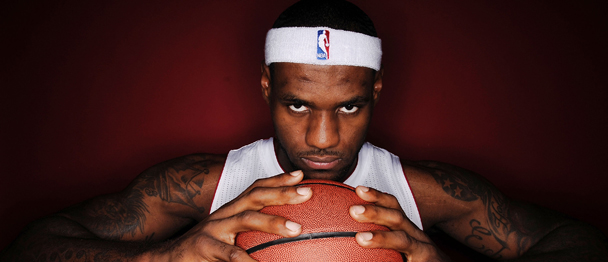
So it was fitting that LeBron left the #23 behind when he headed for South Beach., where he’s distinguished his game from MJ’s. Sure, he shares Jordan’s athleticism and elevation, but he has some of Magic Johnson’s game too, the way he jump starts the fast break and uses his height to see over the defense and deliver excellent passes. And like Magic, he doesn’t need to score 30 points to dominate a game.

He has a little Karl Malone in him as well, the way he explodes to the basket on the break like a freight train (Just ask Kyle Korver what it’s like to have him bearing down on you) and has the upper body strength to absorb contact and still make the shot; and a drop of Pippen, with his ability to control a game by locking down the opposition’s best perimeter scorer.

Playing with Wade and Bosh has allowed LeBron to thrive in all aspects of his game, not just scoring. He’s able to let the game come to him and play a style that he’s more comfortable with. The result has been a beautiful display of basketball.

Free to utilize his vast array of skills, James can tailor his game to whatever the Heat need on any given night. Sometimes that means scoring 40 points and taking over a game down the stretch as he did in the final minute of Game 5 last night against the Bulls; other times it’s being more of a facilitator, especially when Wade is rolling. In the Heat’s first round series against the 76ers it meant controlling the boards. During their second round defeat of the Celtics his primary responsibility was to smother Paul Pierce.

LeBron’s defense was the story in the Heat’s Eastern Conference Finals victory over the Bulls. The turning point of the series was when he shut down MVP Derrick Rose for the final five minutes of the fourth quarter of Game 4, forcing him to take difficult fadeaways in the Bulls last two possessions of regulation. It was reminiscent of Game 2 of the 1991 NBA Finals when Phil Jackson moved Pippen onto Magic and the Bulls won four straight after losing Game 1 to the Lakers. LeBron, like Pippen, changed the series by cutting off the head of the snake.

Another advantage to playing with Wade and to a lesser degree Bosh is they allow LeBron to rest on offense. Not being the focal point of every possession has kept him fresh and enabled him to close strong in the fourth quarter, as he did in games 4 and 5 against the Bulls. He wouldn’t have covered Rose in his Cleveland days because he needed to preserve his energy in order to score. Instead, it was Rose who didn’t have a second scorer to lean on and was forced to play almost the entire Game. Consequently, he wasn’t fresh down the stretch of Games 4 and 5 and came up short.

I thought LeBron would win in Miami, but his game would be restricted by the talent around him. It turns out he needed a wingman in order to fully blossom. Now he’s one step away from earning the coronation “King James.” Whether he wins a ring or not, it’s time to stop comparing him to the great players of yesteryear. He’s a prototype, the first player in the history of the game to possess such a magnificent blend of talent, size, strength and skill. Enjoy it.


The General Doesn’t Do NBA

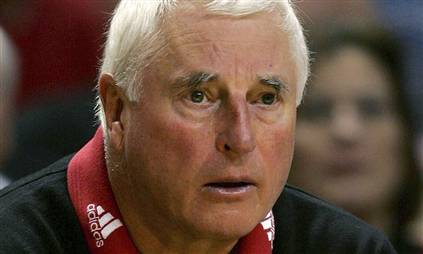
I’ve found this year’s NBA playoffs to be riveting, though I’m sure Bobby Knight would not agree. The General made his opinion of NBA basketball clear several years ago when he uttered these famous words:

“If the NBA were on channel 5 and a bunch of frogs making love were on channel 4, I’d watch the frogs, even if they were coming in fuzzy.”

Here’s a bonus clip of Knight’s top ten sounds bites.

Bosh vs. Noah

by Paul Knepper

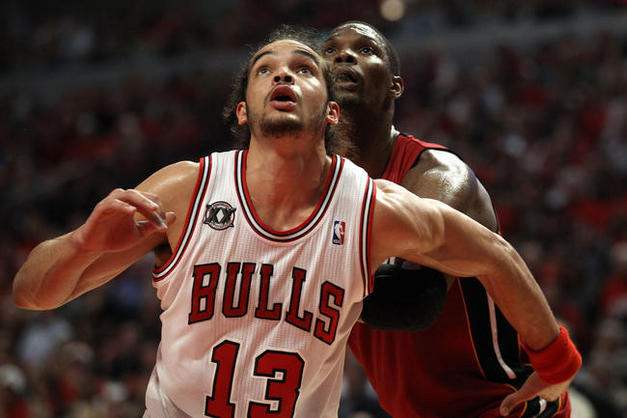
One of the key matchups in the Eastern Conference Finals between the Heat and Bulls has been Chris Bosh against Joakim Noah. On paper Bosh is the better player. The six-time All-Star has averaged 20 points and 9.2 rebounds for his career, though his numbers took a hit this season as he deferred to LeBron James and Dwayne Wade.

Noah, on the other hand, has yet to make an All-Star team and posts just 8.5 points and 8.4 rebounds for his career. This was his best statistical season, in which he averaged 11.7 points, 10.4 rebounds and 1.5 blocks per game. The Bulls center is a superior defender and excellent passer. His greatest value lies in the intangibles he brings to the court, specifically his infectious energy.

The two big men have guarded each other at times during the current series. Bosh has been the better offensive player, scoring at a rate of 24 points per game and carried the Heat offensively during stretches of Game 3 when Noah was in foul trouble. Yet, Noah has exceeded Bosh in just about every other statistical category, including; rebounds, blocks, steals and assists. His passing out of the high post and help defense has been particularly impressive.

Bosh and Noah are both in their prime, ages 27 and 26 respectively. Bosh has the name and the numbers, but Noah’s value to the Bulls is immeasurable. Which one would you rather have on your team?