Dealing With DeMarcus

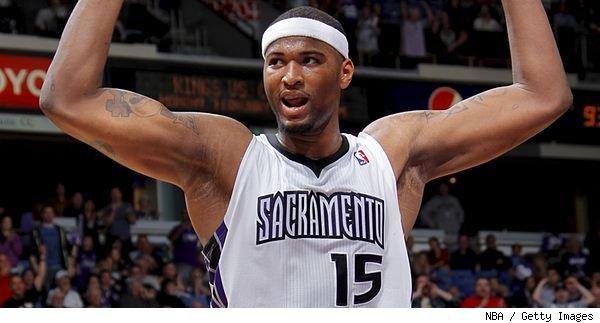
Past the midway point of DeMarcus Cousin’s rookie season, as Dennis Green might say, he is who we thought he was; a superbly talented big man with troubling character issues.

Sacramento fined their young power forward an undisclosed amount on Monday after investigating his role in an altercation with teammate Donte Greene following the Kings 99-97 l0ss to Oklahoma City Saturday night. Cousins was reportedly upset that Greene didn’t pass him the ball for the final sh0t of the game, instead dishing it to Tyreke Evans, who missed a three-point attempt. Cousins confronted Greene in the locker room after the game and again on the team flight before being removed from the plane.

This wasn’t the first time the Kings had to discipline their big man this season. He was fined during training camp for verbally abusing the team’s strength and conditioning coach and Coach Paul Westphal kicked him out of practice in November. Then he was fined and removed from the starting lineup for one game for making a choking gesture at Golden State’s Reggie Williams during a game in December.

It sounds like Cousins is hardly worth the trouble, until you remember that he’s one of the most physically gifted big men to enter the NBA over the past decade. He has big, soft hands, a wingspan well over seven feet and at 6’11 and close to 300 pounds is adept at gaining good position in the low post. He’s used that size and strength along with great instincts to lead NBA rookies in rebounding and become a very difficult force to defend around the basket.

The rookie is averaging 13.9 points and 8.1 rebounds per game in just 27 minutes a night. Last night, in his first game since the altercation with Greene, he posted 21 points, 13 rebounds and 2 blocks in just 27 minutes of action. He’s been dominant at times this season, though his effort and aggressiveness have been inconsistent.

His reputation as a malcontent dates back to his high school days. Last year, during his lone season at Kentucky he clashed with Coach John Calipari on the sidelines on several occasions and developed a reputation for being moody. The media and scouts questioned his drive and conditioning. Still, he put staggering numbers per minute, averaging 15.9 points, 9.9 rebounds and 1.8 blocks in just 23 minutes per game.

That mixture of talent and controversy made Cousins a divisive figure heading into last year’s NBA draft. On talent alone he may have been the first player selected, but teams shied away from him because of perceived character issues. ESPN college basketball analyst Fran Fraschilla summed it up the sentiment of scouts when he said, “He [Cousins] is either going to get a general manager fired or get him executive of the year.” Sacramento’s President of Basketball Operations Geoff Petrie took a chance on Cousins’ immense talent and selected him with the fifth pick.

Now the question for the Kings is how to deal with their immature, ultra-talented rookie. Immature is the key word. Cousins is only 20 years-old, two years removed from high school and like most elite modern day athletes has been pampered every step of the way. Coach Cal knew the kid was one-and-done at Kentucky and had no incentive to discipline him or time to teach him how to carry himself on or off the court.

The Kings’ relationship with their prized rookie is complicated by the high stakes business of the NBA. The league and teams are marketed through individual players. Superstars sell tickets, which gives top tier players a stranglehold over their respective organizations. We saw the power LeBron wielded over the Cavs, pressuring them to make moves to keep him in town. Carmelo has held the Nuggets hostage all season with his demands and Orlando, New Orleans and Utah are already quivering at the prospect of losing their franchise players, Dwight Howard, Chris Paul and Deron Williams next season.

The Kings know they have something special in Cousins and are well aware of how valuable he could be to the franchise if he fulfills his potential. It’s also become increasingly difficult for small market teams to retain star players. So management has been walking the tightrope between trying to mold him into the person and consequently the player he can be, without pushing him away if and when he becomes that player.

They decided to hold Cousins out of their game against the Suns Sunday night while investigating his altercation with Greene and fined him for the incident, but failed to suspend him. It was a slap on the wrist for a player who’s initiated four incidents this season.

Management’s middle of the road approach with Cousins won’t work. Young men don’t stop making demands, acting out and bucking authority unless there are serious repercussions to their actions, such as a substantial suspension in Cousins’ case. They need to take a stand. Paternalism may push him away, but if they don’t try and rein him in now, he won’t be worth the trouble of holding them ransom in the future anyway, regardless of how much he improves his game.

Carmelo, LeBron and Chris Paul may be divas, but they play hard, value team ball and are respected in the locker room. That’s what makes them great players and is the reason their teams are so desperate to hold on to them. The Derrick Colemans and Stephon Marburys of the world don’t win championships or sell tickets.
Most Influential African-American Athletes

Sports have been a catalyst for social change in this country, especially within the civil rights movement, as African-Americans have battled institutional racism in order to earn equal opportunity and respect in the athletic arena. Through courage and determination, many individual athletes blazed trails for future ballplayers and in the process became heroes and role models for African-Americans in all sectors of society. Black History Month is the perfect time to count down the twenty most influential African-American athletes in sports history.

20) Jackie Joyner-Kersee

Sports Illustrated named Joyner-Kersee the greatest female athlete of the 20th century. She won six Olympic medals in track and field, including three golds, and also scored over 1,000 points in a stellar college basketball career with the UCLA Bruins. She was an inspiration for countless African-American girls.

19) Bill Russell

Russell won 11 NBA championships over his 13 seasons with the Boston Celtics and changed the way the game was played through his dominance on the defensive end of the court. He was a stalwart supporter of Dr. Martin Luther King Jr. and the civil rights movement and became the first African-American head coach in any major sport.

18) Andrew “Rube” Foster

Rube was one of the best African-American pitchers of the early 20th century, though his biggest contribution to the game came as an entrepreneur. He organized the National Negro League in 1920, the first long-standing league for African Americans, which was essential to the growth of Negro League baseball in this country.

17) Charlie Sifford

Sifford was the target of racist taunts as he was repeatedly denied access to PGA events throughout the 1950’s. He eventually became the first African-American to participate on the tour when the PGA dropped it’s “Caucasian-only clause” in 1961 and in 2004 became the first African-American inducted into the World Golf Hall of Fame.

16) Frederick “Fritz” Pollard

In 1919, Pollard and Marshall became the first African-Americans to play in the NFL. Walter Camp once called Pollard “one of the greatest runners these eyes have ever seen.” He led the Akron Pros to the first NFL championship in 1920 and a year later was named player-coach, making him the first African American head coach in the NFL.

15) Jack Johnson

The first African-American to win the heavyweight title was a lightning rod for controversy. He was beloved within the African-American community, though a brash black man with an affinity for white women didn’t go over very well with white America. His victory over Jim Jeffries in 1910 sparked race riots throughout the country.

14) Magic Johnson

Magic brought excitement and prosperity to college basketball and the NBA with his style, flare and million-dollar smile. His announcement that he’s HIV-positive changed the way people perceived the illness and he’s been a leading advocate for HIV/AIDS research and prevention ever since.

13) Hank Aaron

Hammerin’ Hank was the epitome of class, as he endured horrific racism in pursuit of the most hallowed record in professional sports, Babe Ruth’s 714 home runs. Since eclipsing the Babe’s mark he’s worked with Major League Baseball to advance the rights of minorities within the game.

12) Tiger Woods

This son of an African-American father and Thai mother is arguably the greatest golfer of all time and has introduced a white, country club sport to people from all different racial and socio-economic backgrounds. In the process, he’s chipped away at the institutional racism that still exists within the golf world.

11) Curt Flood

Flood refused to accept a trade from the St. Louis Cardinals after the 1969 season and instead took Major League Baseball to court, challenging the reserve clause, which he compared to slavery. The case went all the way to the Supreme Court, where he lost, but it was the first step in a process that eventually led to free agency in baseball.

10) Wilma Rudolph

Rudolph was one of the stars of the 1960 Olympics in Rome, where she became the first American female to win three gold medals in track and field during one Olympic games. She emboldened girls around the globe to compete in athletics and was an active participant in the civil rights movement.

9) Althea Gibson

Gibson has been called “the Jackie Robinson of tennis” for breaking the sport’s color barrier. She was the first African American to win a Grand Slam event and won a total of five throughout her career. When she retired from tennis she became the first African American woman to play professional golf.

8)  Arthur Ashe

Ashe remains the only African American man to win Wimbledon and was a staunch proponent of civil rights in the U.S. and abroad. He was one of the first athletes to take a stand against apartheid in South Africa and fought for the right of immigrants in the United States, even getting twice for the causes. He also raised awareness for HIV/AIDS, the disease which eventually killed him.

7) John Carlos/Tommy Smith

The two track stars provided one of the most memorable moments in Olympic history when they lowered their heads and raised black-gloved fists on the medal stand during the playing of The Star-Spangled Banner at the 1968 Games. Carlos and Smith paid an enormous price for their gesture, but they succeeded in calling the world’s attention to the plight of African-Americans.

6) Jim Brown

Considered by many to be the greatest football player to ever suit up on the gridiron, Brown starred with Raquel Welsh in the first interracial love scene in a movie in 100 Rifles. He worked with other great athletes to bring about social and political change within the African-American community and in recent years has successfully quelled gang violence in California.

5) Michael Jordan

“Air” Jordan transcended race, becoming one of the most popular athletes in the world and elevating the popularity of basketball to new heights in the U.S. and abroad. He redefined the marketability of a professional athlete, becoming a brand unto himself, and recently became the first African American former athlete to be the majority owner of a sports franchise.

4) Joe Louis

“The Brown Bomber” was one of the greatest boxers of all-time and is best remembered for knocking out Germany’s Max Schmeling. The victory over Hitler’s pawn made him a hero to white America; no small feat in 1938, and it’s safe to say that no athlete has been more embraced and revered by the African-American community.

3) Jesse Owens

Owens was the first African-American athlete to be lionized by Americans of all races when he shattered Hitler’s idea of a “master race” at the 1936 Olympics in Berlin. His four gold medals and three world records at the Games inspired millions of African-Americans, including a young Jack Roosevelt Robinson.

2) Muhammad Ali

Ali was one of the greatest pugilists of all-time, a poet, a showman, and perhaps most importantly, an activist. He’s become a worldwide symbol of resistance for his willingness to stand up for what he believes in, whether it’s racial equality, his religion or opposition to the Vietnam War, often at great personal cost.

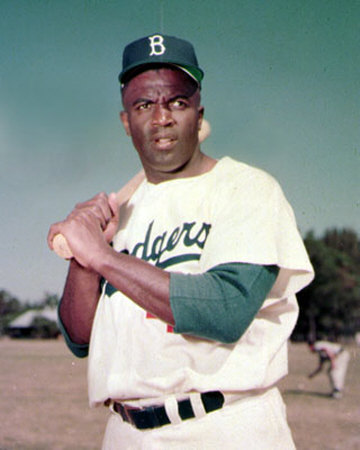
1) Jackie Robinson

No athlete is more closely identified with the struggle of African-Americans than Robinson. He overcame vile racism and overwhelming pressure to brake the color barrier to America’s favorite pastime, inspiring African-Americans in all facets of society with his courage and dignity. Later in life he used his status to support the civil rights movement.

Honorable Mentions: Wilt Chamberlain, Nat “Sweetwater” Clifton, Ernie Davis, Lee Elder, Florence Griffith-Joyner, Spencer Haywood, Carl Lewis, Marion Motley, Leroy “Satchel” Paige, Frank Robinson, Gene Upshaw, Serena and Venus Williams


Rocco and Me

By Paul Knepper

Sports fans choose their favorite ballplayers for different reasons. Some root for athletes who play for their favorite teams, grew up near them or attended the same school. Others admire players for their style of play or flare.  Some identify with athletes that exhibit the personal qualities they value in themselves and others.

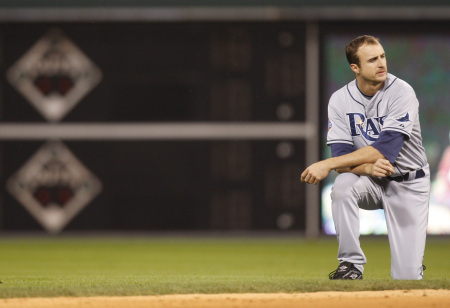
Over the past three years I’ve become a big fan of baseball player Rocco Baldelli because I admire the courageous way he’s battled illness.

Baldelli was a five-tool prospect who drew comparisons to Joe DiMaggio when the Rays selected him out of high school with the sixth pick in the 2000 draft. He had an impressive rookie season for the Rays in 2003 and followed it up with another solid season in 2004. Then the injuries began.

After the 2004 season, Baldelli tore the anterior cruciate ligament in his left knee while playing baseball with his younger brother. During rehabilitation, he injured his left elbow, requiring Tommy John surgery, which caused him to miss the entire 2005 season and half of 2006.

He pulled his hamstring in spring training in 2007 and the problem lingered, limiting him to 35 games that year. While rehabbing from that injury the Rays’ centerfielder experienced excessive fatigue and muscle cramps after brief workouts. Routine baseball activities left him exhausted and it took days for him to recover.

Baldelli underwent a series of tests and in March of 2008 was diagnosed with “metabolic and/or mitochondrial abnormalities.” He held back tears as he informed the media that he wouldn’t be able to play in the near future and didn’t know if he’d be able to play again. Rocco also felt the need to refute rumors that he had Multiple Sclerosis, a serious blood disorder or had used steroids.

To some extent I can relate to Baldelli’s struggles. I’m not a professional ballplayer, but I love playing ball, especially basketball. For much of the past nine years, and especially the past three, I haven’t been able to.

I too have a strange illness. I’ve received varying diagnoses, from chronic sinusitis to Fibromyalgia, though no doctor seems to be sure what the crux of the problem is. I have chronic head and facial pain and swelling and suffer from extreme fatigue. Regardless of how much I sleep, my body is thoroughly exhausted and my thoughts are foggy. My muscles ache and feel very weak. Sometimes they shake or spasm.

Daily tasks are burdensome and I avoid activities that require me to go outside at this time of year because cold weather causes discomfort in my head and limbs. Most of the time I’m not strong enough to exercise, and when I am, even minimal exertion may make me ill for days.

I recognize that my situation doesn’t compare to Baldelli’s. I love playing basketball, but it’s not my livelihood. I’m not immensely talented and my illness isn’t costing me millions of dollars. I haven’t had my dream thwarted. I also don’t assume to know the exact nature or degree of his symptoms.

However, I can empathize with some of the emotions that he’s experienced. I know the frustration of feeling that your body is failing you at far too young an age. I understand how fatigue can affect your social life, general mood and self-esteem. I too have felt like a guinea pig, constantly trying different treatments, having my hopes squashed every time a doctor doesn’t have an answer or a medication fails to help.

I know what it’s like to not want to talk about an illness, but feel compelled to explain. I understand the difficulty in attempting to distinguish severe fatigue from the feeling one experiences after a sleepless night, or overexertion at the gym. I’ve had my have toughness, sincerity and mental health questioned too.

Rocco refused to give up on his career after his diagnosis. After experimenting with different treatments and an extended rehab assignment, the Ray’s outfielder made it back to the big club in August 2008, in time for the team’s first A.L. East title.

Despite being too weak to play in back-to-back games and needing to sit down and rest at times in the outfield, Rocco played a key role in the playoffs. He homered in the ALCS and World Series and knocked in the winning run against the Red Sox in Game 7 of the ALCS. After the season he received the 2008 Tony Conigliaro Award, presented annually to a baseball player “who has overcome adversity through the attributes of spirit, determination and courage.”

In December of 2008 he was re-diagnosed with channelopathy, a less serious illness involving dysfunction of ion channels or the proteins that regulate them. Soon after, he signed with the Red Sox, though he only played in 62 games in 2009 and a shoulder injury kept him off of the post-season roster.

After being unable to find a job last winter, he rejoined the Rays as a minor league instructor, but he didn’t stop working out  and on July 19th, signed a minor league deal with the Rays Single-A affiliate. Once again, he fought his way back to the big leagues and played ten games for Tampa Bay in September. However, after one playoff game he was sidelined with cramping in his leg.

A couple of weeks ago Baldelli announced his retirement at the age of 29. He’s going to remain with the Rays organization as a minor league instructor. He said he’s proud of what he accomplished and doesn’t regret his career being cut short due to illness. He also noted that some of the most memorable moments of his career occurred since his diagnosis, specifically the Rays run to the World Series in 2008.

He went on to say, “I don’t live angrily; I live kind of happy. Why would I look at the negative aspects of everything that I’ve been through and live the rest of my life talking about those things that aren’t the important things to me? The important things to me were all the wonderful things I got to do.” He added, “And you know what. The only time I feel like it’s good to retire is when you’re happy to retire. And I’m happy.”

Even in retirement, Rocco continues to inspire me with his positive outlook. A mysterious illness robbed him of his health, livelihood and millions of dollars; If he can be at peace with his illness, so can I.

Battle of the Birdmen

By Paul Knepper

Denver Nuggets forward Chris Andersen and former WWE wrestler  Koko B. Ware are two of the most colorful athletes in their sports and both are affectionately referred to as “The Birdman.” Which of these professional athletes is most fly? Below is a head-to-head comparison.

koko

Athletic Success

B. Ware’s popularity exceeded his success in the squared circle, though he received the ultimate honor for his athletic achievements when he was inducted into the WWE Hall of Fame in 2009.

With his long wingspan and great leaping ability Chris Andersen is one of the best shot blockers in the NBA and a key component of a Nuggets team that won over 50 games in each of the previous two seasons.

Style

Koko always looked stylish entering the ring in bright baggy pants and sunglasses, though it was his yellow macaw Frankie who turned the ladies’ heads.

Confined by the NBA’s strict uniform codes, Andersen expresses himself through a dazzling array of tattoos across his arms, upper torso and neck, and an early 80’s punk-rock mohawk.

Claim to the Name

Koko used to flap his arms as he the entered the ring with Frankie on his shoulder to the tune of Morris Day and The Time’s “The Bird.”

Before soaring at the 2005 Slam Dunk Contest Andersen announced, “It’s time for the birdman to fly.” He has wing tattoos on his biceps and celebrates emphatic dunks by flapping his hands in a flying motion.

How About a Little Separation Between Sport and State?

By Paul Knepper


As I watched some girl from Glee sing America the Beautiful before Sunday’s big game, I found myself wondering when exactly the Super Bowl became mistaken for Patriots Day?  Sports are supposed to be a diversion from controversial issues like politics and religion and I’ve grown increasingly disgusted by the way sporting events are used as a platform to promote nationalism and militarism in this country. Sunday’s game put me over the edge.

Let me run down the litany of patriotic propaganda that was thrust upon the viewing audience. First there were the presidents. Like Commanders-in-Chief before him, President Obama couldn’t pass up the opportunity to espouse his love of America’s favorite pastime during the most televised event of the year. Then shortly before kickoff the fans at Cowboy Stadium were subjected to a video tribute celebrating the 100th birthday of Ronald Reagan. These people paid thousands of dollars a ticket to see a football game, not a prelude to the Republican National Convention.

After the presidential portion of the event the viewing audience was bombarded with a heavy dose of nationalist propaganda. First, Fox showed several past and current NFL stars reciting the Declaration of Independence with an American flag waving in the background. I’m sure Thomas Jefferson and the boys were thinking about the right to play football – especially for the predominantly African-American NFL – when they signed their names to that historic document. I know this has become a Fox tradition, but so is that robot dancing in the corner of the screen. That doesn’t make it a good idea.

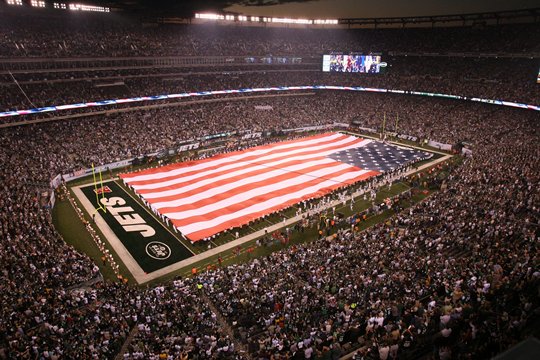
Next, several military men unfurled an enormous American flag on the field as Lea Michelle belted out America the Beautiful. Apparently, The Star-Spangled Banner is no longer enough, we now need two songs extolling the virtues of this great nation before the game. I suppose given the Christina Aguilera debacle we can’t blame the NFL for hedging their bets on that one.

And how could we possibly have a sporting event of that magnitude without the military getting in on the action. It began subtly with the color guard presenting the flag and a few uniformed officers serving as honorary captains during the coin toss. Then there were the shots and interviews of troops watching the games in Iraq and Afghanistan.

I fully support facilitating communication between troops and their families and providing the public at large with a glimpse into life on the base. I just don’t think a sporting event is the proper venue for it. If that were the NFL, Fox or military’s primary concern they could air monthly or bi-annual specials showcasing the troops. That would give Americans the option to tune in or not. What takes place during the Super Bowl is nothing but cross promotion between the three parties.

After Christina Aguilera botched the national anthem the Navy treated the fans in Cowboy Stadium to a ceremonial fly-over by four F-18s. By the way, the roof was closed in the domed Cowboy Stadium. The fans saw the jets for two seconds on the jumbo screen and this ridiculous stunt cost the Navy, and in turn taxpayers $450,000.

The encroachment of the American imperialist agenda upon the sports world isn’t confined to the Super Bowl. The national anthem has been played regularly before sporting events since World World II and after the September 11th attacks several baseball stadiums added a rendition of  God Bless America during the seventh inning stretch. It’s also become common place for fighter jets and enormous American flags to make appearances at football games.

At the risk of sounding unpatriotic, I don’t think I should have to rise at attention and salute the flag every time I attend a sporting event. We don’t sing the national anthem before a Broadway show or at the movie theater. Why should a ballgame be any different? I’ve actually been yelled at for not removing my hat during the singing of the Star-Spangled Banner. I’m sorry, I thought the freedoms this country were founded upon gave me the right to express my love of country if, when and how I choose.

Sports leagues and team owners receive plenty of compensation in return for marketing the United States of America. The federal and local governments don’t poke their heads into the business of professional sports leagues – with the exception of addressing rampant drug use – unless it’s to offer up public funds for the construction of new luxury stadiums, so the billionaire team owners don’t have to dip into their own pockets.

As Sally Jenkins of the Washington Post pointed out yesterday in an excellent piece on the excesses of football, “The last great building binge in the NFL was from 1995 through 2003, when 21 stadiums were built or refurbished in order to create more luxury boxes, at cost of $6.4 billion.” Jenkins asked, “Know how much of that the public paid for? $4.4 billion.” Bankrupt states are cutting spending on social welfare programs and education, while footing the bill for new stadiums replete with sky boxes the average tax payer will never step foot in.

Enough is enough. I’d like to go to a ballgame without having the stars and stripes shoved down my throat. If there’s one aspect of our lives which should be free of government interference and propaganda it’s our play time. There’s a word for societies which intertwine the forces of nationalism, militarism, private enterprise and entertainment: It’s called fascism. This country needs separation between sport and state.

Top Ten Athletes I’d Like to Hear Sing the National Anthem

by Paul Knepper

Everybody has heard by now that Christina Aguilera flubbed the words of the national anthem in front of 160 million viewers prior to Super Bowl XLV in Dallas. Any time I hear a botched rendition of the Star Spangled Banner at a sporting event I think of Carl Lewis’s infamous hack job before a Nets-Bulls game in 1993. However, there have been athletes who have nailed the anthem at sporting events, Jerry Stackhouse, Walter McCarty and Jose Lima, to name a few. Upon reflecting on these athletes turned crooners, I put together a list of the ten current or former athletes I’d most like to hear sing the anthem at a sporting event.

10) Dave Stewart/ Bill Cartwright

It would be embarrassing to throw the ultra-competitive, high-pitched hurler out there by himself, so I partnered him with one of the deepest voices ever to man the paint. The only thing more unorthodox than Big Bill’s baritone voice was his eccentric shooting style.

9) Arnold Schwarzenegger

Who can forget Julius belting out “Yakety Yak” in the shower? I want to hear more from the Governator, though it’s unlikely he’ll be caroling at events in California any time soon, where his approval rating has dipped lower than his voice.

8)  Avery Johnson

The Nets coach’s bizarre squeaky southern twang looks as unnatural as it sounds. It’s as if he’s having an internal battle with his mouth while trying to enunciate the words. I used to find it irritating, but the Louisiana native’s peculiar pitch has grown on me and I’d love to hear its full range.

7) Shaquille O’Neal

We got a taste of the Diesel’s skills on the mic from his fabled days with the Fu-Schnikens and free-style Kobe dissing. At times “The Big Mumbler” makes Ozzy Osbourne sound like an elocutionist, but the Shaqtus has a flare for the dramatic and would be entertaining even if we couldn’t understand a word.

6) Mike Ditka

If you saw Ditka sing “Take Me Out to the Ballgame” at Wrigley Field a few years ago then no explanation necessary. Coach looked like his head was about to explode as he sputtered out high-pitched barking noises, while neglecting to break for air.

5) Ozzie Guillen

There’s a decent chance the White Sox skipper would get booed, either for messing up a line (English is his second language) or pissing off the crowd one way or another. If he were, you can be sure he’d start swearing like a sailor. It would make for great television.

4) Bill Parcells

Technically, he’s not a pro athlete (though he was drafted by the Lions) and there’s nothing unusual about his voice, but the Tuna is one of the biggest curmudgeons in sports. Can you imagine how uncomfortable he’d be singing a tune in front of a packed house? It would be fantastic.

3) Randy “The Macho Man” Savage

The Macho Man would make a grand entrance to “Pomp and Circumstance,” decked out in sunglasses, a bandanna and colorful robe. Then he’d serenade the crowd with his signature gravely voice, broken up by several emphatic pauses. I can hear it now… “And the home… of the… brave… Ooooh Yeah!”

2) Dikembe Mutombo

Call me crazy, but I’d pay money to hear a lovable 7’2 giant who sounds like Cookie Monster sing any song. Dikembe would perform with a big grin on his face and be the first to tell us what an excellent job he did. Maybe he could even sprinkle in a few diva-like finger wags throughout the song.

1) Mike Tyson

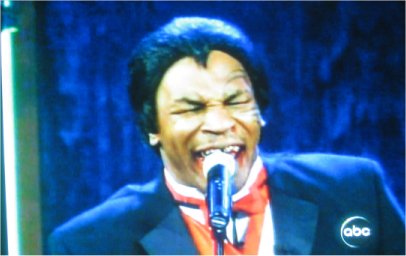
It never grows old that the once baddest man in the world sounds like Mickey Mouse on roofies. Speaking of roofies, I found the champs rendition of “In the Air Tonight” in The Hangover simply breathtaking. Plus, there’s always a chance Iron Mike will go Artest and attack a few fans.

Honorable Mentions: Charles Barkley, Herm Edwards, Manny Ramirez

Andy Pettitte – The Tipping Point

By Paul Knepper

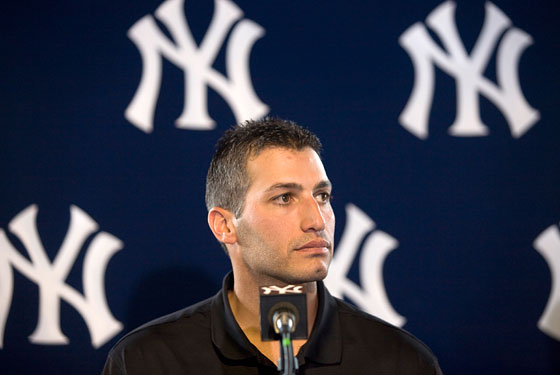
Andy Pettitte was a tremendous competitor. He was a winner. And he was a cheater.

Before he even made an official announcement that he’d hung up his pinstripes for the last time, sports journalists began penning their Andy Pettitte tribute pieces. Interestingly, most relegated his use of performance-enhancing drugs to a mere anecdote, a blip on a potential Hall of Fame resume. Not me. Andy Pettitte means too much to me.

Soon after the Yankees called up the young Texan in 1995 I could see there was something special about him, the way he battled on the mound when he didn’t have his best stuff.  Even more than Jimmy Leyritz’s game-tying home run in Game Four of the ’96 World Series it was Pettitte’s brilliant performance against the Braves in Game Five which kicked off a new Yankee dynasty. The 24-year-old out-dueled John Smoltz, one of the greatest clutch pitchers of his generation, 1-0 to give the Yankees a 3-2 series lead. Jimmy Key finished off the Braves in Game Six.

Thirteen years later, during his second stint in Pinstripes the crafty lefty won the clinching game in all three of the Yankees playoff series, securing their first championship in nine years. He closed out the Phillies in Game Six of the World Series, pitching on three days rest for the first time in his career, at age 37.

In between those magical moments were countless other memorable performances by #46. There was also the Mitchell Report. Released in December 2007, it accused Pettitte of using the performance-enhancing drug human growth hormone (HGH) in 2002. The Yankees’ hurler verified the claim two days later, stating that he used it not to gain a competitive advantage, but to allow himself to heal more quickly so he could help his teammates. One year later, in an affidavit to Congress he confessed to also using the drug in 2004.

Pettitte’s admission was a tipping point in the steroid scandal. Up until then performance-enhancing drugs were believed to be confined to jacked up sluggers, fringe players trying to make it in the league and a few other random offenders. It was several bad apples, not the whole bunch.

Pettitte was different. He was a member of the “Core Four”.  Along with Derek Jeter, Jorge Posada and Mariano Rivera, he formed the backbone of the Yankee teams of the 1990s and 2000s. The true-blooded Bombers were a source of pride for Yankee fans. Having come up through the system they provided validation for championship teams replete with free agent mercenaries.

However, the importance of the Core Four expanded beyond the Bronx. For better or worse, through greed and glory, the Yankees are America’s team. Their 27 championships far exceed that of any other team. The pinstripes are iconic, as are the names, Ruth, Gehrig, DiMaggio, Mantle and Berra. The Yankees’ history is the history of baseball. That’s held true over the past fifteen years, during which the Yanks have appeared in seven Fall Classics, winning five of them.

The Core Four also reminded fans of a bygone era. In an age of constant player movement, they were teammates for sixteen seasons (minus Pettitte’s three year stint in Houston). They played the game the way it’s supposed to be played, with quiet dignity, leaving everything on the field and never stirring up controversy off of it. Every baseball fan admired the way they raised their level of play in the postseason.

Pettitte’s southern drawl and aww shucks demeanor was particularly endearing. He cried when asked if he’d miss the New York fans after signing with the Astros following the 2003 season. He seemed like one of us.

As much as Jeter or Rivera, he was synonymous with the postseason, winning 19 postseason games, more than any pitcher in history. The image of him staring into the catcher’s mitt, brim pulled down low, glove spread out beneath his eyes, could easily be the World Series logo.

So when Pettitte admitted to using HGH it caused baseball fans to reevaluate their position on performance-enhancing drugs. Some concluded that it’s not a big deal because everybody was using them. There was an even playing field. Others took a hypocritical stance, refusing to endorse Barry Bonds or Mark McGwire for the Hall of Fame, while giving Pettitte a pass, for any number of reasons. Then there were those for whom Pettitte’s admission was a crushing blow to their concept of morality and fair play in the game they loved.

I fall into the last category. I wish I didn’t. Perhaps I’m being overly dramatic, self-righteous or simply naïve, but baseball hasn’t been the same for me since.

I still love Andy Pettitte. I always will. He provided me with too many great memories not to. And I still admire the way he competed on the mound and carried himself off of it. It’s because I hold him in such high regard that I lost respect for the game.

If Andy Pettitte is a cheater, then Major League Baseball is rotten to the core.

Curtis Martin is More Than a Hall of Famer

By Paul Knepper


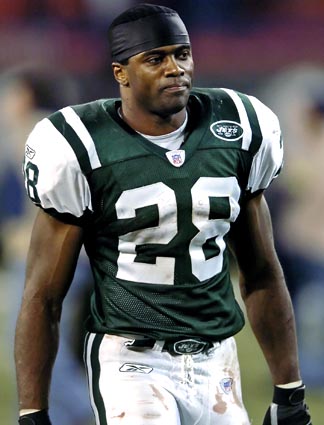
Curtis Martin is one of 15 finalists on the ballot for the Pro Football Hall of Fame and should be among those selected this Saturday for induction. As his long time coach Bill Parcells said on Monday, “Running back is a production position, and his production is indisputable.”

Martin’s 14,101 career rushing yards rank fourth all-time behind Emmitt Smith, Walter Payton and Barry Sanders. He scored 100 touchdowns and joined Sanders as the only players to rush for 1,000 yards in each of their first ten seasons. However, it would be insufficient to reduce Curtis Martin to statistics.

Martin mastered every aspect of the running back position. He wasn’t the fastest or strongest ball carrier, though he had great vision and patience, always knowing when and where to hit the hole. He ran hard, was shifty in traffic and elusive enough to avoid the big hits.

The former University of Pittsburgh star’s great hands aren’t reflected in his receiving numbers because he typically stayed in to block on passing downs. Number 28 picked up the blitz as well as any running back I’ve ever seen. It didn’t matter if it was Ty Law coming around the corner or Greg Lloyd bursting through the middle, Curtis stood him up.

Any coach will tell you that the number one priority for a running back is to protect the football and Martin did that better than anybody. He has the unofficial record for least fumbles per carry in NFL history and once went 408 touches without coughing it up, followed by another streak of 865 possessions without fumbling. He even retired with a perfect passer rating, connecting for touchdowns to Wayne Chrebet on both passing attempts of his career.

Years ago Parcells told a story about the running back’s rookie season in New England (1995). In the Patriots first pre-season game “The Tuna” wanted to see what his third round draft pick was made of so he called seven consecutive running plays for the kid. After the seventh Parcells called the rookie to the sidelines. Martin had blood and snot smeared across his face and was gasping for air, but when Parcells asked him if he was tired he shook his head no. The coach knew then he was a gamer.

Martin was named Offensive Rookie of the Year that season and after two more years with the Pats reunited with Parcells when he signed with the Jets as a free agent. This past Monday his former coach shared another great story. During a Jets victory over the Dolphins at the Meadowlands:

“[Martin] hits his head on the back of the turf really hard,” Parcells said. “He’s just laying there 4-5 feet from my feet. And this stream of blood just starts running out of his nose, both nostrils. It runs down onto his lips as he is laying there. He just gets up, he just stares at me as he is walking back to the huddle, blood running down his face. Mentally very strong.”

Martin earned the respect of teammates and opponents by providing  that type of effort during every practice and game of his eleven year career. He missed just four games during his first ten seasons, playing in 119 straight at one point, a remarkable feat at a position which receives so much punishment. He suited up with torn muscles, badly sprained ankles and for several games during his final season a serious knee injury which ended his career.

It was his ability to sustain his effort and production over a long period of time which made him great. Running backs are lucky to have six or seven prime seasons before the constant pounding slows them down. Martin won the rushing title in his tenth season, the oldest player ever to do so, at the age of 31.

In a football era of narcissistic personalities and off-the-field turmoil, Martin simply handed the ball to the referee after scoring touchdowns and made a point of  picking up all the dirty towels in the locker room once a week in order to remain humble. Can you imagine another star athlete doing that?

Number 28 never crooned for the cameras either. He was the fourth leading rusher of all-time, playing in the biggest market in the country, and received relatively little national acclaim. His New York counterpart Tiki Barber was a much bigger star even though he fumbled more times in a game than Martin did all season.


The Jets running back was worthy of admiration away from the field as well. He said on several occasions that he views football as a platform which enables him to help others. That wasn’t just talk. He put aside 12% of every football paycheck for charity and founded the Curtis Martin Job Foundation.

Now he works with single mothers, an organization that sends doctors to third-world countries to perform operations, and helps fight homelessness in New York City. There’s a well known story about the time he sat in Times Square in freezing weather for three hours until he convinced a homeless man to accept a temporary residence.

Last summer, Martin was inducted into the Jets Ring of Honor. More telling than the accolade was the site of the typically cantankerous Parcells tearing up as he  introduced his former running back. Martin took the mic and at the end of his speech said, “New York, you’ve been good to me and I hope I’ve been as good to you as you’ve been to me. I hope I’ve been a good role model for your children.” You certainly have Curtis.

A bust in Canton would be nice, but Curtis Martin is much more than a Hall of Famer.


Top Ten Basketball Books

By Paul Knepper

Last week a friend of mine asked  if I could recommend a good basketball book. That’s not a simple question for a hoops junkie like me. It gave me the idea to come up with a list of my favorite basketball books. Let me know what you think and if you have any recommendations for books I may have missed.

10) Wooden: A Lifetime of Observations and Reflections on and off the Court by John Wooden and Steve Jamison

Ten championships in twelve years. Enough said. Coach Wooden was an American treasure and his insights into the game he loved are simple, yet incredibly profound.

9) The City Game: Basketball from the Garden to the Playgrounds by Pete Axthelm

Axthelm waxes poetic about two different basketball scenes in New York City during the 69-70 season; the majestic atmosphere and personalities at the Garden during the Knicks championship run and the superb talent and pitfalls of playground legends on the streets of Harlem like Earl “The Goat” Manigault.

8)  Fab Five: Basketball, Trash Talk, the American Dream by Mitch Album

An inside look at the iconic team that changed the game by introducing Hip-Hop culture into the sport and winning their way. The book provides describes their individual personalities and addresses their polarizing affect on the media and fans.

7) Loose Balls: The Short, Wild Life of the American Basketball Association by Terry Pluto

This book’s quirky, disjointed style embodies the league it portrays. Some of the stories about characters like Marvin Barnes will have you laughing out loud. However, Pluto makes it clear that the ABA had plenty of talent and developed many of the innovations which are now staples of the NBA.

6) The Book of Basketball: The NBA According to the Sports Guy by Bill Simmons

This book suffers from an identity crisis, caught between a serious chronicle of the history of the NBA and the Sports Guy’s typical schtick. That being said, it’s the most comprehensive history of the league out there. Simmons’ Hall of Fame pyramid is particularly creative and entertaining.

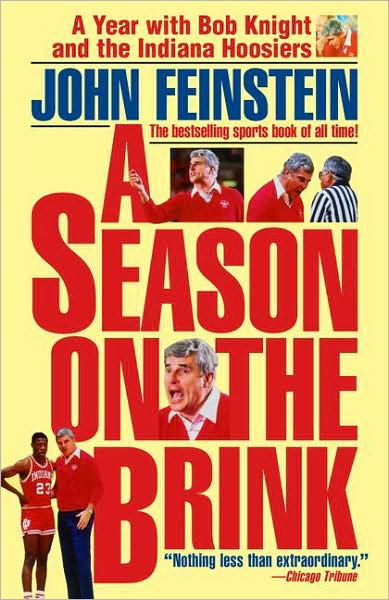
5) A Season on the Brink by John Feinstein

What could be more dramatic than a season-long behind-the-scenes look at Robert Montgomery Knight? Feinstein captures the General’s soft side, in addition to his often calculated outbursts. All in all it’s not a very flattering portrayal of Knight, and supposedly, he hasn’t spoken to Feinstein since.

4) Life on the Run by Bill Bradley

Dollar Bill took his journal entries from a three week period towards the end of the 1973-74 season and spun them into this masterpiece. His brilliance is evident as he breaks down the game of basketball and it’s role in his life and society in a way that nobody else could.

3) The Last Shot: City Street, Basketball Dreams by Darcey Frey

Frey chronicles the lives of four high school kids from Coney Island, Brooklyn (including a young Stephon Marbury) who view a basketball scholarship as their “last shot” to escape the projects. He pulls you into these kids’ dreams and brings you along for the ride as the system fails them.

2) The Breaks of the Game by David Halberstam

Halberstam uses the 1979-1980 Portland Trailblazers as a lens through which to view the growth of the NBA and the various factors which motivate and distract players, affecting the quality of play in the process. This is a must read for anybody interested in the history of the league.

1) Heaven is a Playground by Rick Telander

Telander hung out at Foster Court in Brooklyn for two summers and chronicled the personalities of the talented, comical and sometimes sad characters who passed through. The result is a fascinating account of the role basketball plays in ghetto life and the effect the ghetto has on basketball.

Honorable Mentions:

Let Me Tell You a Story: A Lifetime in the Game by John Feinstein and Red Auerbach

Pistol: The Life of Pete Maravich by Mark Kriegel

Sacred Hoops: Spiritual Lessons of a Hardwood Warrior by Phil Jackson

Seven Seconds or Less: My Season on the Bench with the Runnin’ and Gunnin” Phoenix Suns by Jack McCallum

The Jordan Rules by Stan Smith

The Jump: Sebastian Telfair and the High Stakes Business of High School Ball by Ian O’Connor

The Rivalry: Bill Russell, Wilt Chamberlain, and the Golden Age of Basketball by John Taylor

When the Game Was Ours by Larry Bird, Earvin Johnson Jr. and Jackie MacMullan


Will the Real Joe Dumars Please Stand Up?

By Paul Knepper

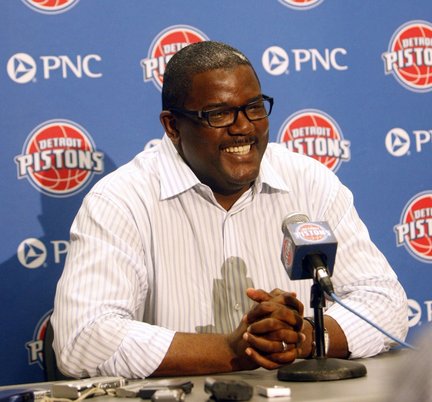
Joe Dumars was one of the most beloved sports figures in Detroit when the Pistons named him their President of Basketball Operations and General Manager in 2000. During his first several years on the job, the architect of the “Bad Boys” reincarnated became a Motown legend. Now, three years after their last trip to the conference finals the franchise is in disarray and Joe D is a big reason why.

Weeks after Dumars joined the Pistons front office their franchise player Grant Hill bolted for Orlando. Dumars used the loss of Hill to acquire the first piece of a championship puzzle, Ben Wallace, via a sign and trade with the Magic. Wallace, who was perceived as an offensively challenged role player went on to win Defensive Player of the Year four times with the Pistons.

Two years later, Dumars made three more crucial acquisitions. He selected Tayshaun Prince, a 6’10 forward who most scouts agreed was too frail to play in the NBA, with the 23rd pick in the draft.  Then he signed free agent point guard Chauncey Billups who had played for five teams in his first five years in the league and traded high-flier Jerry Stackhouse to Washington for Richard “Rip” Hamilton, a lanky shooting guard who the Wizards President of Basketball Operations Michael Jordan was anxious to get rid of.

Prince developed into one of the most versatile players in the league, Hamilton was named to three all-star teams and Billups earned the  nickname Mr. Big Shot, while leading the Pistons to a championship in 2004.

Joe D wasn’t done yet. Despite the Pistons reaching the Eastern Conference Finals in 2003, he fired coach Rick Carlisle and replaced him with Larry Brown. Midway through the ’03-04 season he added the final piece to the puzzle, trading for Rasheed Wallace of the Portland Trailblazers. Sheed joined with Ben Wallace and Prince to form the best defensive front line in basketball.

During his first eight years in the Pistons front office, Dumars seemed to make all the right moves, with the notable exception of passing on Carmelo Anthony, Dwyane Wade and Chris Bosh in favor of Darko Milicic with the second pick in the 2003 draft. His Pistons advanced to six consecutive Eastern Conference Finals from 2003-2008 and won the NBA Championship in 2004. Dumars was named NBA Executive of the Year for the ’02-’03 season and developed a reputation as one of the best general managers in the league.

In 2008 the tide began to turn for Joe and the Pistons. After losing in the conference finals to a seemingly inferior Cavaliers team the Pistons’ President decided it was time to make some changes.

Dumars terminated coach Flip Saunders (who replaced Larry Brown after the ’04-’05 season) and promoted assistant coach Michael Curry to the head job. The Pistons GM also believed the team had gone as far as they could with their nucleus and in November ’08 traded Chauncey Billups, Antonio McDyess and Cheikh Samb to the Denver Nuggets for Allen Iverson.

Dumars hoped Iverson, still one of the best scorers in the league, could get the Pistons over the hump and back to the NBA Finals. More importantly, Iverson’s $20.8 million a year contract expired at the end of the season clearing up cap space for Dumars to sign a couple of big-time free agents.

Neither scenario worked according to plan. The team went into free fall, finishing 39-43 and was ousted in the first round of the playoffs. Iverson was a disaster in Detroit. His shoot first mentality didn’t mesh with the Pistons unselfish style of play and the diminutive guard was relegated to the bench before missing the playoffs due to injury. To make matters worse, Billups led the Nuggets to the Western Conference Finals that season.

Dumars dismissed Curry after one season, replacing him with John Kuester. Then he failed to sign a star player and instead of saving up for the free agent bonanza in the “summer of LeBron,” used the cap space to sign Ben Gordon and Charlie Villanueva to a combined $19 million per year. Gordon, an undersized shooting guard has averaged a whopping 13 points per game over a season and a half in Detroit and Villanueva has contributed a mediocre 12.5 points and 4.6 rebounds a contest.

Detroit finished a dismal 27-55 last season and their big off-season acquisition was an over-the-hill Tracy McGrady. Kuester immediately clashed with Prince  and inexplicably benched Rip for the past ten games, which has ruffled the feathers of veterans on the club. The Pistons are a measly 17-31 and looked apathetic on the court during a 124-106 loss to the Knicks Sunday night.

Their current roster doesn’t provide much reason for optimism either. Dumars has failed to infuse the team with the type of young talent they can build around and his hands are tied by the money he locked up in Prince, Hamilton, Villanueva and Gordon.

Karen Davidson, daughter of long time owner William Davidson, who passed away in 2009, is currently attempting to sell the team. When new ownership takes over they’ll have to decide which they believe is the real Joe Dumars, the GM that built a perennial contender out of other teams castaways or the President who has overseen the rapid descent of a proud franchise.